
Settings and constraints validation to enable design for operations
a technology of constraints and setting constraints, applied in the direction of program control, instruments, requirement analysis, etc., can solve the problems of time-consuming and expensive processes, and achieve the effect of reducing the time required for deployment of applications and deployment modifications
- Summary
- Abstract
- Description
- Claims
- Application Information
AI Technical Summary
Benefits of technology
Problems solved by technology
Method used
Image

Examples
Embodiment Construction
Exemplary Operating Environment
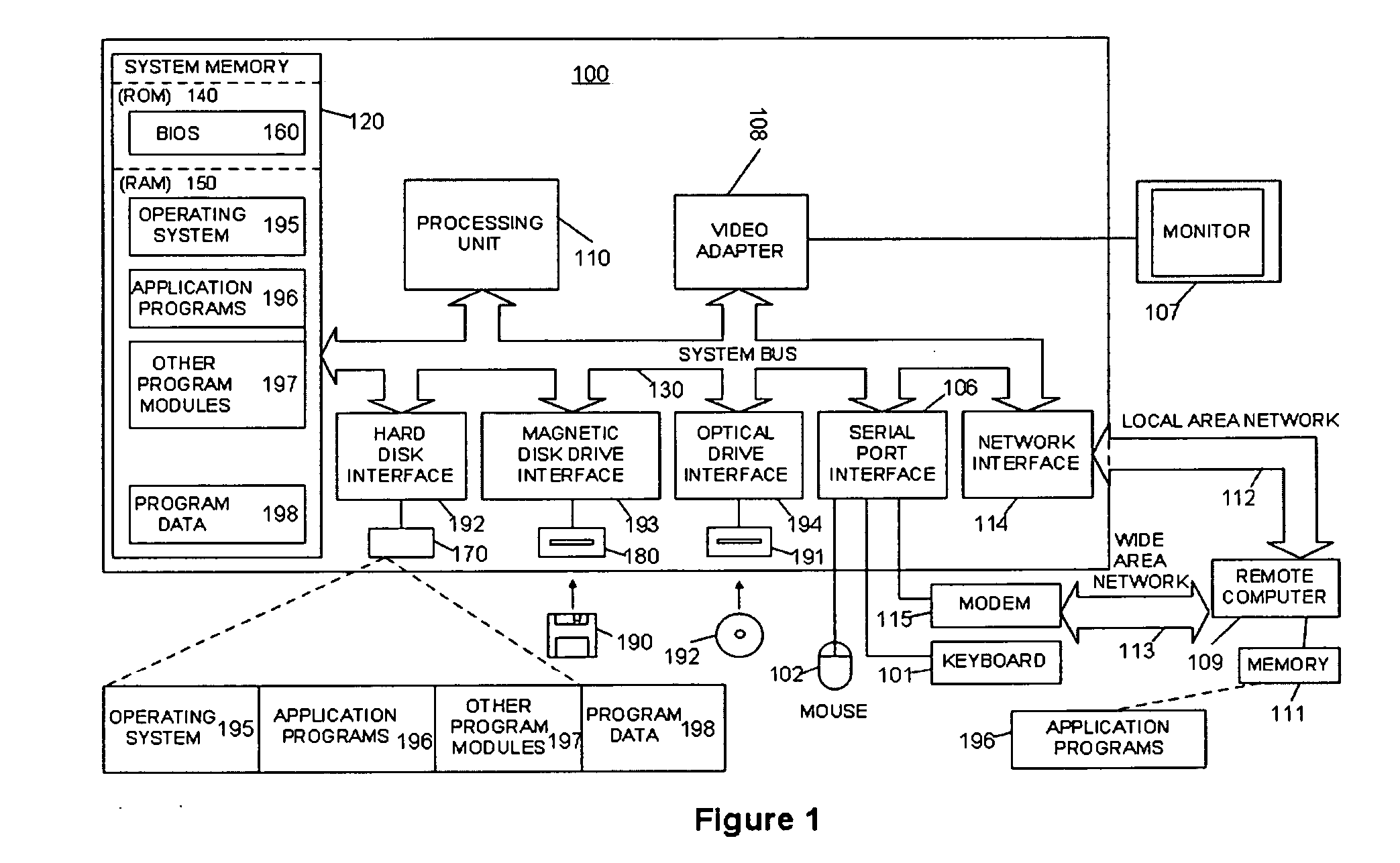
[0013]FIG. 1 is a functional block diagram of an example of a conventional general-purpose digital computing environment that can be used to host design tools that implement various aspects of the present invention. In FIG. 1, a computer 100 includes a processing unit 110, a system memory 120, and a system bus 130 that couples various system components including the system memory to the processing unit 110. The system bus 130 may be any of several types of bus structures including a memory bus or memory controller, a peripheral bus, and a local bus using any of a variety of bus architectures. The system memory 120 includes read only memory (ROM) 140 and random access memory (RAM) 150.
[0014] A basic input / output system 160 (BIOS), containing the basic routines that help to transfer information between elements within the computer 100, such as during start-up, is stored in the ROM 140. The computer 100 also includes a hard disk drive 170 for reading f...
PUM
 Login to View More
 Abstract
Description
Claims
Application Information
 Login to View More