
Timing bias compensation for a data receiver with decision-feedback equalizer
a data receiver and decision-feedback equalizer technology, applied in the field of data receivers, can solve the problems of degrading data recovery, adding significant levels of inter-symbol interference (isi) to a high-speed data stream, and dfe systems including additional complexity to determine the feedback tap weight adaptively, so as to improve jitter tolerance and reduce bit-error rate
- Summary
- Abstract
- Description
- Claims
- Application Information
AI Technical Summary
Benefits of technology
Problems solved by technology
Method used
Image

Examples
Embodiment Construction
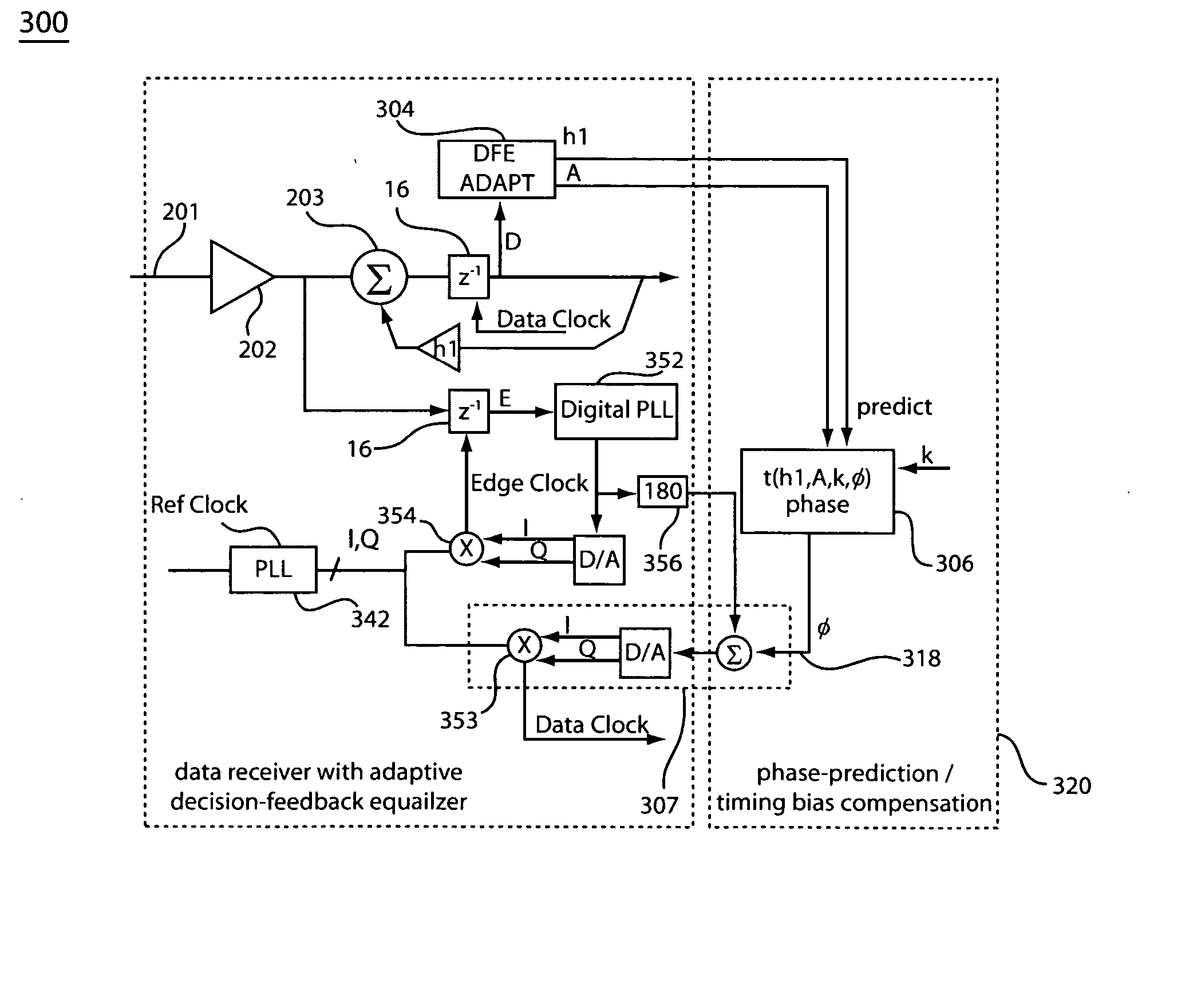
[0030] A method and apparatus for providing a timing bias compensation for a data receiver system, which employs a decision-feedback equalizer (DFE) are described. Exemplary embodiments make use of a linear approximation formula based on a normalized first decision-feedback tap weight. The formula provides a timing bias estimate, which is employed to adjust the phase relationship between a data clock and an edge clock to advance or delay the data sampling point of a receiver system. Application of the timing bias compensation provides a data sampling time closer to a center of a DFE corrected eye diagram, improving jitter tolerance of a data receiver system.
[0031] Exemplary embodiments provide a method for realizing a time-corrected sampling point for a received waveform, which has been conditioned with decision-feedback equalization (DFE) in a data receiver system. A general embodiment provides a method for determination of a time-correction value for a data sampling point of a re...
PUM
 Login to View More
 Abstract
Description
Claims
Application Information
 Login to View More