Method for controlling the spectral response of light sensitive elements, and image sensor with a controllable spectral response

a technology of light sensitive elements and controllable spectral response, which is applied in the field of image sensors, can solve the problems of poor color separation obtained in this fashion, high cost, and potential prone to long-term misalignment and ultimately image degradation

a technology of light sensitive elements and controllable spectral response, which is applied in the field of image sensors, can solve the problems of poor color separation obtained in this fashion, high cost, and potential prone to long-term misalignment and ultimately image degradation

US20060131480A1Active Publication Date: 2006-06-22SAMSUNG ELECTRONICS CO LTD

Image

Smart Image Click on the blue labels to locate them in the text.
Viewing Examples
Smart Image
  • Method for controlling the spectral response of light sensitive elements, and image sensor with a controllable spectral response
  • Method for controlling the spectral response of light sensitive elements, and image sensor with a controllable spectral response
  • Method for controlling the spectral response of light sensitive elements, and image sensor with a controllable spectral response

Examples

Experimental program
Comparison scheme
Effect test

Embodiment Construction

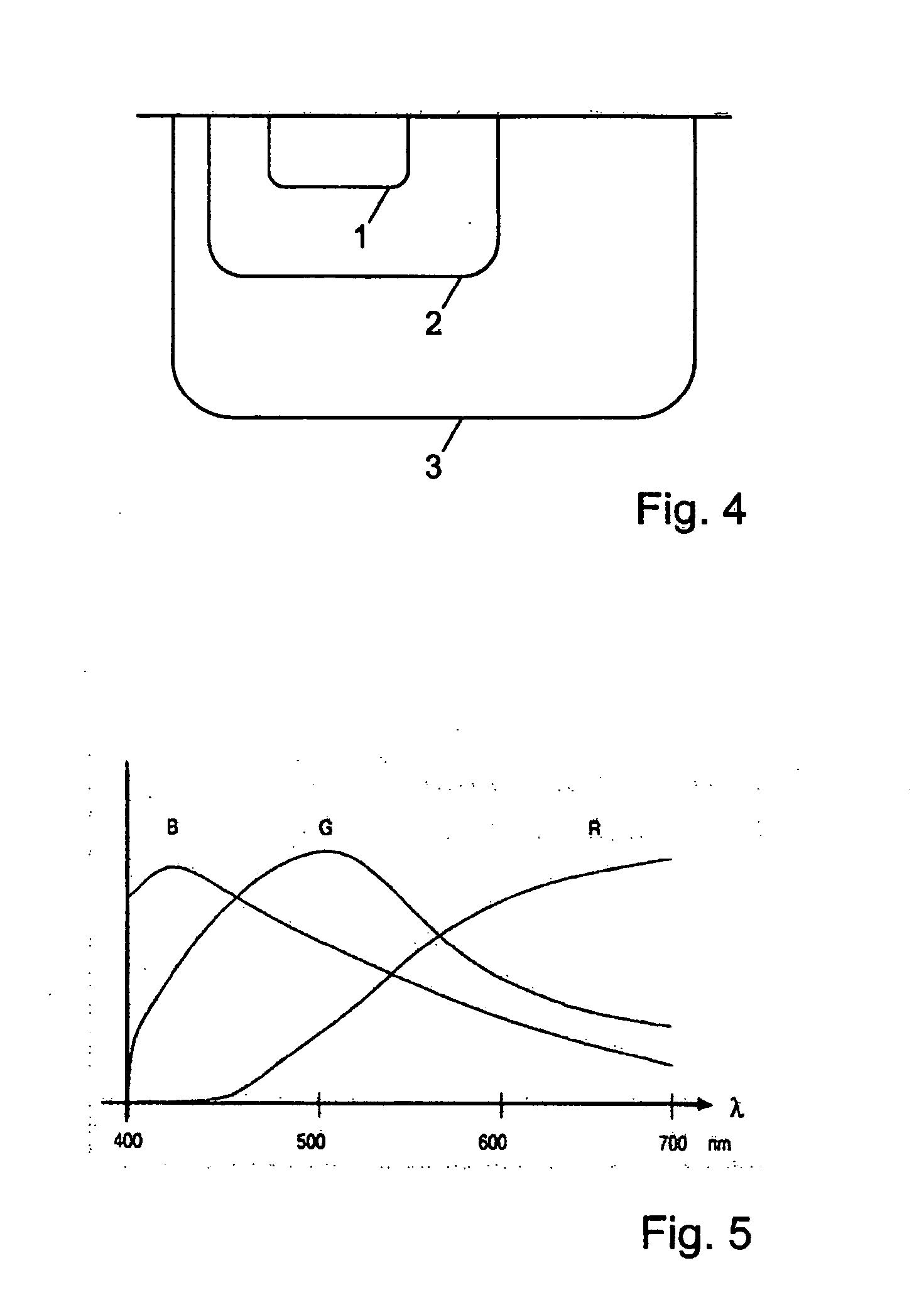
[0032] In a preferred embodiment, the spectral response is changed by modulating the depth of the sensitive area of the light sensitive elements, using an appropriate control signal. Depth modulation enables capturing photons of different wavelengths at various rates.

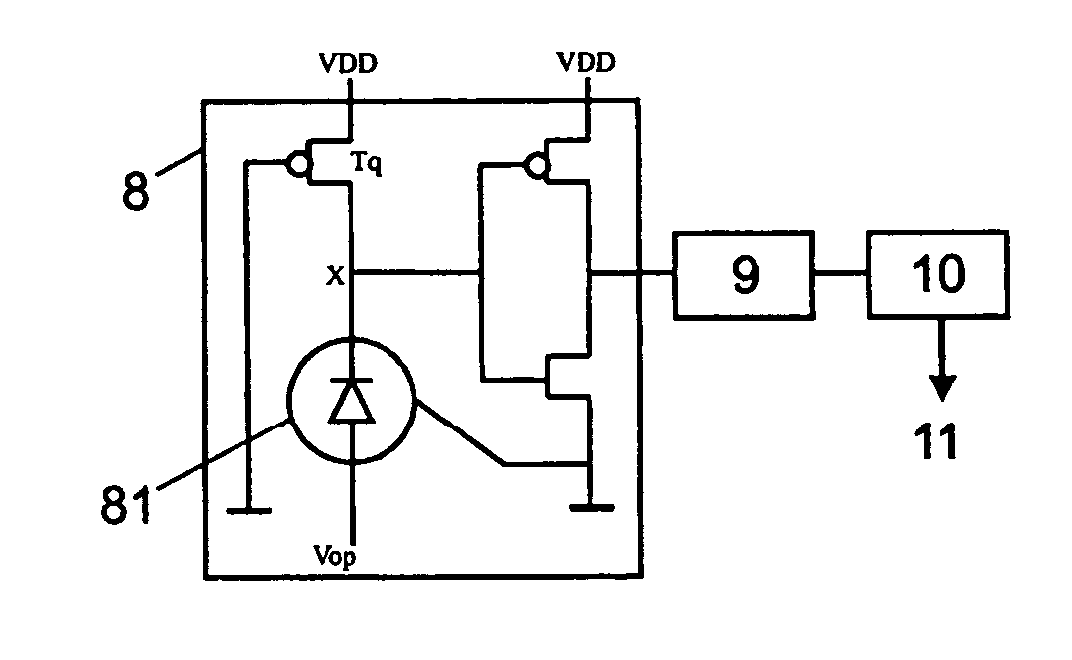
[0033] In a preferred embodiment, the light sensitive elements are based on the Single Photon Avalanche Diode (SPAD) technology. SPADs are optical detectors sensitive to the arrival of a single photon. They are also known as photon counting devices. A SPAD operating in Geiger mode is a diode 81, or p-n junction, that is reverse biased beyond its breakdown voltage. Under those conditions the diode 81 p-n junction may trigger an avalanche upon photon arrival. Such zone is called multiplication region 5. FIG. 6 shows a cross-section example of a SPAD implemented In CMOS technology. Other structures are also possible in the framework of the invention and have been successfully demonstrated. The multiplication region 5, a g...

the structure of the environmentally friendly knitted fabric provided by the present invention; figure 2 Flow chart of the yarn wrapping machine for environmentally friendly knitted fabrics and storage devices; image 3 Is the parameter map of the yarn covering machine
Login to View More

PUM

No PUM Login to View More

Abstract

It is disclosed a method for controlling the spectral response of light sensitive semiconductor elements in an array (8) using an electric control signal (Vop) applied to said semiconductor elements. The light sensitive semiconductor elements could be a single photon avalanche diode (81) operating In Geiger mode. The invention as well refers to an Image sensor comprising at least one light sensitive semiconductor elements and a circuit for applying a control voltage (Vop) to said semiconductor element so as to change its spectral response. Without being limiting, the sensor of the invention could be part of a digital camera, video camera, 3D image sensors, scanner, video telephone, autofocus system, medical image acquisition system, etc.

Description

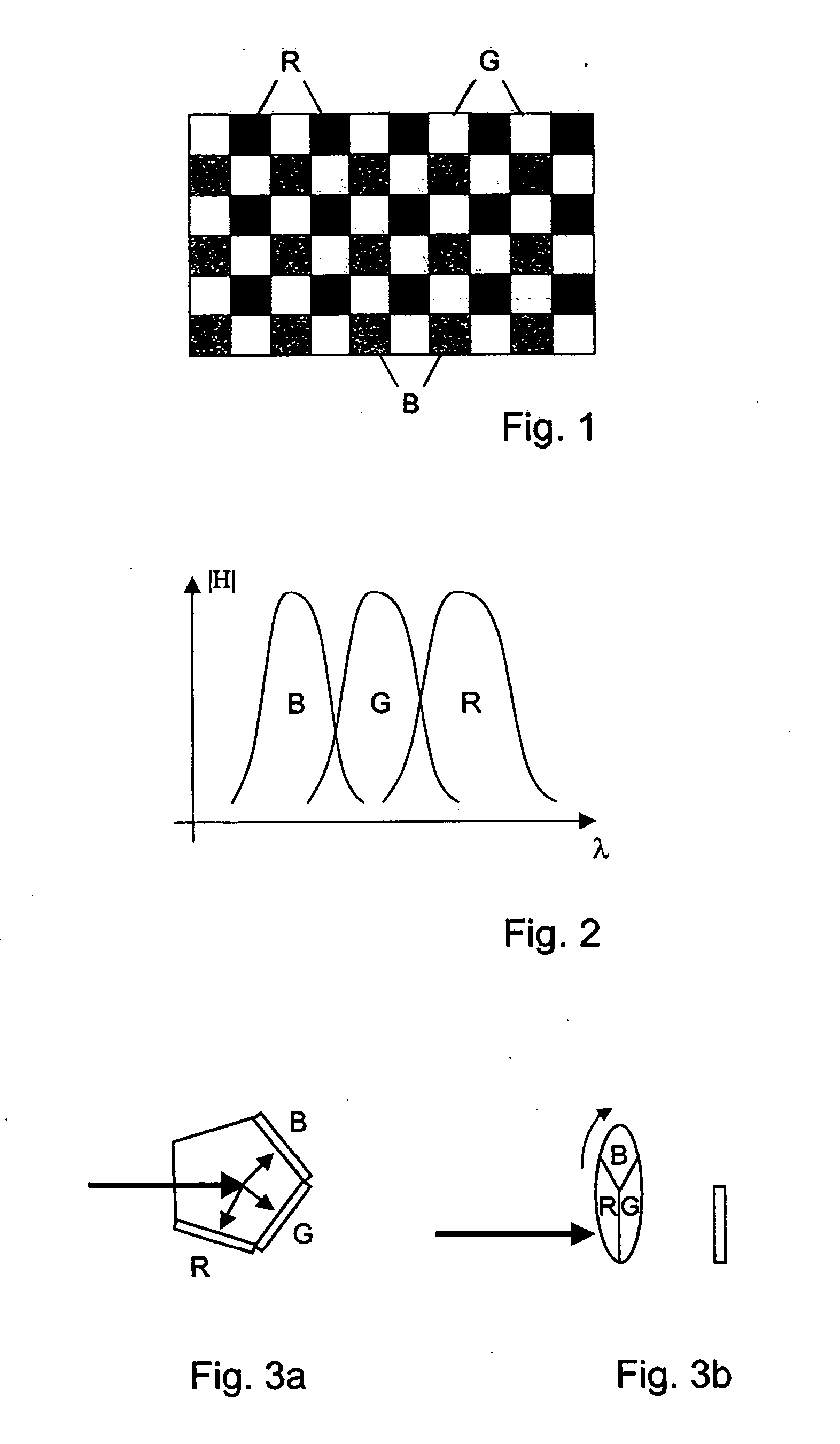
FIELD OF INVENTION [0001] The present invention relates to image sensors, in particular to color image sensor for 2D or 3D image acquisition. In particular the present invention relates to a method for controlling the spectral response of light sensitive semiconductor elements in an array according to the independent claim 1 and to an image sensor with the characteristics according to the Independent claim 15. STATE OF THE ART [0002] Conventional imagers can detect colored scenes by reconstructing a mosaic of pixels mostly sensitive to one of the primary colors (red “R”, green “G”, and blue “B”). Pixels are made selectively sensitive by covering them with a color filter. The filtering pattern is usually repeated over a matrix of 2×2 pixels favoring green. FIG. 1 shows one such color pattern as it is implemented in conventional solid-state imagers. [0003] The separation of colors is dependent of the selectivity of the three filters. The spectral response |H| measured in typical filte...

Claims

the structure of the environmentally friendly knitted fabric provided by the present invention; figure 2 Flow chart of the yarn wrapping machine for environmentally friendly knitted fabrics and storage devices; image 3 Is the parameter map of the yarn covering machine
Login to View More

Application Information

Patent Timeline
22 Jun 2006
Publication
US20060131480A1
IPC
H01J40/14; H01L31/00
CPC
G01J1/0488; G01J1/44; H01L27/14645; H01L31/101; H01L31/107; H04N3/155; H04N25/773
Inventors
CHARBON, EDOARDO; NICLASS, CRISTIANO