[0004] Secondly, to produce a
wind power unit to more efficiently harness useable levels of energy from a broader range of wind speeds.
[0007] Existing
propeller turbine wind power units of present state of the art are not harnessing a very high percentage of energy from the cross section of wind addressed by such units. Three bladed propellers do not harness much of that energy. Present state of the art arrangements with larger numbers of blades might present some improvement within the scope of smaller sized systems. The inner 50% of the
radius of propeller driven wind power systems is not harnessing much of the cross section of energy being addressed. The most practical solution to dealing with the inner 50% of the
radius of propeller blades from their axle center, is to efficiently block off that area, and access the redirected energy with turbine blades extending radially beyond the blocked off area.
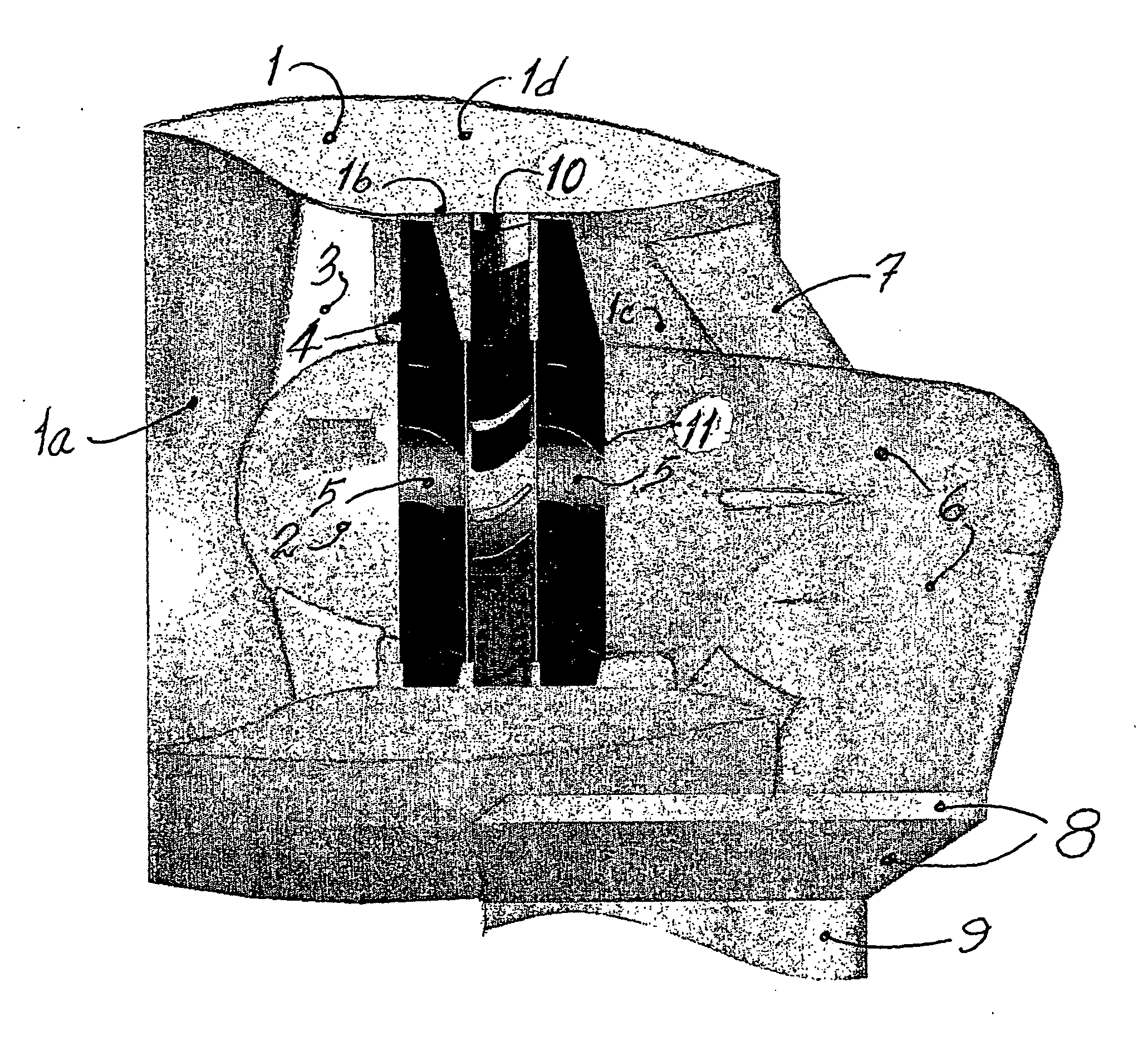
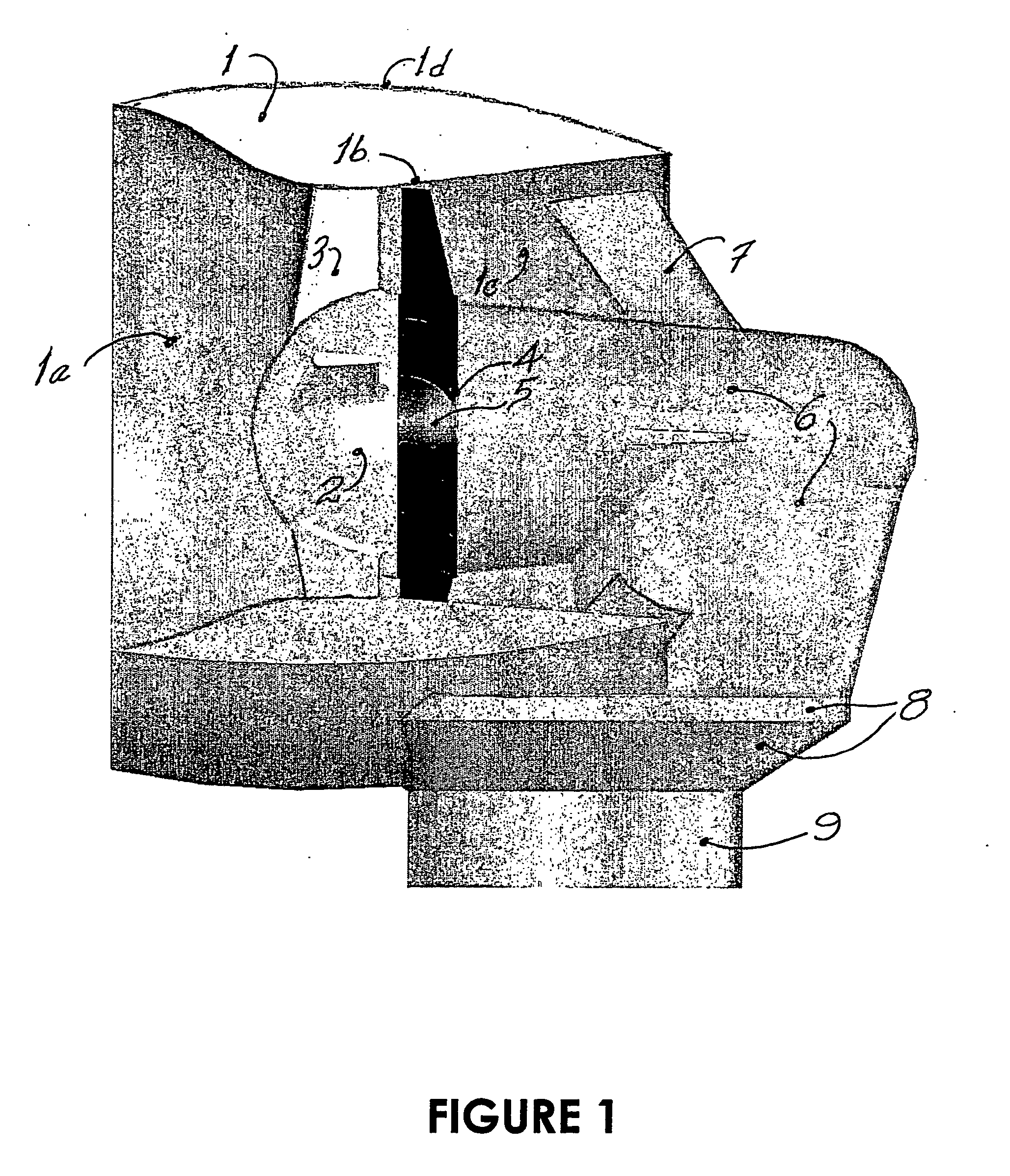
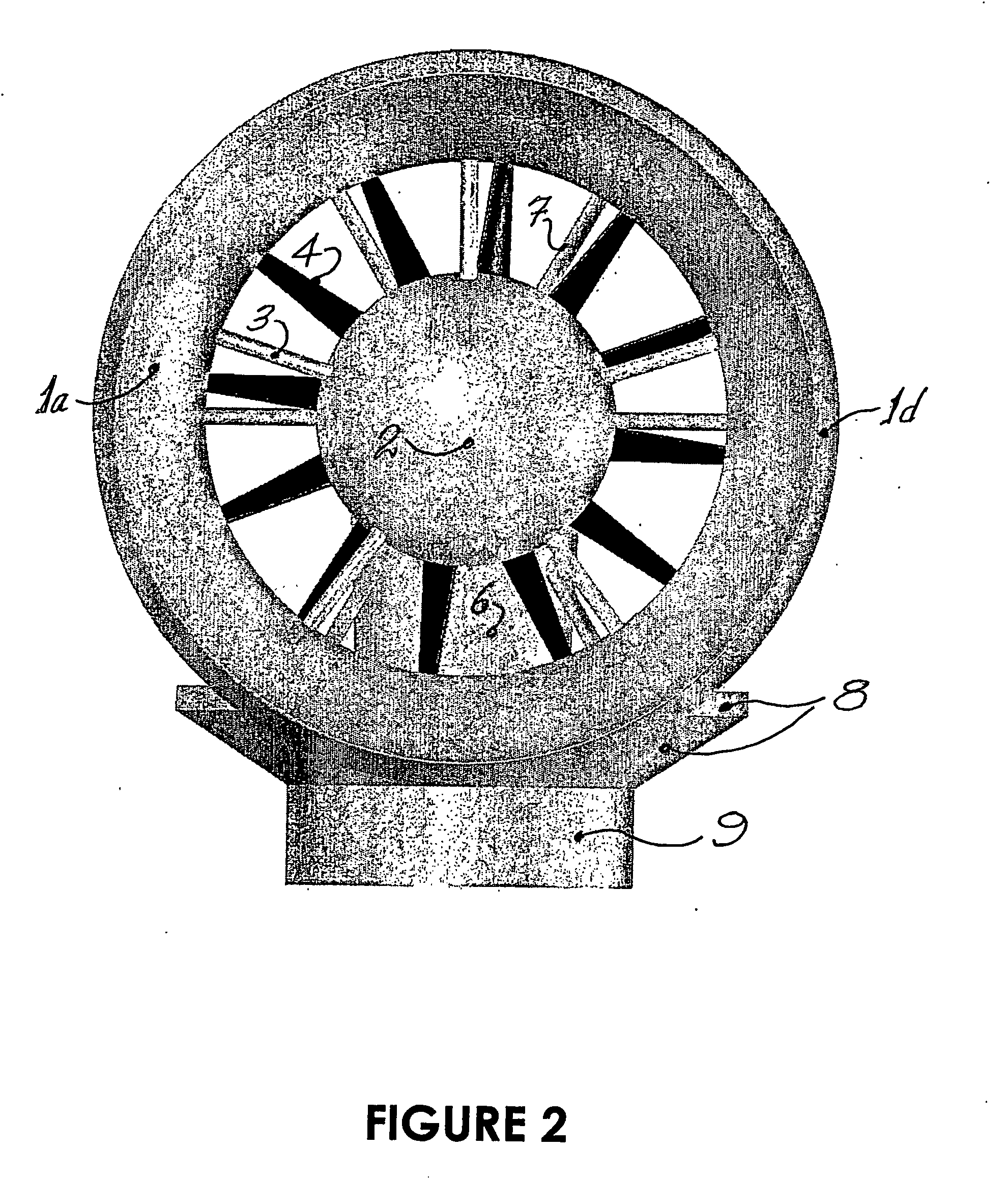
[0008] This invention, in its presently preferred embodiment, employs a spherical head arrangement, hereinafter referred to as a “speedball” in front of, and covering more than 50% of the radius from axle center to the outer tips of its turbine blades. The speedball increases the velocity of redirected wind energy, to more completely address a larger number of shorter turbine blades.
[0010] Present state of the art wind turbine systems tend to be limited as to the range of wind speeds from which they can harness a useful amount of wind energy. The spherical head arrangement increases the speed of the wind redirected from that inner 50% of the center to blade tip radius of the
turbine rotor and blade
assembly, but the faster moving wind is inclined to address only the inner radial portion of the turbine blades. To even out
wind flow through the operating aperture containing the multi-bladed
turbine rotor, a compound curved intake scoop arrangement is used to scoop inward a larger volume of incoming wind, toward the said shorter and more numerous turbine blades. This annular ring scoop is further designed with an inner facing airfoil arrangement, which increases the velocity of the captured wind, to much the same extent as that achieved by means of the said spherical head. The overall objective is to increase incoming
wind speed, and then have this faster moving wind evenly address the aperture containing the larger number of shorter turbine blades. A further
advantage of the said intake scoop, is that it captures an enlarged volume of oncoming wind, thereby creating compression, increasing the
mass or weight of the wind column as it addresses the turbine blades, increasing the wattage of
kinetic energy addressing the turbine blades. Through the combination of an extended length outer periphery airfoil extending rearward from the front outside edge of the said intake scoop, and an outward expansion proceeding to the rear behind the
turbine rotor and blades
assembly, a lower pressure or vacuum exhaust situation is achieved.
[0011] We now have a wind turbine engine, with supercharging at its intake, higher velocity and compression of wind
mass entering the cylindrical encasement of its turbine rotor and blades, and with all of its blades adequately addressed to produce
maximum torque.
[0012] This is followed by an exhaust area of continuously lowering pressure, behind the turbine rotor and blade
assembly. All of the basic attributes of a turbine engine are now present within this embodiment. In the particular case of this wind turbine engine, its turbine blades will have
blade pitch control. Where a 3-bladed wind turbine of present state of the art has its blades built to take
advantage of
aerodynamic lift, the short blades of this wind turbine engine must be shaped to harness more direct torque.
Blade pitch control is considered essential in this embodiment, to most efficiently access a full range of wind speeds, as well as being able to set the turbine blades at full open neutral in the case of excessively high wind speeds, and at that point, the blades are then being more directly driven by
aerodynamic lift, and continue to produce power. What is now readily apparent, is that with a much higher level of efficiency, we are now dealing with a situation where a wind turbine engine will be rather small in size, against its output potential, compared to wind turbines of present state of the art.


 Login to View More
  Login to View More