Method for manufacturing magnetic disk glass substrate and method for manufacturing magnetic disk
Inactive Publication Date: 2007-01-04
HOYA CORP
View PDF3 Cites 67 Cited by
Summary
Abstract
Description
Claims
Application Information
AI Technical Summary
This helps you quickly interpret patents by identifying the three key elements:
Problems solved by technology
Method used
Benefits of technology
Benefits of technology
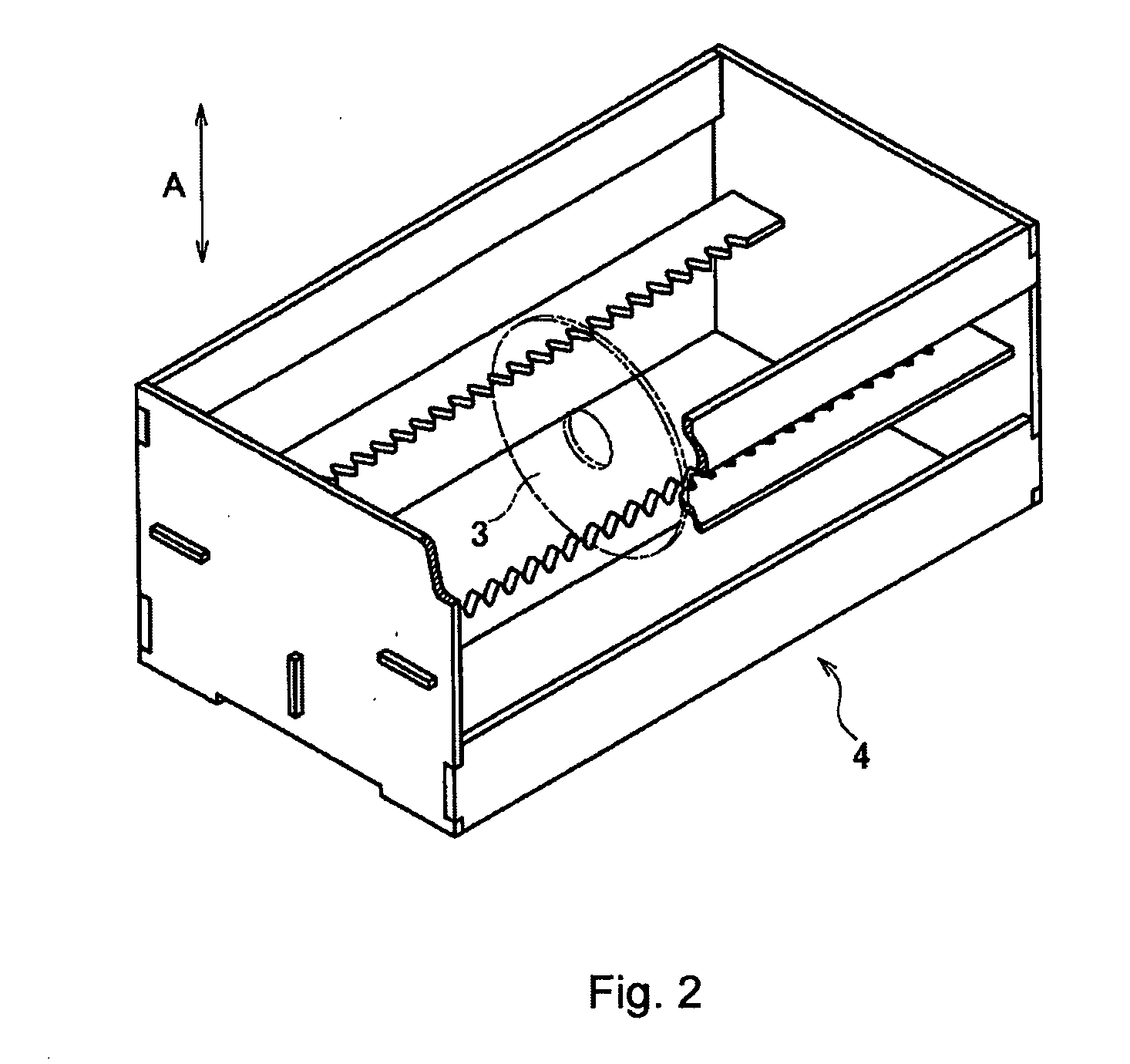
[0018] In order to solve the problem, the intervals between the glass substrates can be increased in the chemical strengthening bath. This solution however reduces the number of glass substrates that can be treated at one time and accordingly reduces the productivity. This is not suitable for the manufacture of small-diameter glass substrates requiring lower cost.
[0038] Since in the method for manufacturing the magnetic disk, the magnetic disk glass substrate manufactured by the method of the invention is used, the resulting magnetic disk allows the magnetic head to have a lower flying height and achieves high-density information recording. In particular, the magnetic disk can be suitably used in small hard disk drives for portable information apparatuses.
Problems solved by technology
Such a thin glass substrate is liable to warp, and accordingly the waviness (undulation) (Wa) may be disadvantageously increased before the chemical strengthening treatment.
Method used
the structure of the environmentally friendly knitted fabric provided by the present invention; figure 2 Flow chart of the yarn wrapping machine for environmentally friendly knitted fabrics and storage devices; image 3 Is the parameter map of the yarn covering machine
View more
Image
Smart Image Click on the blue labels to locate them in the text.
Viewing Examples
Smart Image
Click on the blue label to locate the original text in one second.
Reading with bidirectional positioning of images and text.
Smart Image
Examples
Experimental program
Comparison scheme
Effect test
example 1
Manufacture of Magnetic Disk Glass Substrate
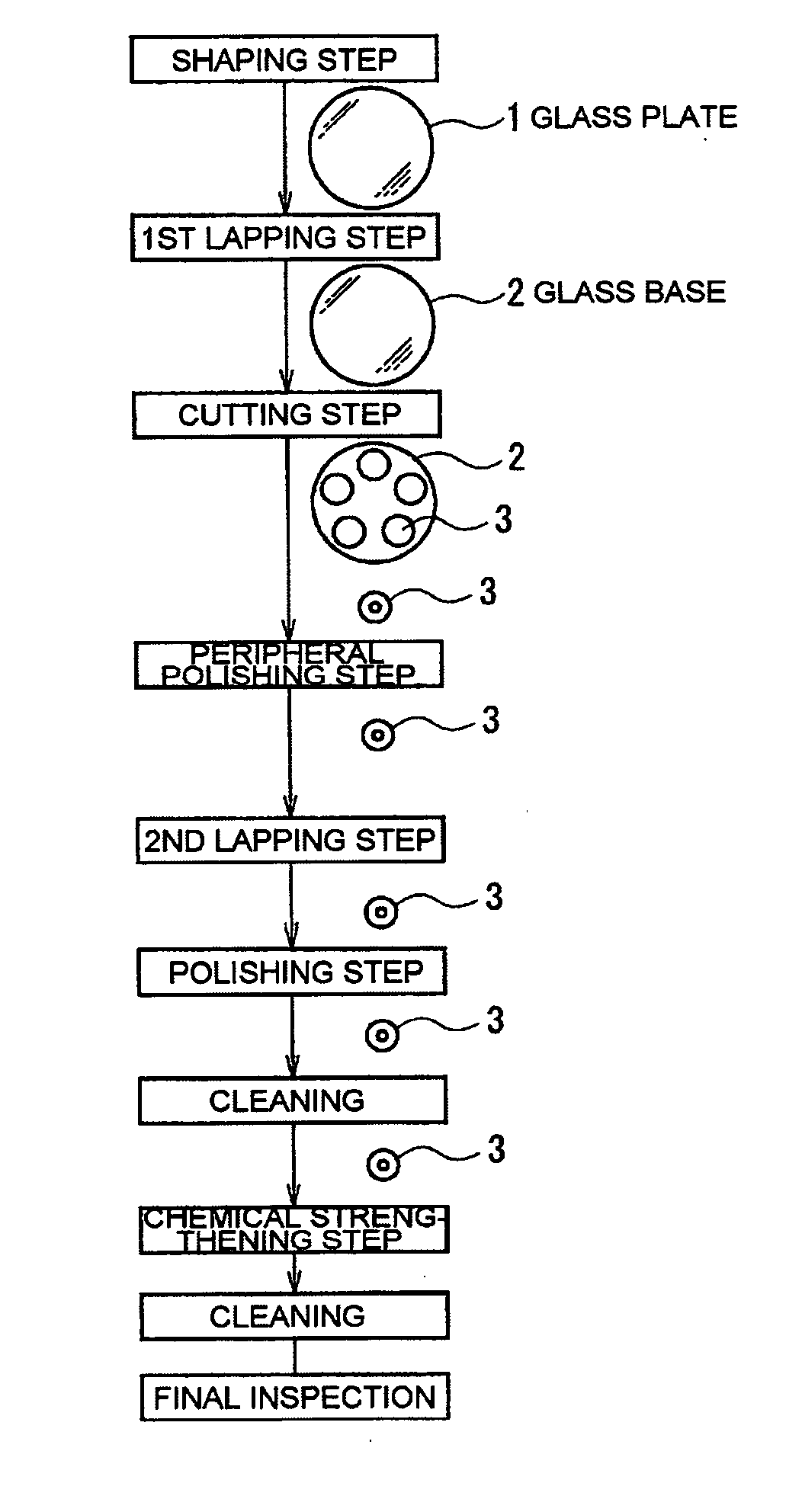
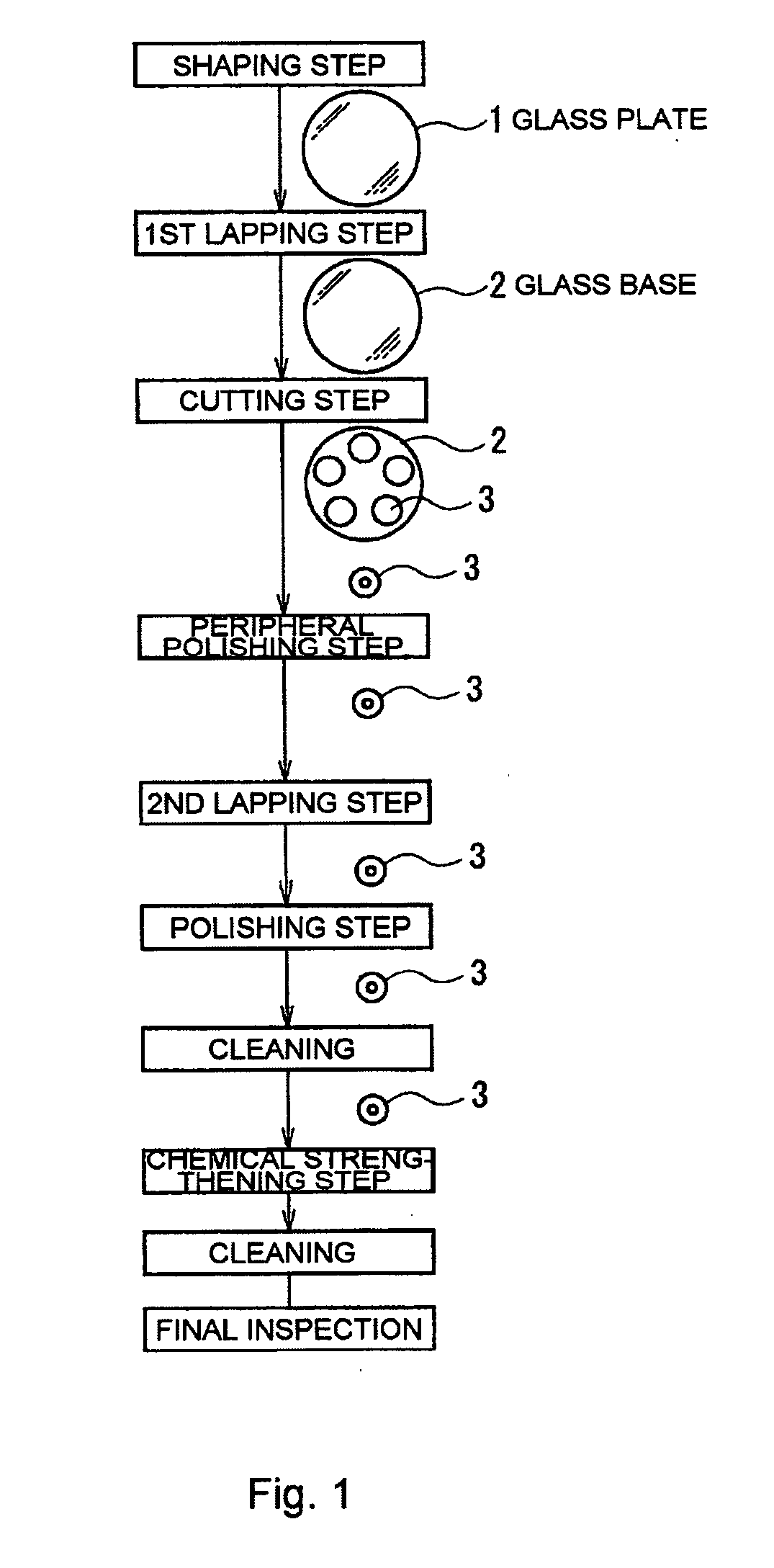
[0094] The method for manufacturing the magnetic disk glass substrate in Example 1 includes the following steps (1) to (8):
[0103] First, a disk-shaped amorphous aluminosilicate glass base was prepared. The aluminosilicate glass contained lithium. Specifically, the aluminosilicate glass base had a composition of 63.6% by weight of SiO2, 14.2% by weight of Al2O3, 10.4% by weight of Na2O, 5.4% by weight of Li2O, 6.0% by weight of ZnO2, and 0.4% by weight of Sb2O3.
[0104] (1) Rough Lapping Step
[0105] A 0.6 mm thick glass sheet made of molten aluminosilicate glass was used as the glass base. The glass sheet was formed into a d...
example 2
Manufacture of Magnetic Disk
[0138] A magnetic disk was manufactured by the following process.
[0139] An Al—Ru seed layer, a Cr—W underlayer, a Co—Cr—Pt—Ta magnetic recording layer, and a hydrogenated carbon protective layer were formed in that order on each main surface of the magnetic disk glass substrate produced through the above-described steps with a statically opposed DC magnetron sputtering apparatus. The seed layer reduces the grain size of the magnetic grains of the magnetic recording layer, and the underlayer orients the easy magnetization axis of the magnetic recording layer in the in-plane direction.
[0140] The magnetic disk at least includes the magnetic disk glass substrate, which is nonmagnetic, and the magnetic recording layer overlying the magnetic disk glass substrate, a protective layer covering the magnetic recording layer, and a lubricating layer overlying the protective layer.
[0141] In Example 2, nonmagnetic metallayers (nonmagnetic underlayers) including th...
the structure of the environmentally friendly knitted fabric provided by the present invention; figure 2 Flow chart of the yarn wrapping machine for environmentally friendly knitted fabrics and storage devices; image 3 Is the parameter map of the yarn covering machine
Login to View More
PUM
Property
Measurement
Unit
Length
aaaaa
aaaaa
Length
aaaaa
aaaaa
Length
aaaaa
aaaaa
Login to View More
Abstract
A method for manufacturing a magnetic disk glass substrate including a chemical strengthening step is provided. In the method, chemical strengthening treatment is sufficiently performed over the entire main surfaces of a glass substrate. Consequently, the resulting magnetic disk glass substrate can provide a magnetic disk allowing the magnetic head to have a low flying height and achieving high-density information recording, and particularly a magnetic desk suitably used in small hard disk drives for portable information apparatuses. In the chemical strengthening step, a chemical strengthening agent is brought into contact with a glass substrate to perform ion exchange by allowing the chemical strengthening agent to flow with respect to the glass substrate, or by moving the glass substrate with respect to the chemical strengthening agent.
Description
[0001] This application claims priority to prior Japanese patent application JP2005-164167, the disclosure of which is incorporated herein by reference. BACKGROUND OF THE INVENTION [0002] The present invention relates to a method for manufacturing a magnetic disk glass substrate of a magnetic desk used in magnetic disk devices, such as hard disk drives (HDD's), and to a method for manufacturing a magnetic disk including the magnetic disk glass substrate. [0003] As the information technology is developing, dramatic innovation on information technology, particularly on magnetic recording technology, is desired more and more. In a magnetic disk used in a hard disk drive (HDD) being a magnetic disk device as a computer storage, the information recording density is being increased rapidly, unlike in other types of magnetic recording media, such as magnetic tapes and flexible disks. Accordingly, the information recording capacity of a hard disk drive contained in a personal computer is dr...
Claims
the structure of the environmentally friendly knitted fabric provided by the present invention; figure 2 Flow chart of the yarn wrapping machine for environmentally friendly knitted fabrics and storage devices; image 3 Is the parameter map of the yarn covering machine
Login to View More
Application Information
Patent Timeline
Application Date:The date an application was filed.
Publication Date:The date a patent or application was officially published.
First Publication Date:The earliest publication date of a patent with the same application number.
Issue Date:Publication date of the patent grant document.
PCT Entry Date:The Entry date of PCT National Phase.
Estimated Expiry Date:The statutory expiry date of a patent right according to the Patent Law, and it is the longest term of protection that the patent right can achieve without the termination of the patent right due to other reasons(Term extension factor has been taken into account ).
Invalid Date:Actual expiry date is based on effective date or publication date of legal transaction data of invalid patent.



 Login to View More