Use of non-opiates for the potentation of opiates

a technology of non-opiates and opiates, which is applied in the direction of biocide, muscular disorder, drug composition, etc., can solve the problems of affecting the overall therapeutic effect and patient quality of life of patients in already under-diagnosed and under-treated conditions, and insufficient analgesic effect cover, etc., to achieve the effect of reducing side effects

a technology of non-opiates and opiates, which is applied in the direction of biocide, muscular disorder, drug composition, etc., can solve the problems of affecting the overall therapeutic effect and patient quality of life of patients in already under-diagnosed and under-treated conditions, and insufficient analgesic effect cover, etc., to achieve the effect of reducing side effects

US20070043112A1Inactive Publication Date: 2007-02-22SOSEI R&D LIMITED

Image

Smart Image Click on the blue labels to locate them in the text.
Viewing Examples
Smart Image
  • Use of non-opiates for the potentation of opiates

Examples

Experimental program
Comparison scheme
Effect test

example

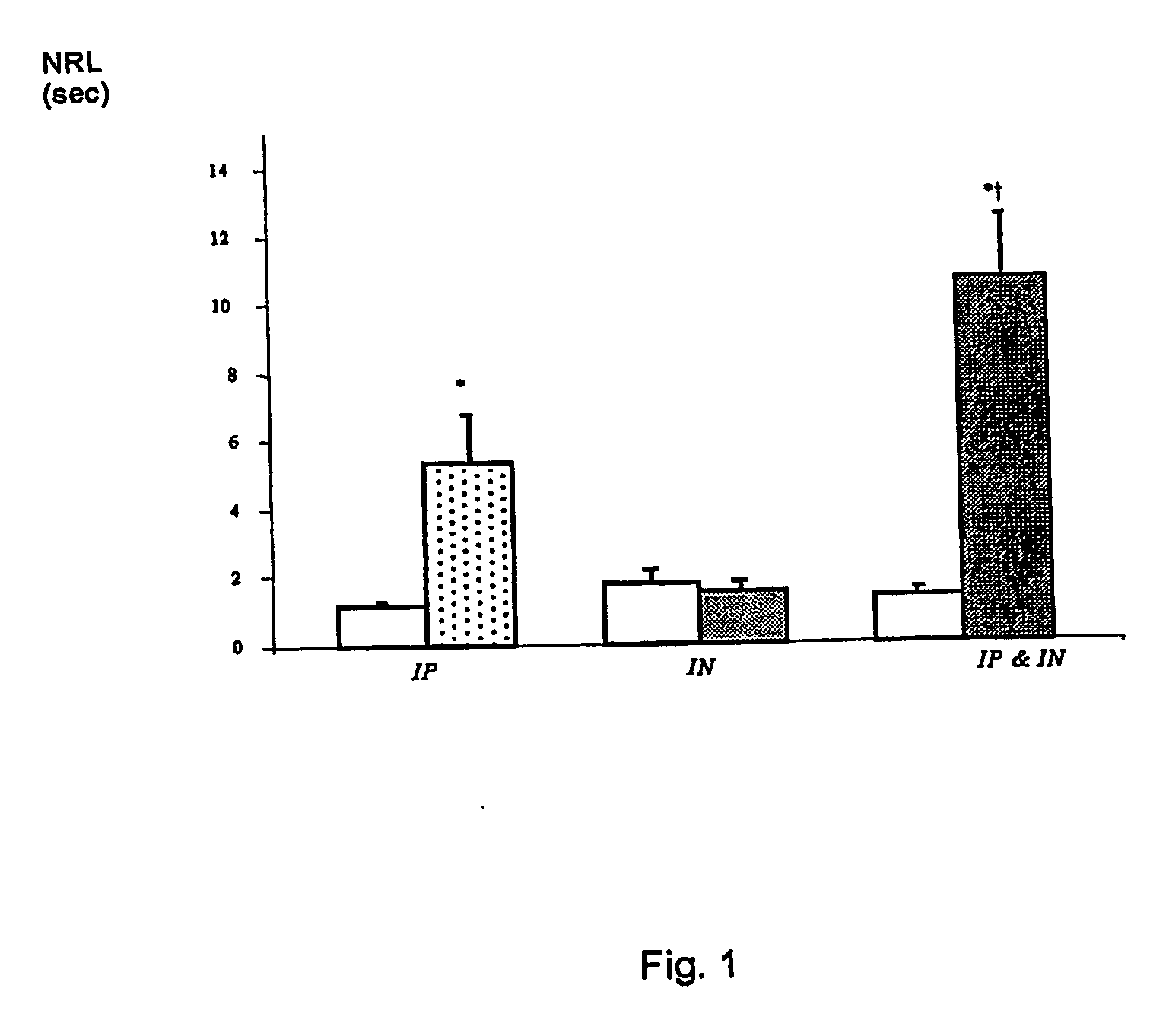
[0033] In this Example, the potentiation of opiate analgesia has been demonstrated, by a nasally administered non-opiate agent, in the rat tail flick assay. FIG. 1 shows the results, and the significant potentiation of morphine analgesia with a non-analgesic dose of the non-opiate agent.

[0034] In FIG. 1, results are expressed as mean±sem for 6 experiments, which are (from left to right): vehicle, morphine (6 mg / kg), vehicle, ifenprodil (1 mg / rat), vehicle IN+vehicle IP, and ifenprodil IN (1 mg / rat)+morphine IP (6 mg / kg). [0035] vehicle: 90% saline 10% propylene glycol [0036] vehicle and morphine were given intraperitoneally 30 min. before the test [0037] vehicle and ifenprodil were given intranasally 30 min. before the test [0038] n=10 rats per group [0039] student's T test: * indicates a significant difference in comparison to the vehicle group for P[0040] student's T test: † indicates a significant difference in comparison to the morphine group for P

[0041] These results indicate ...

the structure of the environmentally friendly knitted fabric provided by the present invention; figure 2 Flow chart of the yarn wrapping machine for environmentally friendly knitted fabrics and storage devices; image 3 Is the parameter map of the yarn covering machine
Login to View More

PUM

PropertyMeasurementUnit
pressureaaaaaaaaaa
timeaaaaaaaaaa
Login to View More

Abstract

A non-opioid analgesic is used for the treatment of intermittent or episodic pain experienced by a patient undergoing chronic pain treatment with an opioid analgesic.

Description

FIELD OF THE INVENTION [0001] The present invention relates to the use of non-opiates for the treatment of pain, and in the potentiation of opiates, to boost analgesia. BACKGROUND OF THE INVENTION [0002] Patients suffering from chronic benign pain and / or cancer pain are often treated with opiates / opioids which are often administered in a controlled release manner. However, from time to time, the analgesic effect cover is insufficient and the patient experiences painful episodes. [0003] Such intermittent, uncontrollable episodes (breakthroughs) are found in chronic benign pain states which can be categorised as musculoskeletal, visceral and headache pain, and include conditions such as osteoarthritis, chronic pancreatitis and chronic migraine. Breakthrough pain is also found in cancer pain conditions associated with the malignant growth of tumours both primary and metastatic in nature. Such conditions are thought to be associated with either pressure on normal tissue (invasion) or th...

Claims

the structure of the environmentally friendly knitted fabric provided by the present invention; figure 2 Flow chart of the yarn wrapping machine for environmentally friendly knitted fabrics and storage devices; image 3 Is the parameter map of the yarn covering machine
Login to View More

Application Information

Patent Timeline
22 Feb 2007
Publication
US20070043112A1
IPC
A01N37/00; A61K31/135; A61K31/137; A61K31/165; A61K31/381; A61K31/395; A61K31/445; A61K31/485; A61K31/5513
CPC
A61K31/135; A61K31/137; A61K31/165; A61K31/381; A61K31/395; A61K31/445; A61K31/485; A61K31/5513
Inventors
BREW, JOHN; BANNISTER, ROBIN MARK