Check patentability & draft patents in minutes with Patsnap Eureka AI!

Transmission of pathological data patterns

Active Publication Date: 2007-03-01
ADVA OPTICAL NETWORKING SE +1
View PDF6 Cites 22 Cited by
  • Summary
  • Abstract
  • Description
  • Claims
  • Application Information

AI Technical Summary

Benefits of technology

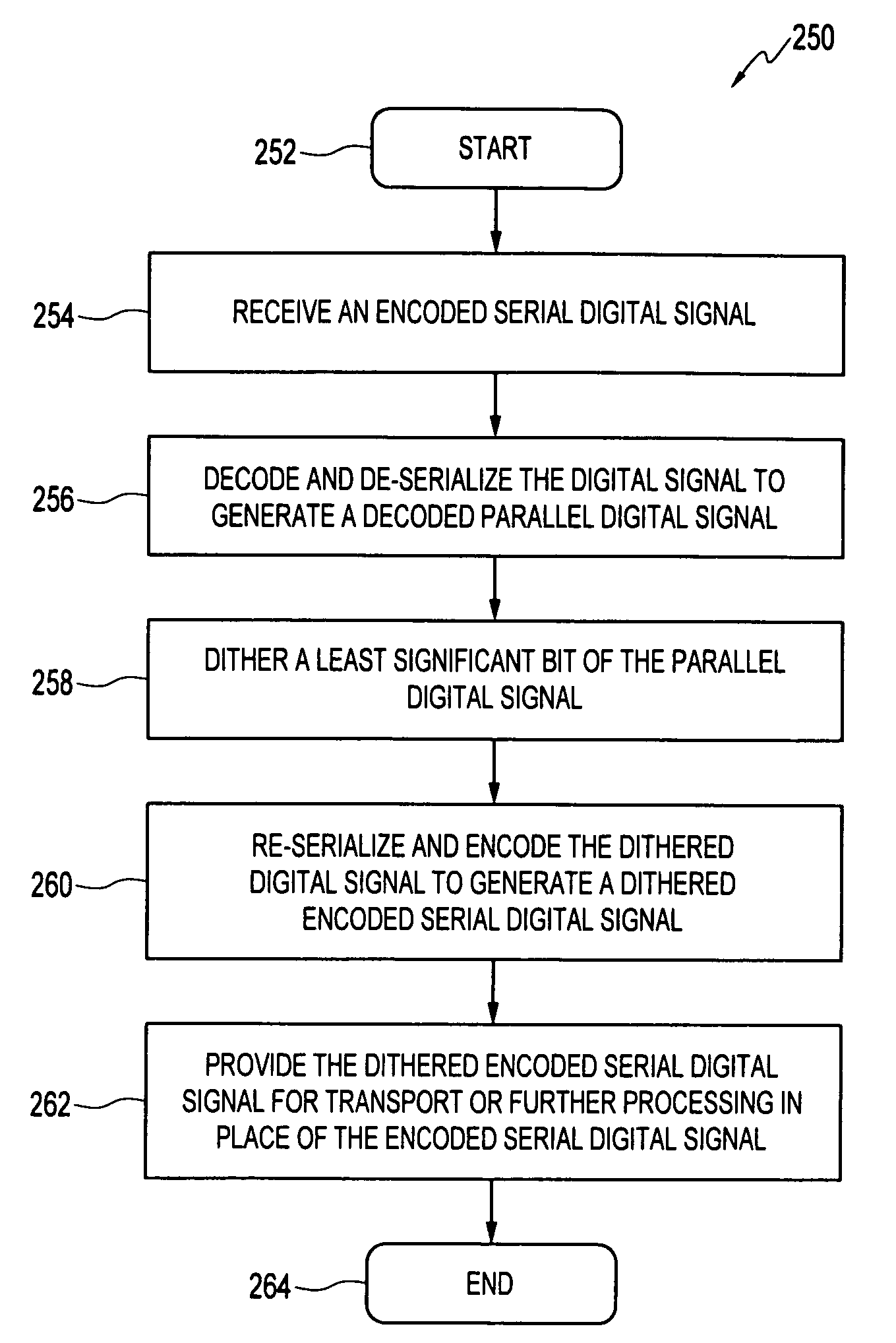
[0012] In light of the foregoing the inventors have concluded that there is a need for an improved method of communicating data signals over optical communications systems in which the adverse effects of pathological signals are reduced or eliminated. The inventors have recognized that many, if not all, of the described adverse effects of pathological signals may be avoided by “dithering,” or adding a small amount of noise to the least significant bit of each data word in parallel form. Such dithering may break up the repeated nature of pathological signals, thus avoiding any associated adverse effects.
[0014] Likewise, the inventors have realized that certain types of dithering are reversible, permitting mathematically-equivalent recovery of the originally encoded signal on the receiver end of an optical communications system. Accordingly, the inventors have appreciated that a transported signal encoded according to an applicable communication standard such as SMPTE 259M may be decoded and de-serialized, the resulting parallel digital data signal may have its least significant bit undithered, and serialization and encoding steps according to the standard such as SMPTE 259M may be re-applied, thereby restoring the transported signal to its originally encoded state, including any pathological data patterns.
[0019] When employed in the context of optical communications, embodiments of the present invention significantly improve transmission of signals encoded for example according to an applicable communication standard such as SMPTE 259M (e.g. including any pathological data patterns) over advanced optical communications networks including, for example, a multi-service DWDM fiber backbone. Methods and devices embodying these advantages may be provided in a form suitable for use with conventional data transmission networks and at a reasonable cost.

Problems solved by technology

One problem with communicating SMPTE 259M signals over optical communications systems involves the content of the signals and how that content affects the performance of certain optical devices employed in the system.
For example, certain signals known as “pathological signals” can adversely affect the power control circuitry of optical transmitters and / or receivers and increase signal-to-noise ratio, bit error rate, intersymbol interference, and / or other adverse effects.
Such a pathological signal may include significant low frequency content and may disrupt system devices not designed for low frequency signals.
Such waveform distortions may cause the bit error rate and picture quality at the receiver to suffer.
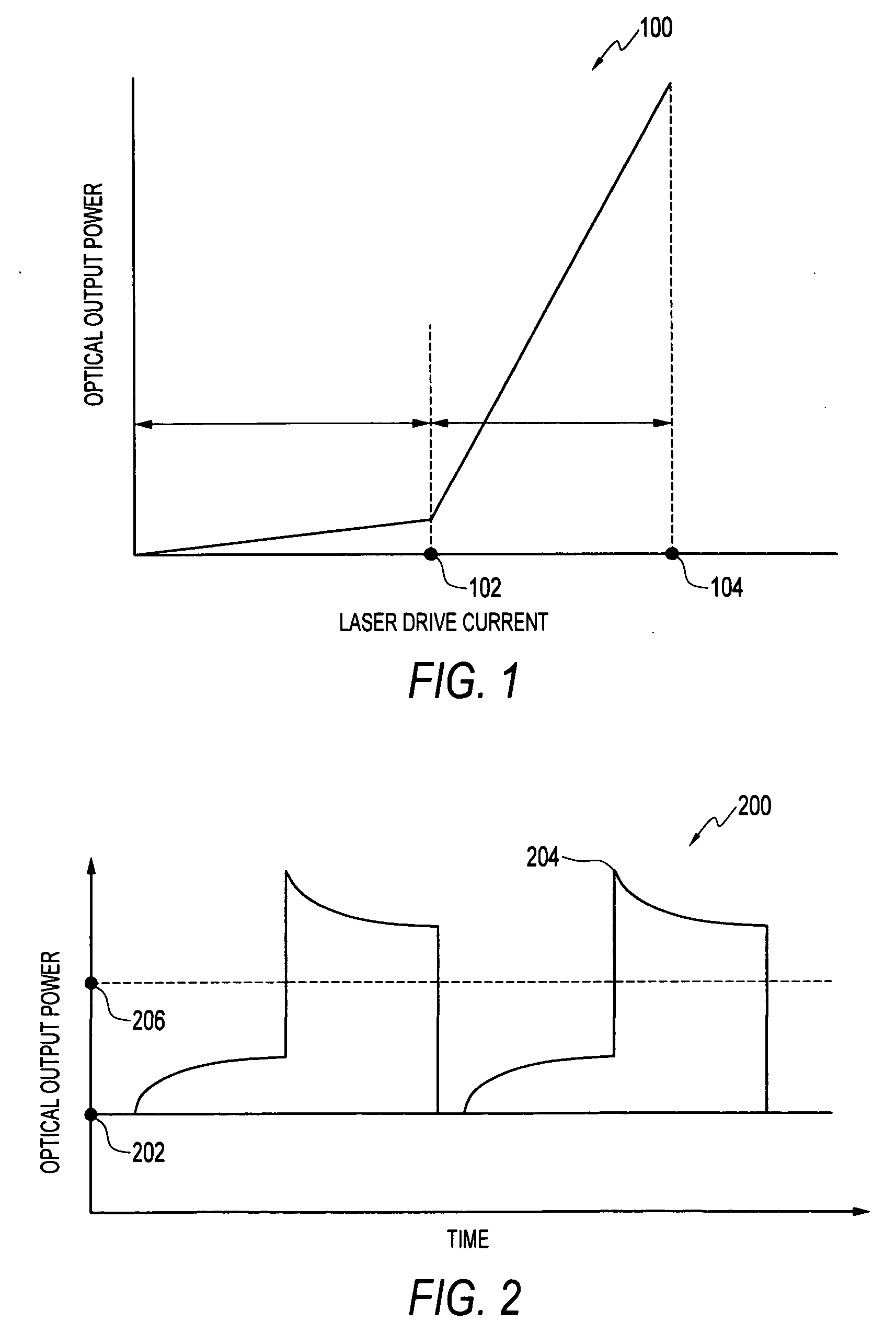
During such pathological signals, the average optical output power may increase or decrease, significantly distorting the transmitted waveform and possibly causing overmodulation and / or adversely affecting signal-to-noise ratio.
Overmodulation of the optical transmitter may cause additional waveform distortion and ringing, leading to intersymbol interference as the laser drive current moves into nonlinear regions of the light versus current (LI) curve such as that shown in FIG. 1.
In this way, waveform distortion can result in intersymbol interference which in turn may cause increased bit error rate, corruption of video data, and / or degradation of picture quality.

Method used

the structure of the environmentally friendly knitted fabric provided by the present invention; figure 2 Flow chart of the yarn wrapping machine for environmentally friendly knitted fabrics and storage devices; image 3 Is the parameter map of the yarn covering machine
View more

Image

Smart Image Click on the blue labels to locate them in the text.
Viewing Examples
Smart Image
  • Transmission of pathological data patterns
  • Transmission of pathological data patterns
  • Transmission of pathological data patterns

Examples

Experimental program
Comparison scheme
Effect test

Embodiment Construction

[0033] The following description is provided to enable a person of ordinary skill in the art to make and use the disclosed inventions and sets forth the best modes presently contemplated by the inventors for carrying out their inventions. In the following description, for purposes of explanation, numerous specific details are set forth in order to provide a thorough understanding of the described inventions. It will be apparent to one skilled in the art, however, that the inventions may be practiced without these specific details. In other instances, structures and devices are shown in block diagram (or otherwise simplified) form for clarity of presentation.

[0034] In the following discussion, the singular term “signal” and plural term “signals” are used interchangeably and are to be understood as including analog or digital information, at a single frequency or a plurality of frequencies, and may or may not include coding, modulation, sideband information, or other features of sign...

the structure of the environmentally friendly knitted fabric provided by the present invention; figure 2 Flow chart of the yarn wrapping machine for environmentally friendly knitted fabrics and storage devices; image 3 Is the parameter map of the yarn covering machine
Login to View More

PUM

No PUM Login to View More

Abstract

A method and apparatus is presented for reducing or eliminating pathological data patterns from signals for transmission over optical communications systems. One embodiment includes a decoder / deserializer configured to receive an encoded serial digital signal, a ditherer configured to dither a least significant bit of each digital data word, and a reserializer / encoder configured to serialize digital data and encode it, for example according to an applicable communication standard such as SMPTE 259M. The improvements may be provided in a single removable unit, such as a small form-factor pluggable (SFP) module compatible with existing optical communications equipment.

Description

CROSS REFERENCE TO RELATED APPLICATION [0001] This application claims the benefit under 35 U.S.C. § 119(e) of U.S. Provisional Application No. 60 / 712,335 filed Aug. 29, 2005, the contents of which are hereby incorporated by reference in their entirety.FIELD OF THE INVENTION [0002] The present invention relates to devices, systems, and methods of data communication and, more particularly, to data communication of digital video signals. BACKGROUND OF THE INVENTION [0003] Communication of digital data, especially digital video data, can be a demanding enterprise. The desire for improved performance has led investigators to attempt alternative methods and modes of communicating digital video. As a result, a wide variety of data communications technologies, including equipment, standards, protocols, etc., have been developed with varying performance characteristics. [0004] One standard for transporting digital video data is known as SMPTE 259M, developed by the Society of Motion Picture ...

Claims

the structure of the environmentally friendly knitted fabric provided by the present invention; figure 2 Flow chart of the yarn wrapping machine for environmentally friendly knitted fabrics and storage devices; image 3 Is the parameter map of the yarn covering machine
Login to View More

Application Information

Patent Timeline
no application Login to View More
IPC IPC(8): H04N5/44H04N5/38H04H9/00H04N7/16H04H1/00H04H20/63H04H20/69H04H60/11
CPCH04H20/63H04L25/03872H04H60/11H04H20/69
Inventor ROTENSTEIN, SERGIU
Owner ADVA OPTICAL NETWORKING SE
Features
  • R&D
  • Intellectual Property
  • Life Sciences
  • Materials
  • Tech Scout
Why Patsnap Eureka
  • Unparalleled Data Quality
  • Higher Quality Content
  • 60% Fewer Hallucinations
Social media
Patsnap Eureka Blog
Learn More