

Compositions and methods for topical application and transdermal delivery of botulinum toxins
a technology of botulinum toxin and botulinum toxin, which is applied in the direction of drug compositions, enzymology, immunological disorders, etc., can solve the problems of slow diffusion rate of botulinum toxin, improper sterilization and sealing of food containers, and dry skin, so as to reduce hypersecretion or sweating, reduce muscle spasms, and treat neurologic pain
- Summary
- Abstract
- Description
- Claims
- Application Information
AI Technical Summary
Benefits of technology
Problems solved by technology
Method used
Image

Examples
example 1
Transport of a Botulinum Toxin In Vivo Using a Revance Peptidyl Carrier
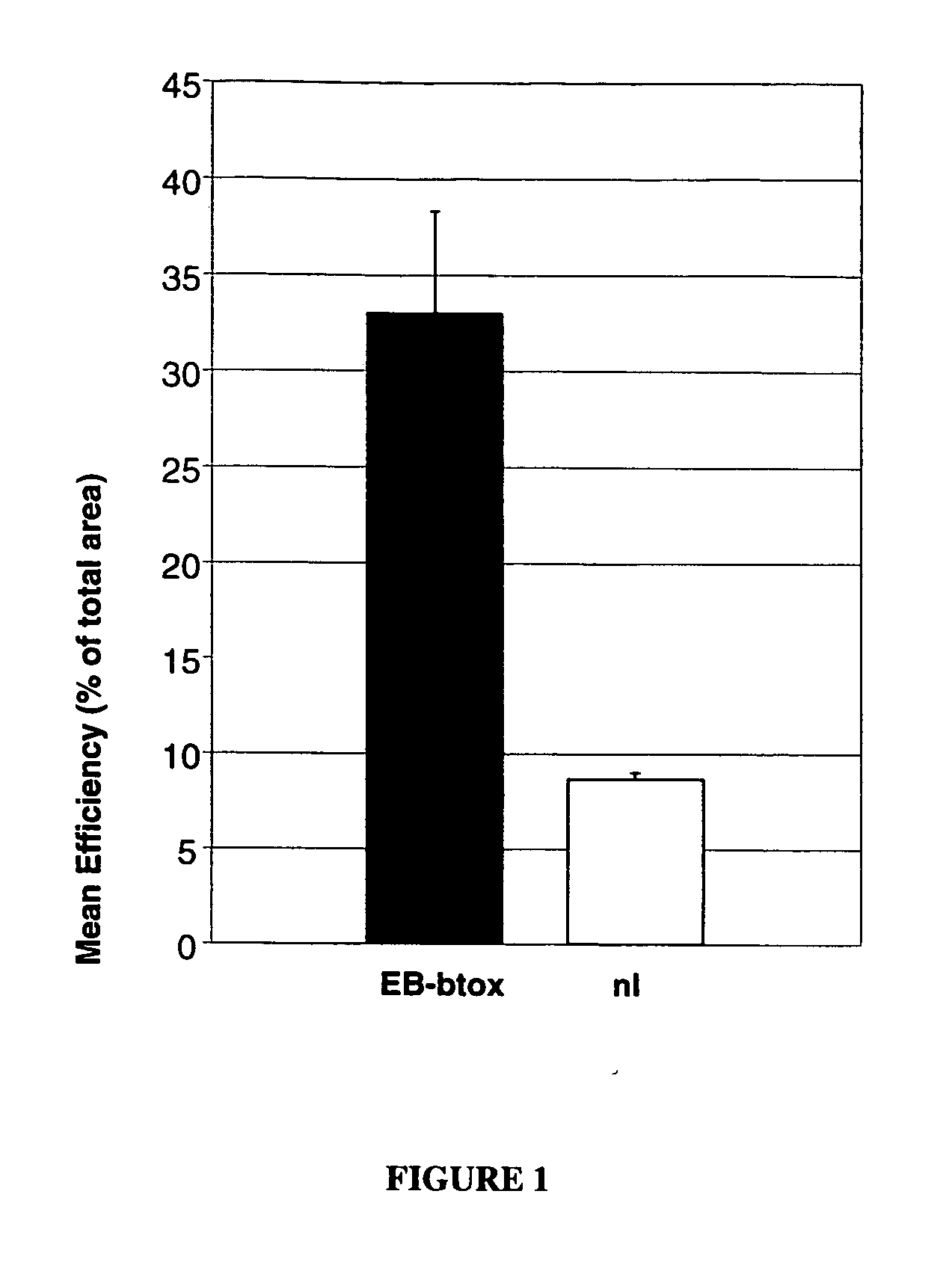
[0078] This experiment demonstrates the use of a peptidyl carrier to transport a large complex containing an intact labeled protein botulinum toxin across intact skin after a single time administration relative to controls.
Backbone Selection:
[0079] The positively charged backbone was assembled by conjugating -Gly3Arg7 to polylysine (MW 112,000) via the carboxyl of the terminal glycine to free amines of the lysine side chains at a degree of saturation of 18% (i.e., 18 out of each 100 lysine residues is conjugated to a -Gly3Arg7). The modified backbone was designated “KNR”. The control polycation was unmodified polylysine (designated “K”, Sigma Chemical Co., St. Louis, Mo.) of the same size and from the same lot.
Therapeutic Agent:
[0080] Botox® brand of botulinum toxin A (Allergan) was selected for this experiment. It has a molecular weight of approximately 150,000.
Preparation of Samples:
[0081] The botulin...
example 2
Therapeutic Efficacy of a Topical Botulinum Toxin Preparation with a Peptidyl Carrier
[0089] Example 1 demonstrated that the peptidyl transdermal carrier allowed efficient transfer of botulinum toxin after topical administration in a murine model of intact skin. However, this experiment did not indicate whether the complex protein botulinum toxin was released in a functional form after translocation across skin. The following experiment was thus constructed to evaluate whether botulinum toxin can be therapeutically delivered across intact skin as a topical agent using this peptidyl carrier (again, without covalent modification of the protein).
[0090] The positively charged backbone was again assembled by conjugating -Gly3Arg7 to polylysine (MW 112,000) via the carboxyl of the terminal glycine to free amines of the lysine side chains at a degree of saturation of 18% (i.e., 18 out of each 100 lysine residues is conjugated to a -Gly3Arg7). The modified backbone was designated “KNR”. Co...
example 3
Therapeutic Efficacy of a Topical Botulinum Toxin Preparation with a Nonpeptidyl Carrier
[0098] This experiment demonstrates the performance of a non-peptidyl carrier in the invention.
Methods:
Backbone Selection:
[0099] The positively charged backbone was assembled by conjugating -Gly3Arg7 to polyethyleneimine (PEI) MW 1,000,000 via the carboxyl of the terminal glycine to free amines of the PEI side chains at a degree of saturation of 30% (i.e., 30 out of each 100 lysine residues is conjugated to a -Gly3Arg7). The modified backbone was designated “PEIR” to denote the large nonpeptidyl carrier. Control polycation was unmodified PEI (designated “PEI”, Sigma Chemical Co., St. Louis, Mo.) of the same size and from the same lot. The same botulinum toxin therapeutic agent was used as in Example 1.
[0100] Botulinum toxin was reconstituted from the Botox product according to the manufacturer's instructions. In each case, an excess of polycation was employed to assemble a final complex th...
PUM
| Property | Measurement | Unit |
|---|---|---|
| Volume | aaaaa | aaaaa |
| Volume | aaaaa | aaaaa |
| Volume | aaaaa | aaaaa |
Abstract
Description
Claims
Application Information
 Login to View More