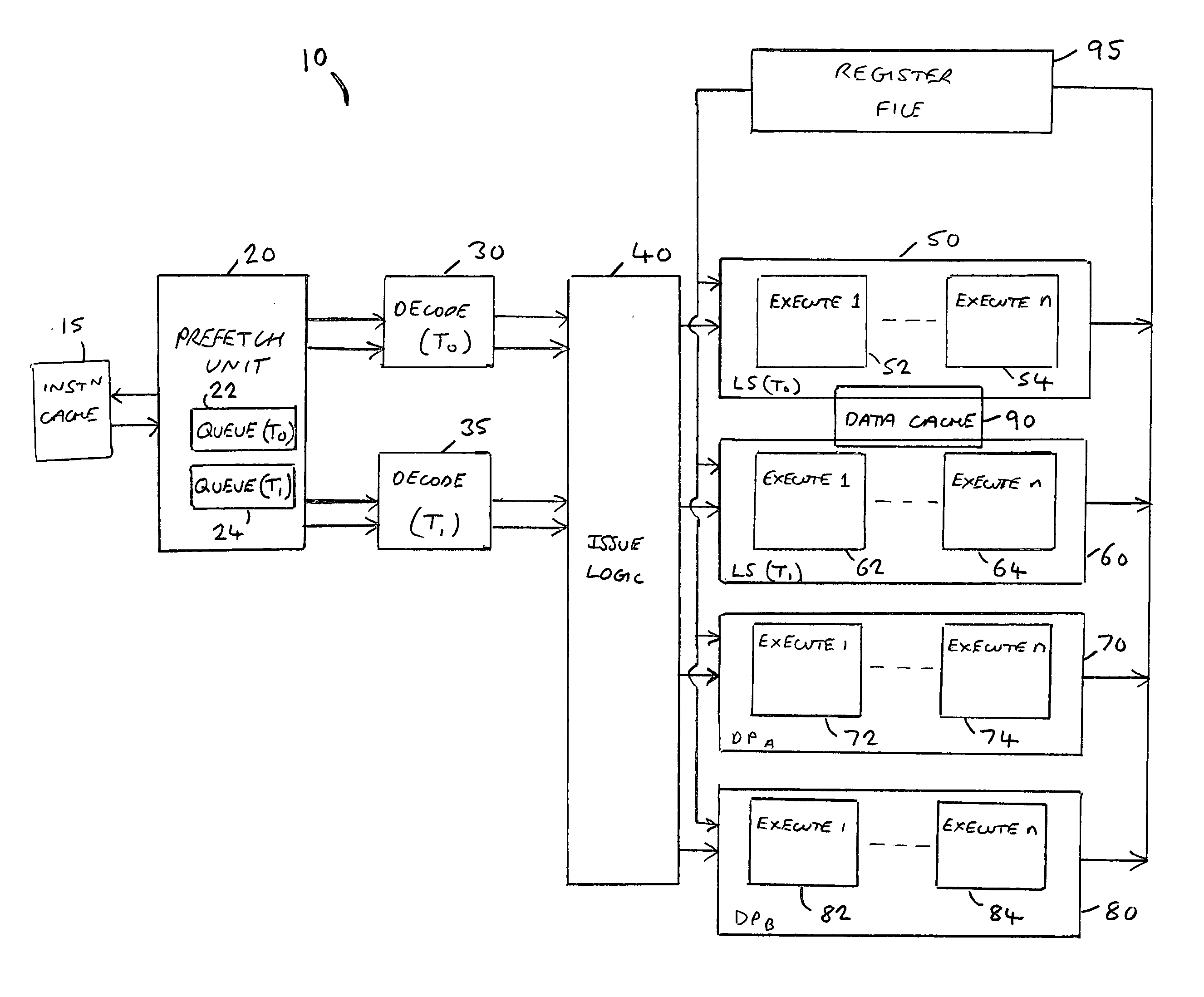
[0013] By such an approach, the required memory access activities that occur within the plurality of execution threads can be spread across multiple execution pipelines, thereby alleviating the earlier described
bottleneck that would occur if only one pipeline was used to
handle memory access operations. Further, since each particular memory access capable pipeline will only
process memory access operations for a subset of the plurality of execution threads, this reduces the hazard detection requirements that would otherwise be required. In particular, each execution thread will typically be used to execute a sequence of instructions from a particular
program thread (i.e. a thread in a user program as viewed by the
operating system) and since by their nature the individual program threads are intended to execute autonomously from one another, there is no need to perform any hazard detection operations, such as address dependency checking, across different program threads, and any hazards that do in fact exist in such situations are
software hazards (i.e. the result of a
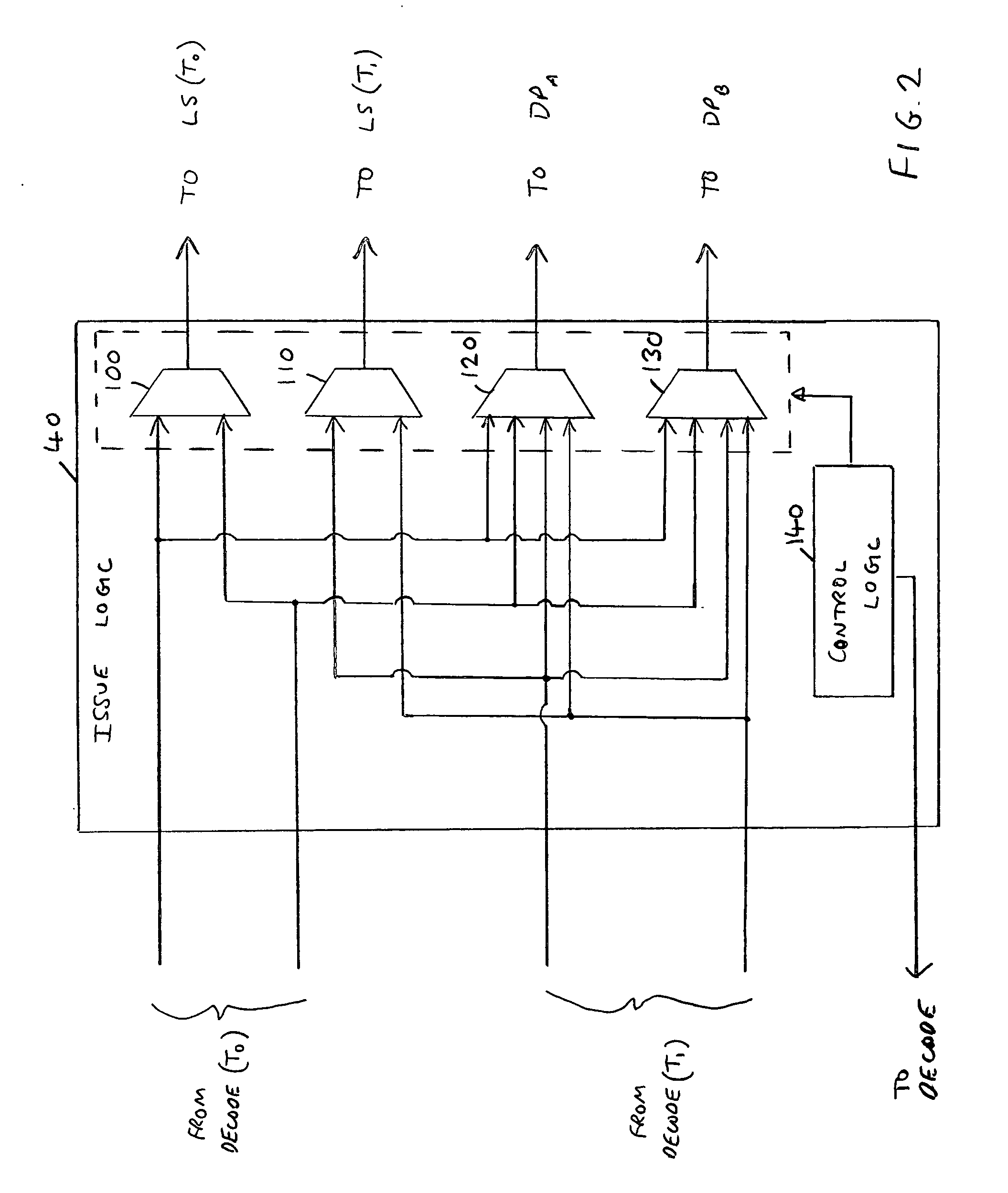
programming error) which do not need to be resolved by the hardware. As a result, hazard detection only needs to be implemented between memory access capable pipelines that can handle memory access operations from the same execution thread, i.e. where there is some overlap between the subset of execution threads associated with one memory access capable pipeline and the subset of execution threads associated with a different memory access capable pipeline.
[0014] It should be noted that the sequence of operations may occasionally include special memory operations which are used for synchronisation between threads, which need to be executed atomically. For such memory operations, hazard detection is required between all threads, but can be implemented by ensuring that for such memory operations no other memory operations are issued during the same cycle. Since occurrence of these special memory operations are rare, the performance
impact of such an approach is minimal. Further the approach is easy to implement.
[0015] In one embodiment, each execution thread is associated with one of the memory access capable pipelines. As a result, there will be no overlap between the subset of execution threads associated with one memory access capable pipeline and the subset of execution threads associated with another memory access capable pipeline and accordingly the need to provide hazard detection hardware can be avoided, since as mentioned earlier there is no need for hardware to detect hazards between different execution threads.
[0017] In one embodiment, each subset comprises one of the execution threads, and hence each memory access capable pipeline only has one execution thread associated with it. The additional benefit residing from such an approach is that each memory access capable pipeline does not need to be able to handle Hit under Miss operations. Instead, if execution of a memory access operation for a particular thread causes a
cache miss, then the load / store part of the pipeline can remain blocked while the memory access is resolved since the only other memory access operations that will have been routed to that pipeline will pertain to the same thread. In the meantime, if the memory access capable pipeline has capability to handle execution of other operations, for example general data processing operations, then any such operations pertaining to different threads can be executed within that memory access capable pipeline since execution of the sequence of operations relating to other threads does not need to be halted pending the outcome of the
cache miss.
[0020] One way in which the cache can be arranged to process multiple access requests in parallel is to use multi-ported RAM (
Random Access Memory) for storing the data within the cache. However, multi-ported RAM is more costly than single-ported RAM, and accordingly this will increase the cost of the data processing apparatus.
[0024] In one embodiment, when data is allocated into the cache following a
cache miss, it is preferably allocated in a group associated with the relevant thread to prevent subsequent accesses from causing stalls. As a further enhancement, in one embodiment data can be migrated between groups with the aim of preventing future stall cycles.


 Login to View More
  Login to View More