
Plasma reformer with extended volume discharge
a technology of arc discharge and plasma, which is applied in the field of plasma reformers, can solve the problems of complex and expensive, the arc cannot be stretched very far beyond the gap, and the complete non-catalytic partial oxidation of hydrocarbon fuel, so as to increase the arc length and discharge volume, and increase the contact time
- Summary
- Abstract
- Description
- Claims
- Application Information
AI Technical Summary
Benefits of technology
Problems solved by technology
Method used
Image

Examples
Embodiment Construction
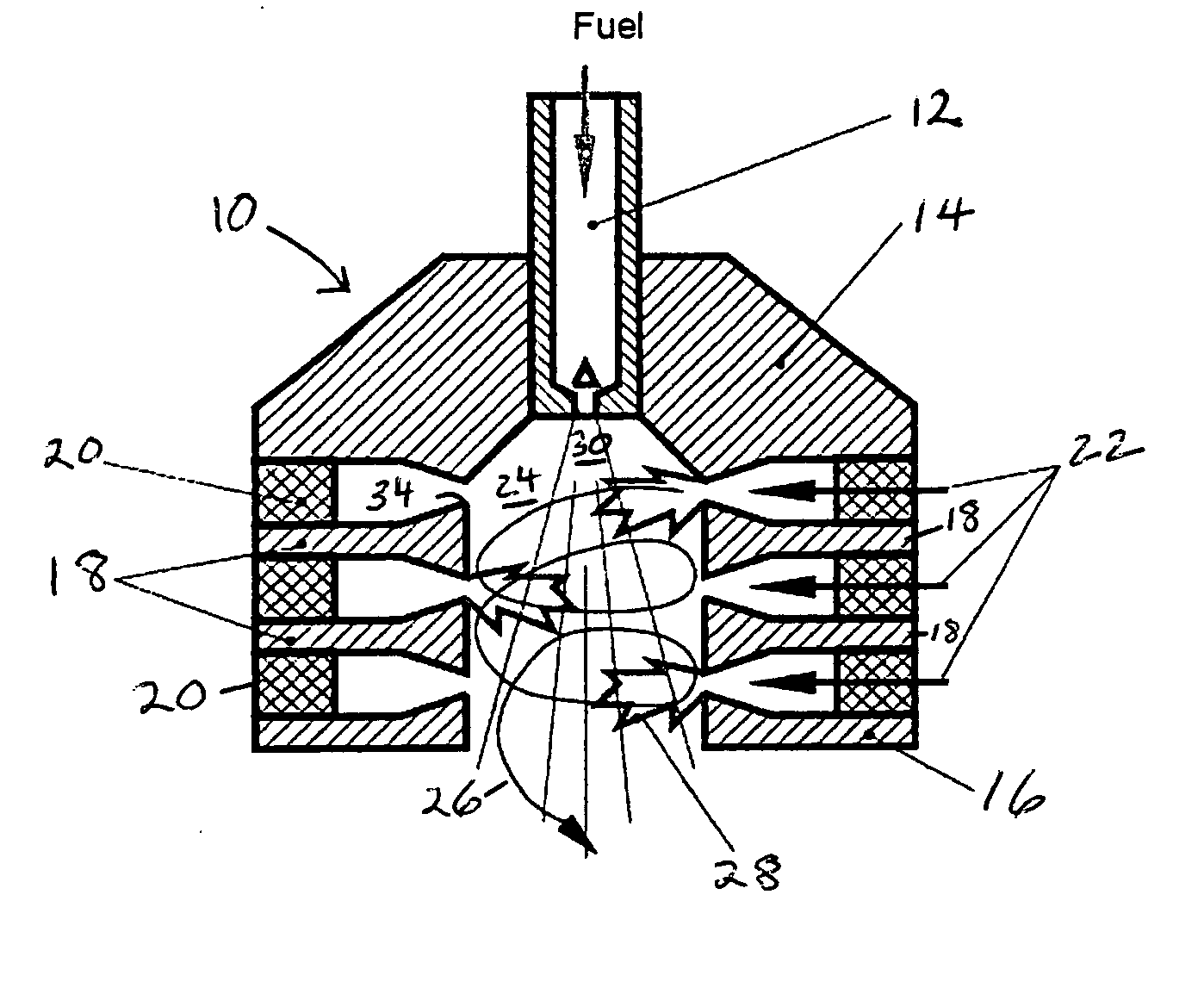
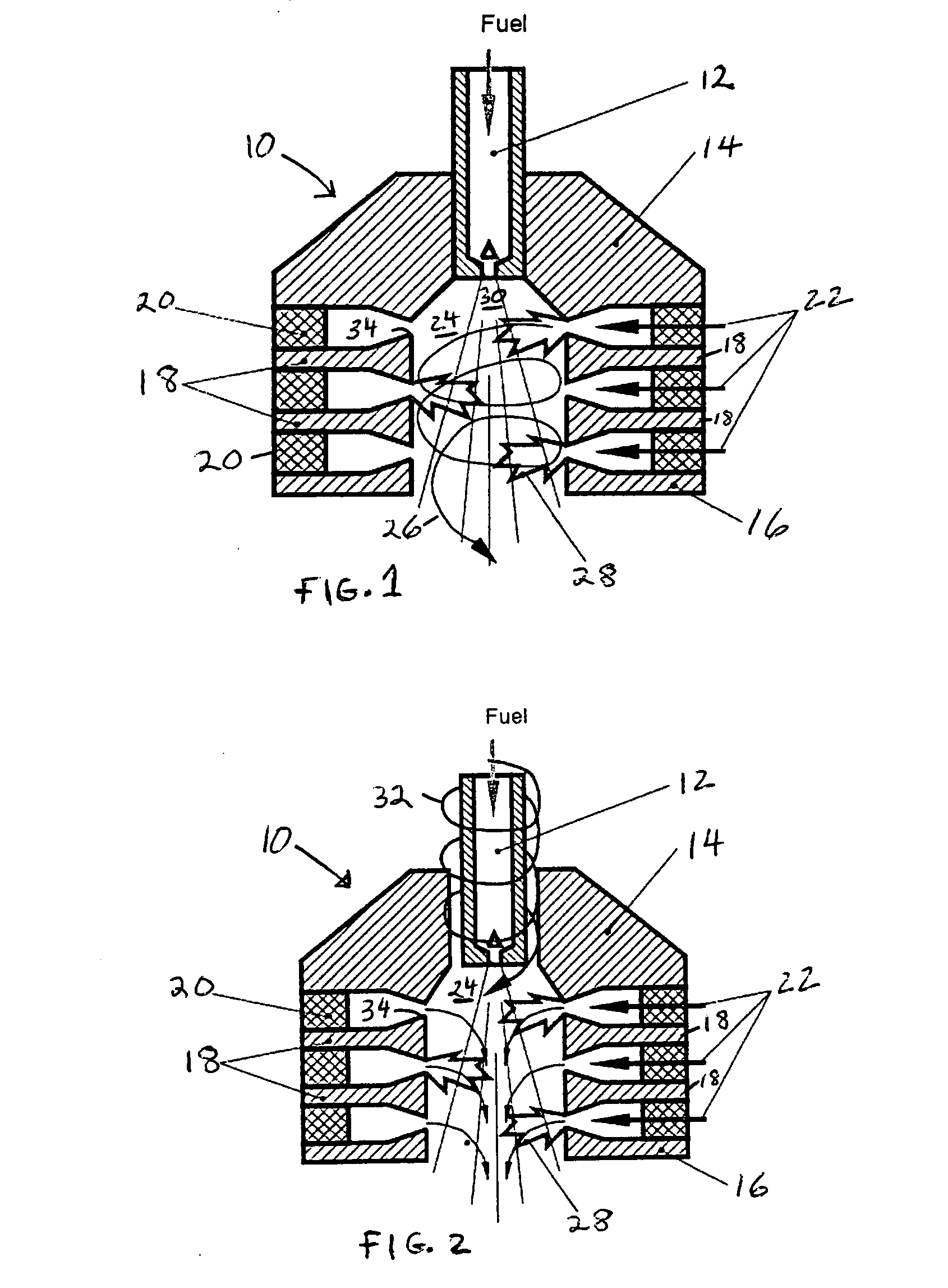
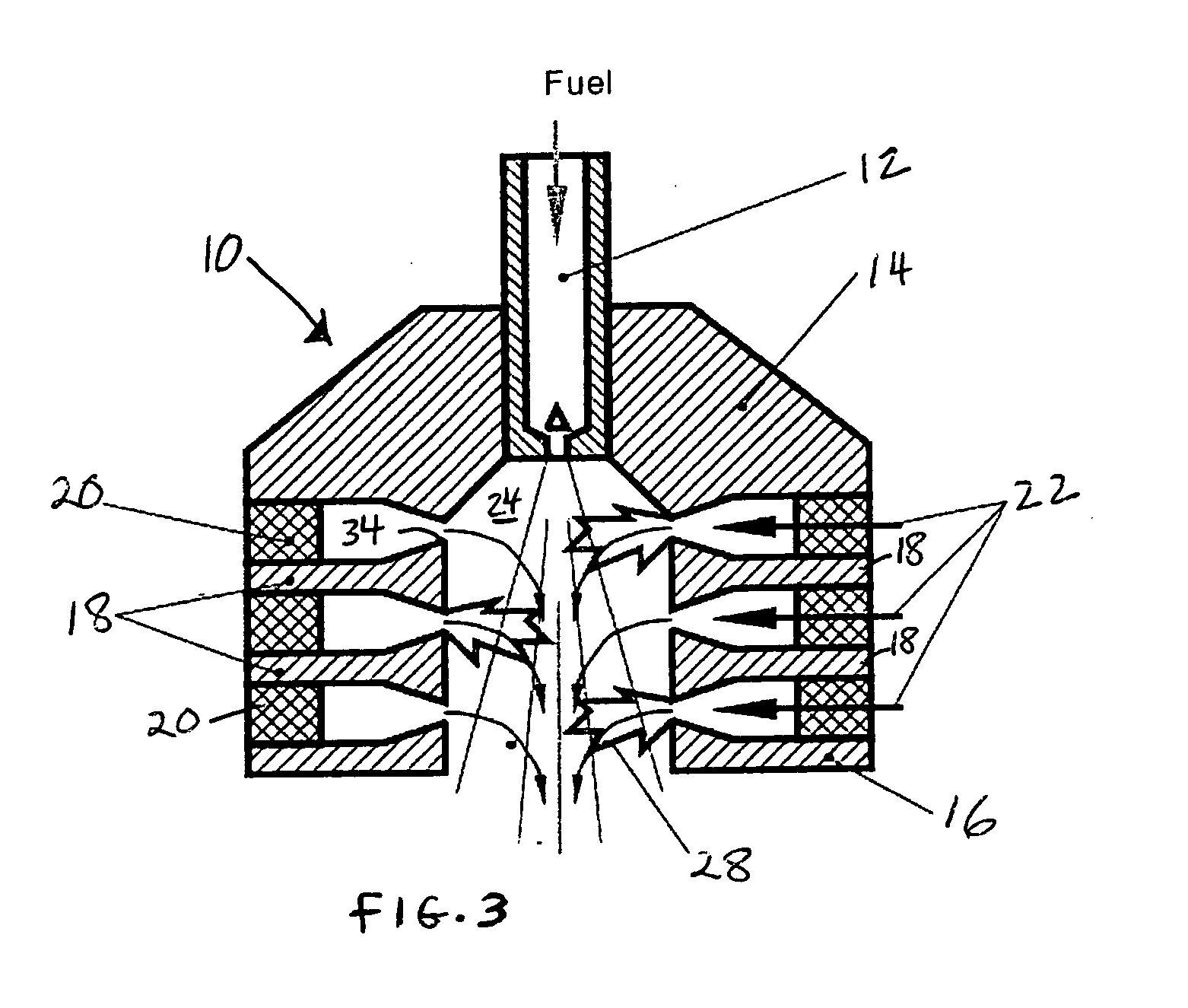
[0016] With reference first to FIG. 1, a plasma reformer 10 includes a fuel atomizer 12 that injects a hydrocarbon fuel into a volume created by high-voltage electrode 14 spaced apart from a grounded electrode 16. In this embodiment, electrically floating electrodes 18 are disposed between the high voltage electrode 14 and the grounded electrode 16. Insulators 20 separate the electrodes. The arrangement of the electrodes 14, 16, and 18 creates gaps through which air 22 flows into a volume 24 within the plasma reformer 10. In this embodiment, the air is injected tangentially to create swirl as indicated by the path 26.
[0017] In operation, a high voltage, for example in the range of 300V-15 kV or higher, is applied between the high voltage electrode 14 and the grounded electrode 16. The high voltage creates a cascade electric arc 28 that rotates because of the tangentially injected plasma air 22. The electrically floating electrodes 18 aid in the production of an extended volume disc...
PUM
 Login to View More
 Abstract
Description
Claims
Application Information
 Login to View More