[0015] It is another object of the present invention, at least in preferred embodiments, to provide a connector for substantially preventing unwanted disruption of a signal transmission line / detonator connection by a tensile force applied to the signal transmission line.
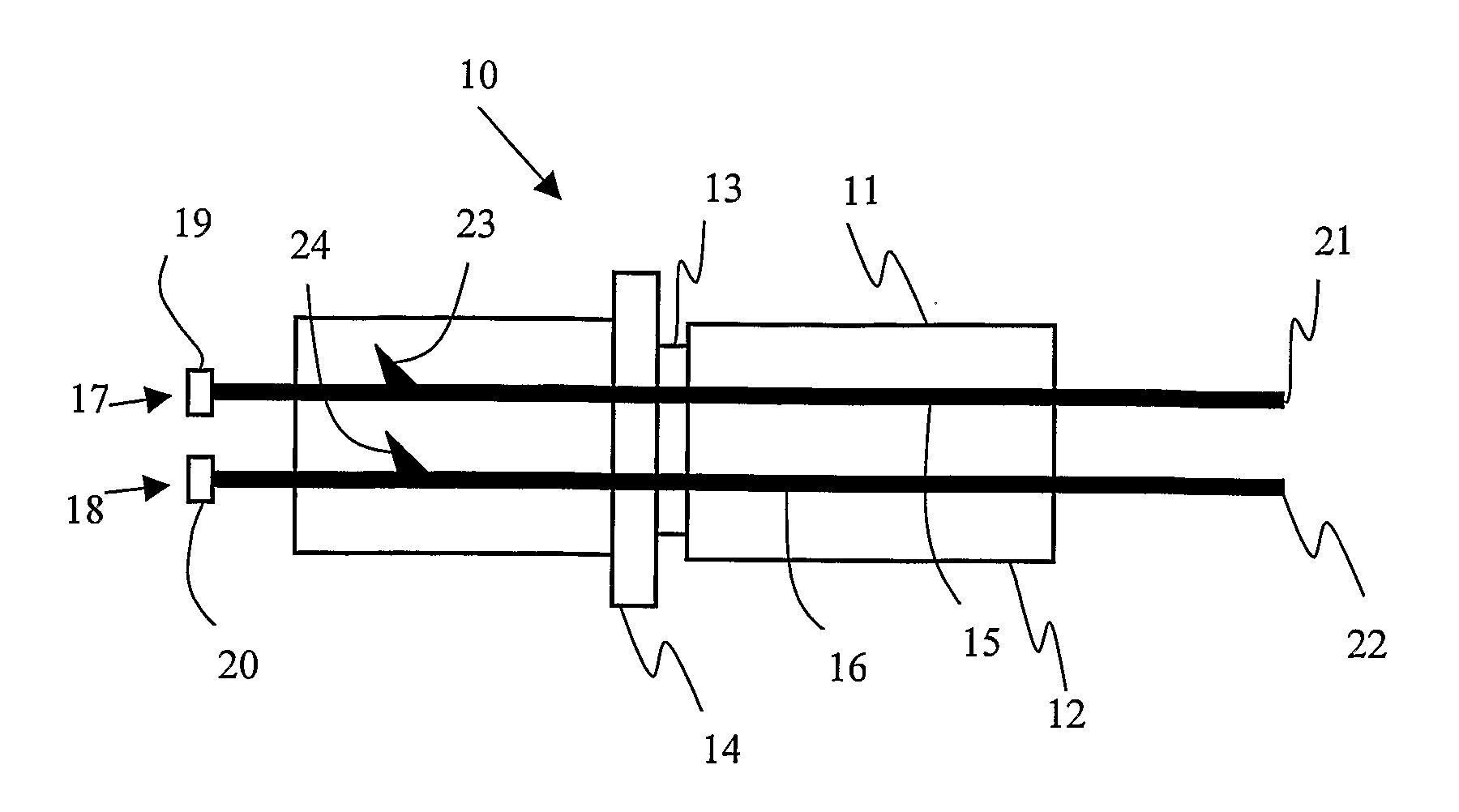
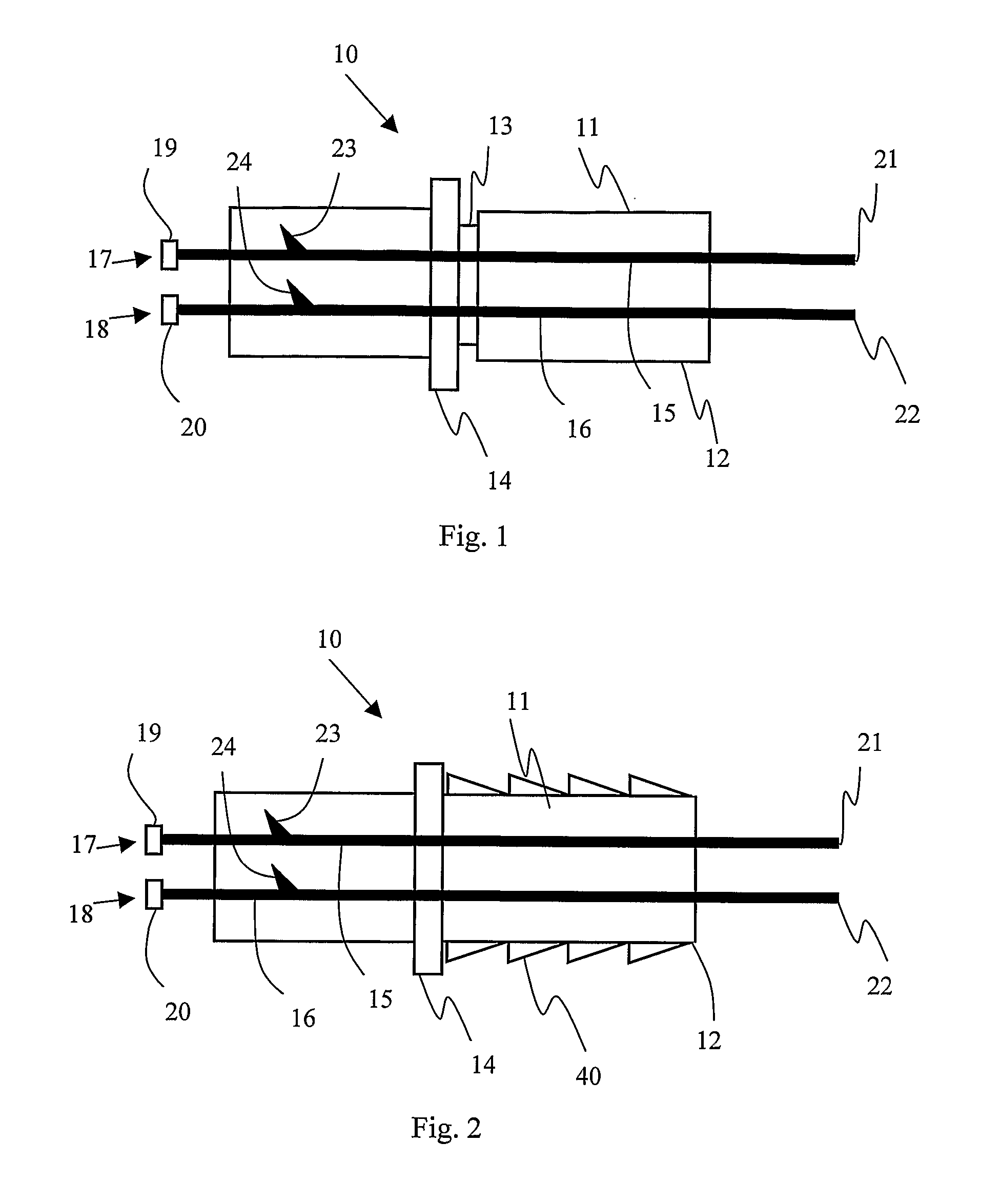
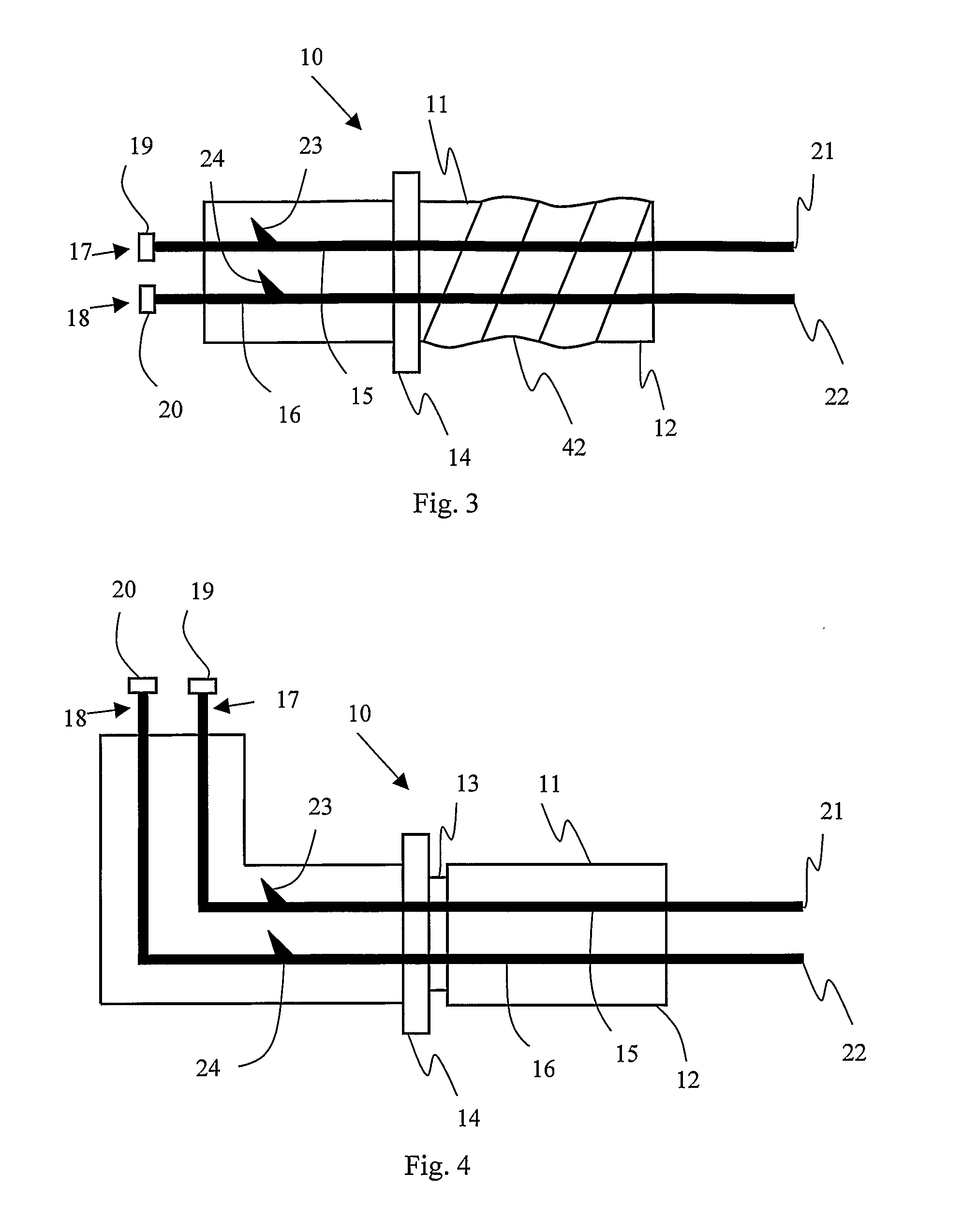
[0017] In one aspect, the present invention provides for a connector that improves the security of connections between signal transmission lines and electronic detonators. Through detailed experimentation, the inventors of the present invention have developed a connector that may be suitably affixed to a detonator preferably adapted to receive the connector. Preferably, the connector is affixed on a non-actuating end of a detonator. Such a connection avoids the need for direct connection between the component wires of a signal transmission line and an electrical component of an electronic detonator. The connector confers significant durability to the signal transmission line / detonator connection, particularly with respect to tensile forces applied to the signal transmission line. In effect, the connector can substantially prevent breakage of the electrical contact and retain physical association between a signal transmission line and components of a detonator, even in the presence of fairly high tensile forces. Moreover, the connector of the present invention avoids the need for complex junction blocks or plug / plug socket systems of the prior art, and may be used, at least in preferred embodiments, in modular blasting apparatuses.
[0021] Preferably, each retaining means comprises a part of said at least one bridge element in contact with said insulating material, said part comprising at least one surface that extends at an angle to a direction of force applied to said at least one bridge element by pulling or tugging one of said parts that emerge from said plug member, thereby causing said at least one bridge element to
resist slippage between said at least one bridge element and said plug member.
[0024] Preferably said at least one bridge element comprises a first end and a second end, each first end being adapted for attachment to a signal transmission line, and each second end being adapted for contact with an electrical component of the detonator. More preferably, each first end comprises a wire clasp or
crimp for grasping the end of a wire emerging from the signal transmission line. Preferably, said electrical component is selected from the group consisting of: a
printed circuit board or a component thereof, means to allow protection from electrostatic damage to other electronic components of the detonator, a
resistor, a
varistor, a
zener diode, a
suppressor diode, an encapsulated
integrated circuit, an SO8 packaging, a filter, a
capacitor, a
spark gap, a small outline
integrated circuit, and a
rectifier, or alternatively said electrical component is connected to a
printed circuit board or a component thereof, means to allow protection from electrostatic damage to other electronic components of the detonator, a
resistor, a
varistor, a
zener diode, a
suppressor diode, an encapsulated
integrated circuit, or an SO8 packaging, a
printed circuit board or a component thereof, a
resistor, a filter, a
capacitor, a
spark gap, a small outline integrated circuit, or a
rectifier. Preferably said at least one bridge element comprises a
metal, a
metal alloy, a
ceramic, a rigid
polymer, or a
semiconductor. More preferably, said at least one bridge element consists of a
metal. More preferably, said at least one bridge element is formed by
stamping a template, from sheet metal.
[0025] Preferably said part of said at least one bridge element that is in contact with said insulating material is adapted for
abutment, impalement or engagement with an internal surface of said plug member, thereby to serve as the retaining means to retain said at least one bridge element in position within said plug member. More preferably, application of a pulling or tugging force to one of said parts that emerge from said plug member, causes said portion adapted for
abutment, impalement or engagement with said internal surface of said plug member to impart a resistive force upon said internal surface, thereby causing each bridge element to
resist slippage between each bridge element and said plug member.
[0032] Preferably the body of electrically insulating material comprises at least one bend and said at least one bridge element comprises at least one corresponding bend thereby to cause engagement therebetween, so as at least to assist in retention of said at least one bridge element within said plug member.


 Login to View More
  Login to View More