
Brake control apparatus
a control apparatus and brake technology, applied in the direction of braking systems, process and machine control, instruments, etc., can solve the problems of inability to obtain reliable judgment, low electric voltage supplied to the sensor, and inability to reliably output the output signal of the sensor, etc., to achieve the effect of not rapidly changing the operation force of the brak
- Summary
- Abstract
- Description
- Claims
- Application Information
AI Technical Summary
Benefits of technology
Problems solved by technology
Method used
Image

Examples
first embodiment
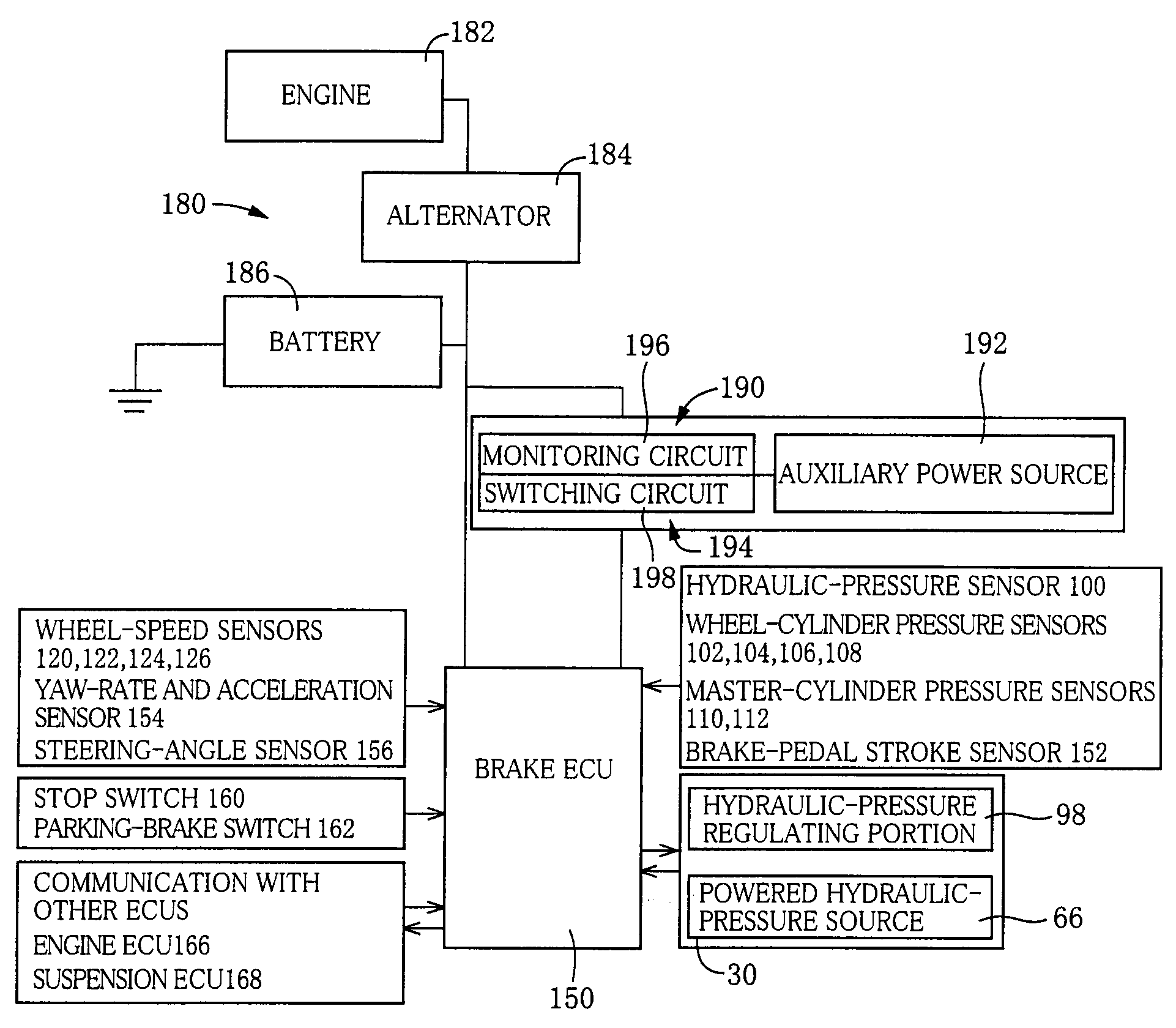
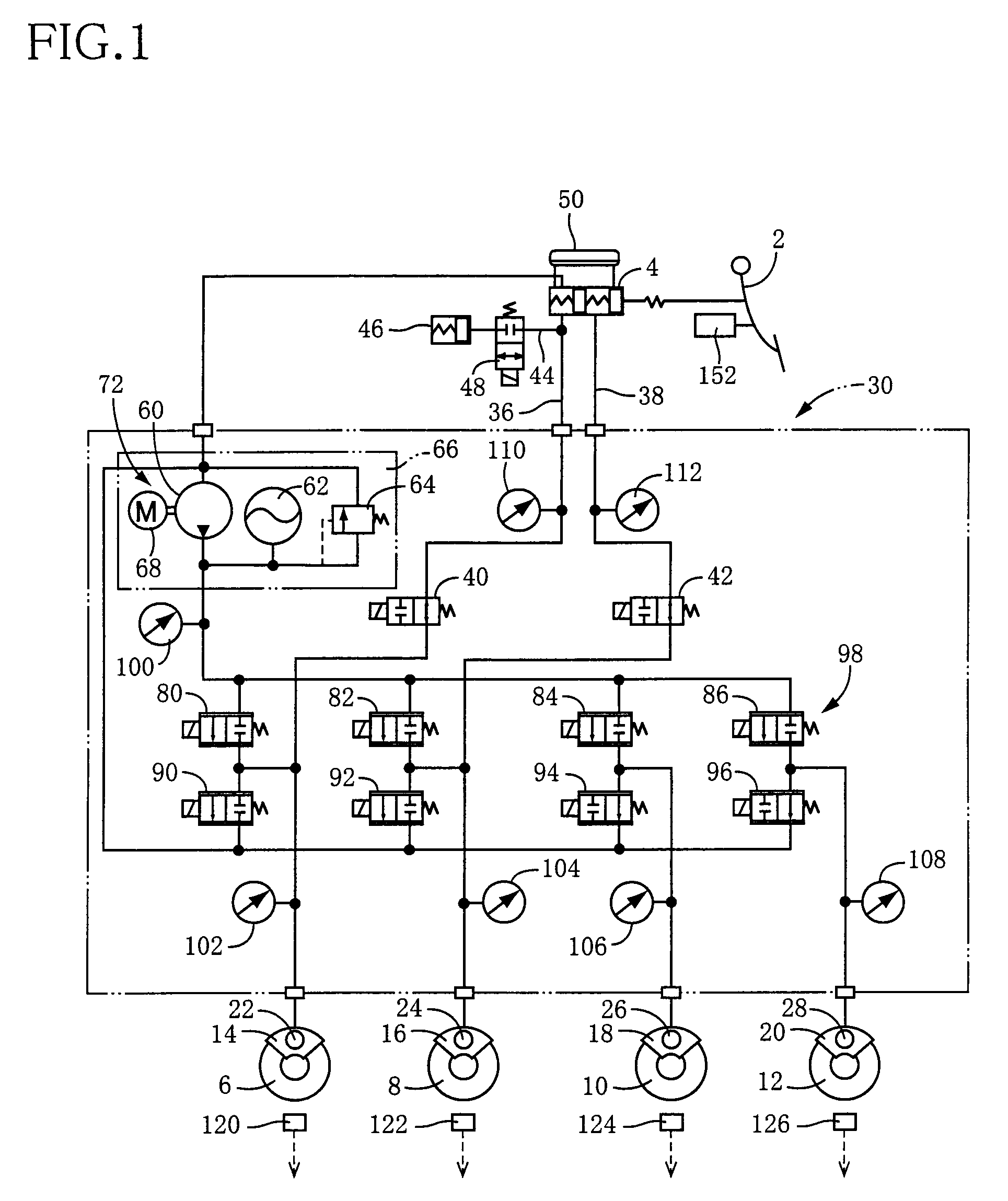
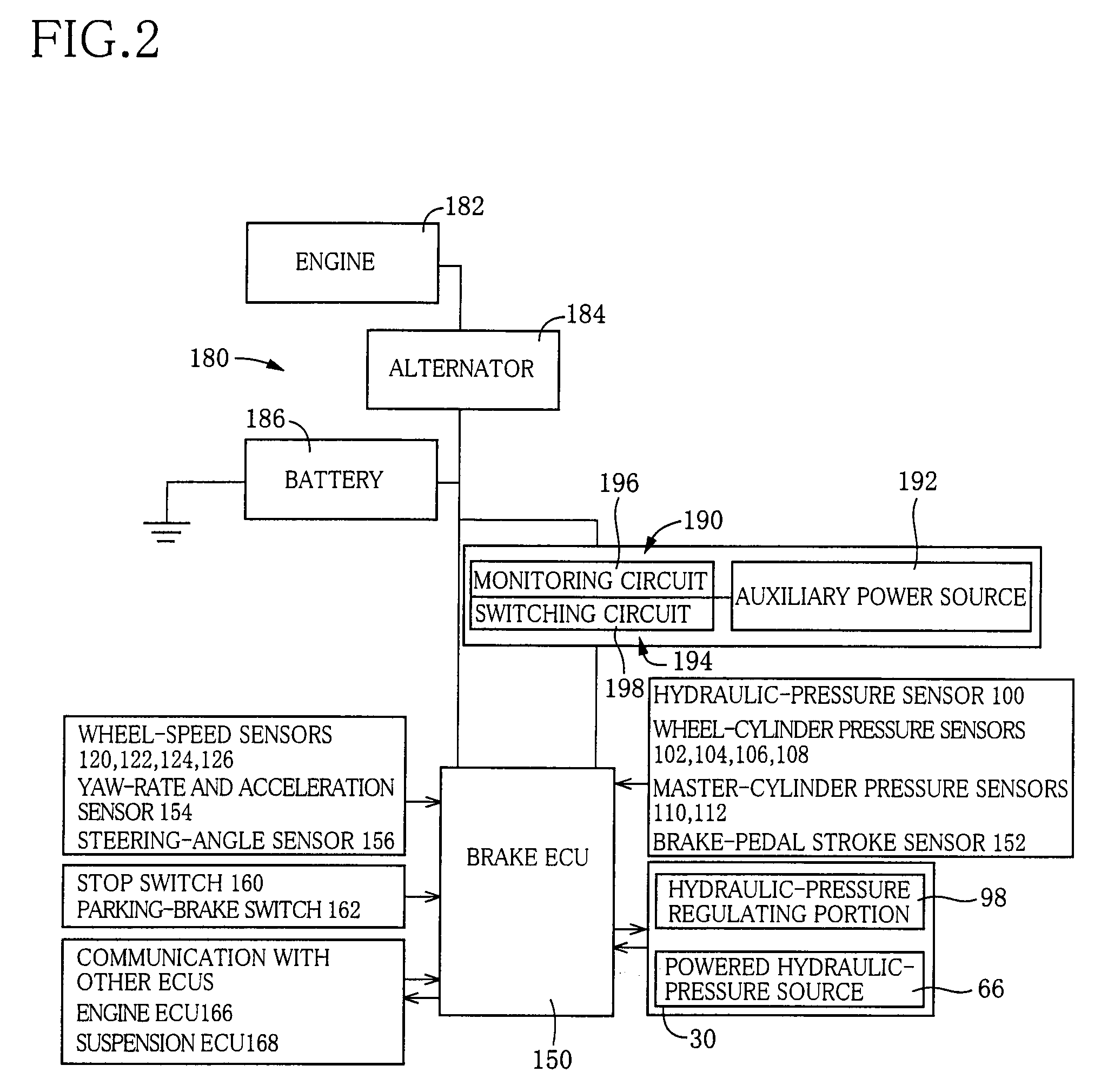
[0082]As is apparent from the foregoing description of the brake control apparatus, a portion of the brake ECU 150 that carries out Step S4 provides a vehicle-stopped-state detecting portion; a portion of the brake ECU 150 that carries out Step S9 provides a hydraulic-pressure limiting portion as a brake-operation-force limiting portion; and a portion of the brake ECU 150 that carries out Step S10 provides a gradient restraining portion. In addition, a portion of the brake ECU 150 that carries out Step S21 provides a detecting portion that detects that a power source is ineffective; a portion of the brake ECU 150 that carries out Step S23 cooperates with the detecting portion to provide a sensor-disablement judging portion as a sensor-ignoring judging portion; a portion of the brake ECU 150 that carries out Step S24 provides a sensor ignoring (disabling) portion; and a portion of the brake ECU 150 that carries out Step S1 provides a limitation canceling portion. Moreover, a portion ...
second embodiment
[0094]As is apparent from the foregoing description of the brake control apparatus, a portion of the brake ECU 150 that carries out Step S57 provides a cranking detecting portion; a portion of the brake ECU 150 that carries out Step S60 provides a hydraulic-pressure limiting portion as a brake-operation-force limiting portion; a portion of the brake ECU 150 that carries out Step S58 or S62 provides a detecting portion that detects that the power source is ineffective, or a sensor ignoring (disabling) portion; a portion of the brake ECU 150 that carries out Step S61 provides a limitation (or restriction) canceling portion; and a portion of the brake ECU 150 that carries out Step S63 or S64 provides a gradient restraining portion.
third embodiment
[0095]The rapid change of the operation force of the brake, caused by the cancellation of the limitation (or restriction) to the operation force, may be restrained by controlling the wheel-cylinder pressure under a second upper limit (i.e., a second restricted value) of the wheel-cylinder pressure for the ineffective state of the power source and is somewhat higher than the above-described, i.e., first upper limit (i.e., a first restricted value) of the wheel-cylinder pressure for the stopped state of the vehicle. This feature is embodied as a third embodiment shown in FIGS. 9 and 10.
[0096]The third embodiment differs from the second embodiment shown in FIGS. 7 and 8, only in that the third embodiment employs, in place of the braking control routine of FIG. 7, a braking control routine of FIG. 9 in which Steps S81 through S92 and S94 are identical with Steps S51 through S62 and S64, respectively, and only Step S93 replaces Step S63. At Step S93, the brake ECU 150 controls the wheel-...
PUM
 Login to View More
 Abstract
Description
Claims
Application Information
 Login to View More