
Reduction of cardiovascular symptoms
a technology of ikr and ikr, applied in the field of reducing cardiovascular symptoms, can solve the problems of sudden death, sudden loss of consciousness, and contribution of ikr /sub>to the increase of the duration of the qt interval, and achieve the effect of reducing the proarrhythmic effect of drugs and reducing or inhibiting ikr
Patent Information
- Authority / Receiving Office
- US · United States
- Patent Type
- Applications(United States)
- Current Assignee / Owner
- Publication Date
- 2008-06-26
- Estimated Expiration
- Not applicable · inactive patent
Smart Images
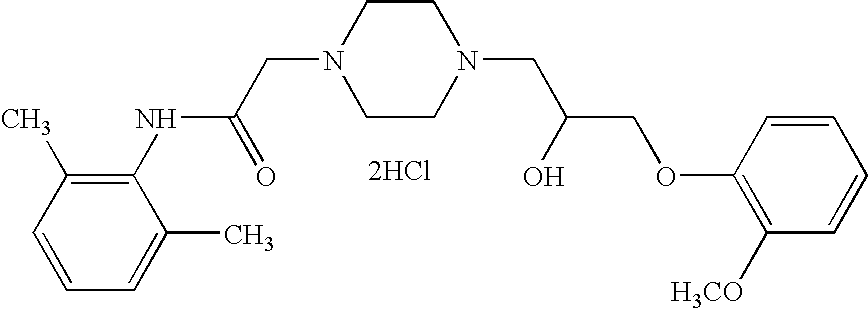
Figure 1 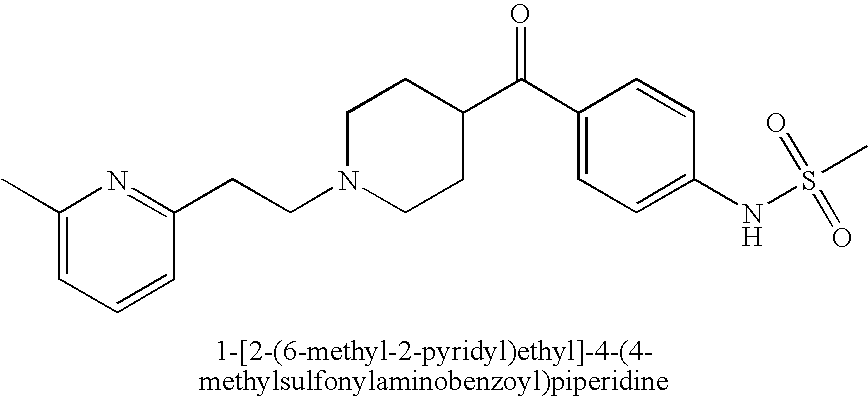
Figure 2 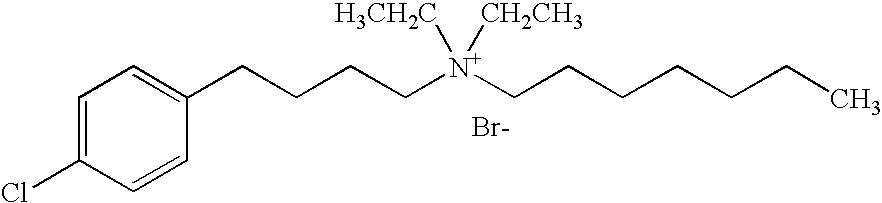
Figure 3
Abstract
Description
[0001] This application claims priority to U.S. Provisional Patent Application Ser. No. 60 / 876,331, filed Dec. 21, 2006, and to U.S. Provisional Patent Application Ser. No. 60 / 898,019, filed Jan. 29, 2007, the entireties of both of which are incorporated herein by reference.FIELD OF THE INVENTION
[0002] This invention relates to methods for treating patients with a dysfunction of the ion channels of the heart suffering from one or more cardiovascular diseases to reduce the proarrhythmic effect of drugs and / or conditions that reduce or inhibit IKr, comprising administering ranolazine to these patients. In one embodiment, the presenting patient exhibits down-regulated or inhibited IKr, caused by drugs including, but not limited to, E-4031, clofilium, dofetilide and cisapride. In a further embodiment the presenting patient exhibits down-regulated or inhibited IKr caused by a dysfunction of the ion channels of the heart such as LQTS.DESCRIPTION OF THE ART
[0003] U.S. Pat. No. 4,567,264, the ...
Examples
example 1
[0071]In the present example, female rabbit hearts were isolated and paced at 1 Hz and exposed to E-4031 (1-60 nM) in the absence and presence of TTX (0.1-3 μM) and ranolazine (5-30 μM). Monophasic action potentials (MAP) from both epicardium and endocardium, and 12-lead ECG signals were recorded continuously.
[0072]E-4031 (1-60 nM), in a concentration-dependent manner, was found to prolong the duration of epicardial MAP (MAPD90) by 75±5 ms from 180±3 to 254±6 ms (n=21, p<0.001), and increase transmural MAPD dispersion by 74±7 ms from 18±4 to 90±10 ms (n=21, p<0.001). Spontaneous or 3-sec pause triggered polymorphic ventricular tachycardias (TdP) occurred in 19 of 21 (90%) hearts studied.
[0073]Ranolazine (5-30 μM) was found to concentration-dependently prolong the epicardial MAPD90 by 32±4% (n=7, p90. TTX (0.1-3 μM) had no effects on MAPD90 or transmural dispersion of MAPD90 (n=5, p>0.05).
[0074]In the presence of 60 nM E-4031, ranolazine (10 μM) shortened the MAPD90 and decreased the...
example 2
[0076]This study was undertaken to investigate the effects of ranolazine (RAN) on clofilium-induced Torsades de Pointes (TdP) in vivo.
[0077]Spontaneous TdP was induced with methoxamine (α1-adrenoceptor agonist) followed by clofilium (Ikr blocker) in anesthetized rabbits as previously described by Carlsson et al (J. Cardiovas. Pharmacol 1990; 16:276-285). RAN was given via intravenous (iv) infusion 10 min prior to clofilium. Arterial pressure (BP), lead II ECG and endocardial Monophasic Action Potential (MAP) were recorded. QT interval was corrected for heart rate by using a formula developed for rabbits: QTc=QT−0.175*(RR−300).
[0078]Clofilium prolonged QTc (130±4 to 200±18 ms, n=6, P90 (123±6 to 201±21 ms, n=6, P50 values of 10, 15 and 10 μM, respectively. RAN at 25 μM completely prevented the occurrence of TdP (0 / 6, P0.05, respectively). Because RAN has been reported to have weak α1-antagonistic activity we compared the pressor effects of RAN on BP to that of prazosin. While α1-adre...
example 3
[0080]Human-ether-a-go-go related gene (HERG) encodes the cardiac rapidly activating delayed rectifier K+ current (IKr). Inhibition of HERG K+ current (IHERG) is a mechanism for drug-induced long QT syndrome. This study was undertaken to study the kinetics of ranolazine block of IHERG at 23° C. using voltage-clamp analysis of HERG channels expressed in HEK293 cells. Block of IHERG by ranolazine was reversible and voltage-dependent, but frequency-independent. Block developed rapidly following channel activation, suggesting state-dependence. At 0 mV, the time constants for development of block were 76.6±1.6, 35.8±2.4, and 19.4±1.7 msec in 10, 30, and 100 μM ranolazine (n=4), respectively. The time course of ranolazine-induced IHERG decay was used to estimate the apparent dissociation constant (14.2 μM). Following repolarization, ranolazine-induced block of IHERG reversed rapidly. At −80 and −100 mV, recovery from block followed a monophasic time course with τ values of 204.3±51.5 and ...