

Echogenic microbubbles and microemulsions for ultrasound-enhanced nanoparticle-mediated delivery of agents
a nanoparticle and nanoparticle technology, applied in the field of biotechnology and medicine, can solve the problems of poor blood supply to the tumor volume, and achieve the effects of preventing drug uptake, prolonging the retention of the drug in the tumor, and enhancing the ultrasonic treatment of vascular thrombosis
- Summary
- Abstract
- Description
- Claims
- Application Information
AI Technical Summary
Benefits of technology
Problems solved by technology
Method used
Image

Examples
example 1
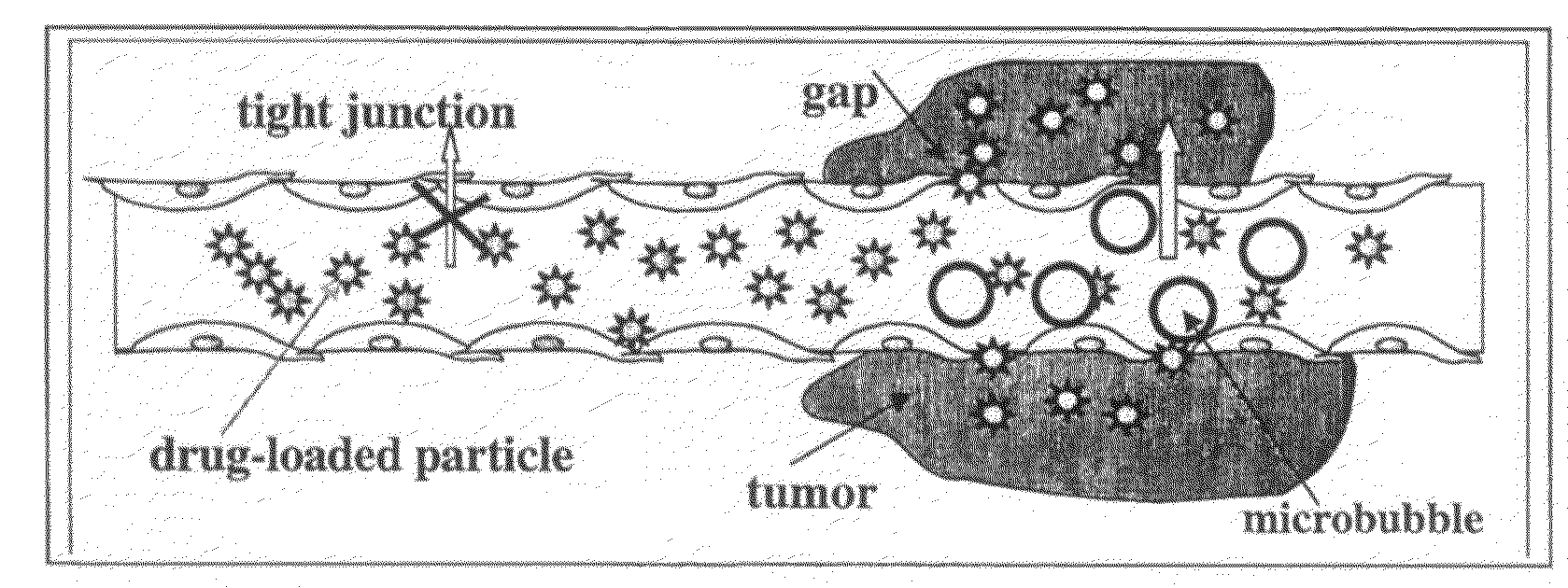
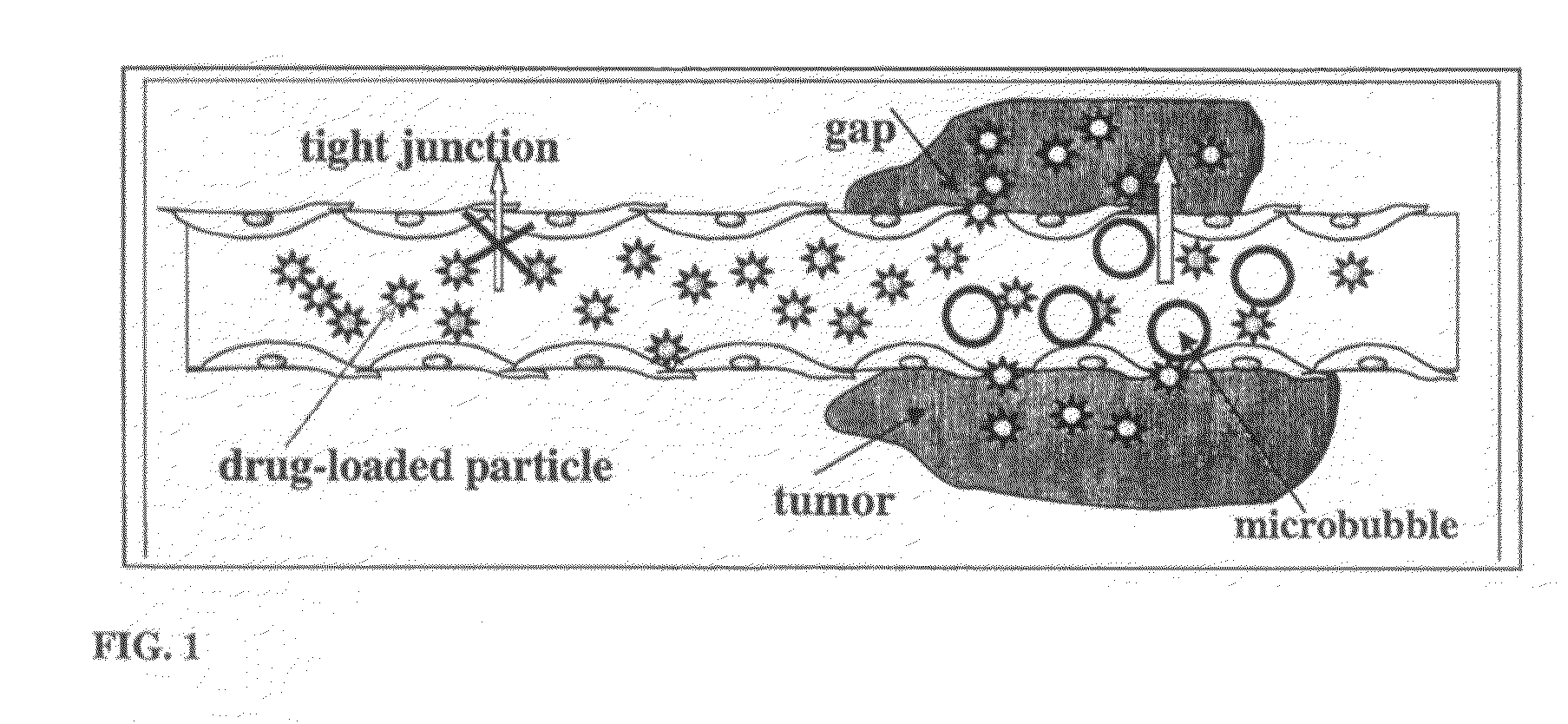
Schematic Representation of Drug Targeting to Tumors Using Micelle / microbubble Systems Disclosed Herein
[0088]Drug targeting is based on the abnormal permeability of the tumor blood vessels due to relatively large gaps between endothelial cells (See, FIG. 1). Micelles and probably also small nanobubbles (up to 500 nm diameter, depending on the tumor type) extravasate and accumulate in the tumor interstitium. Larger nano / microbubbles remain in the circulation. Under tumor-localized therapeutic ultrasound, they serve as cavitation nuclei, triggering drug release from micelles and nanobubbles in the tumor interstitium and enhancing the intracellular drug uptake by the tumor cells.
example 2
Synthesis of PEG / PLLA Diblock Copolymers
[0089]A library of amphiphilic PEG / PLLA diblock copolymers were synthesized by ring opening polymerization of L-lactide, initiated using the hydroxyl group of PEG monoacid in the presence of stannous octanoate as a catalyst. (See, Yamamoto, Y. et al., J. Contr. Release, 77:27-38 (2001); Kim, S C, et al., Particulate Drug Delivery, Samyang Pharmaceuticals R&D, Taejeon, 305-348, 2005, South Korea).
[0090]By varying the ratio of L-lactide to PEG, and the molecular weight of PEG, the PLLA block length and PEG-PLLA block length ratios are varied. The copolymers with the following block length were synthesized:
[0091]PEG: 2000 Da, 5000 Da
[0092]PLLA: 1000 Da, 2000 Da, 3000 Da, 5000 Da
example 3
Characterization of PLLA / PEG Diblock Polymer by NMR and GPC
[0093]Reaction products are analyzed by 1H-NMR (300 MHz). The Mn (median) and molecular weight distribution (Mw / Mn) of the synthesized copolymers are measured by gel permeation chromatography.
PUM
 Login to View More
 Abstract
Description
Claims
Application Information
 Login to View More