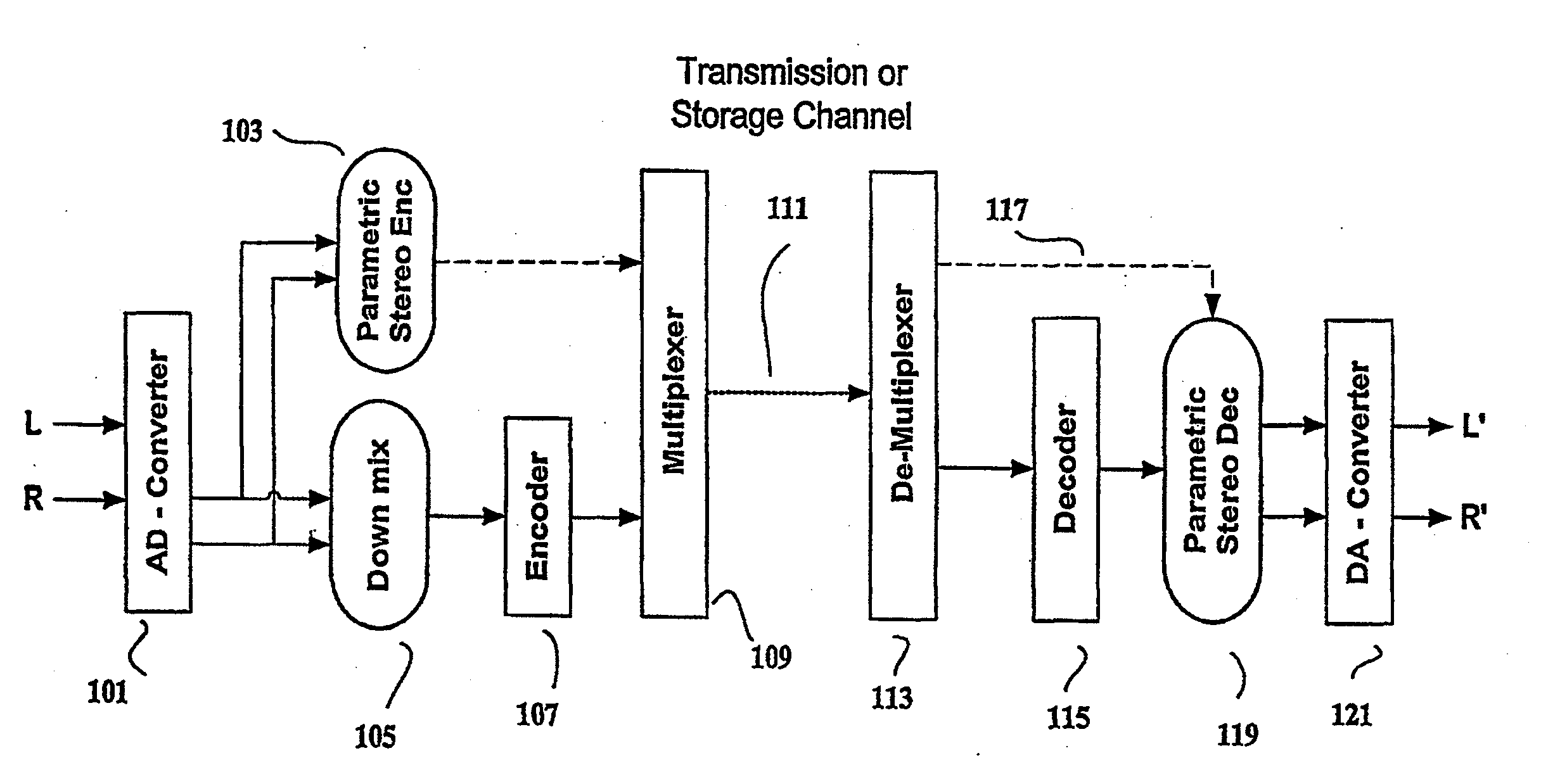
[0008]The present invention employs detection of signal stereo properties prior to coding and transmission. In the simplest form, a
detector measures the amount of stereo perspective that is present in the input stereo signal. This amount is then transmitted as a stereo width parameter, together with an encoded mono sum of the original signal. The
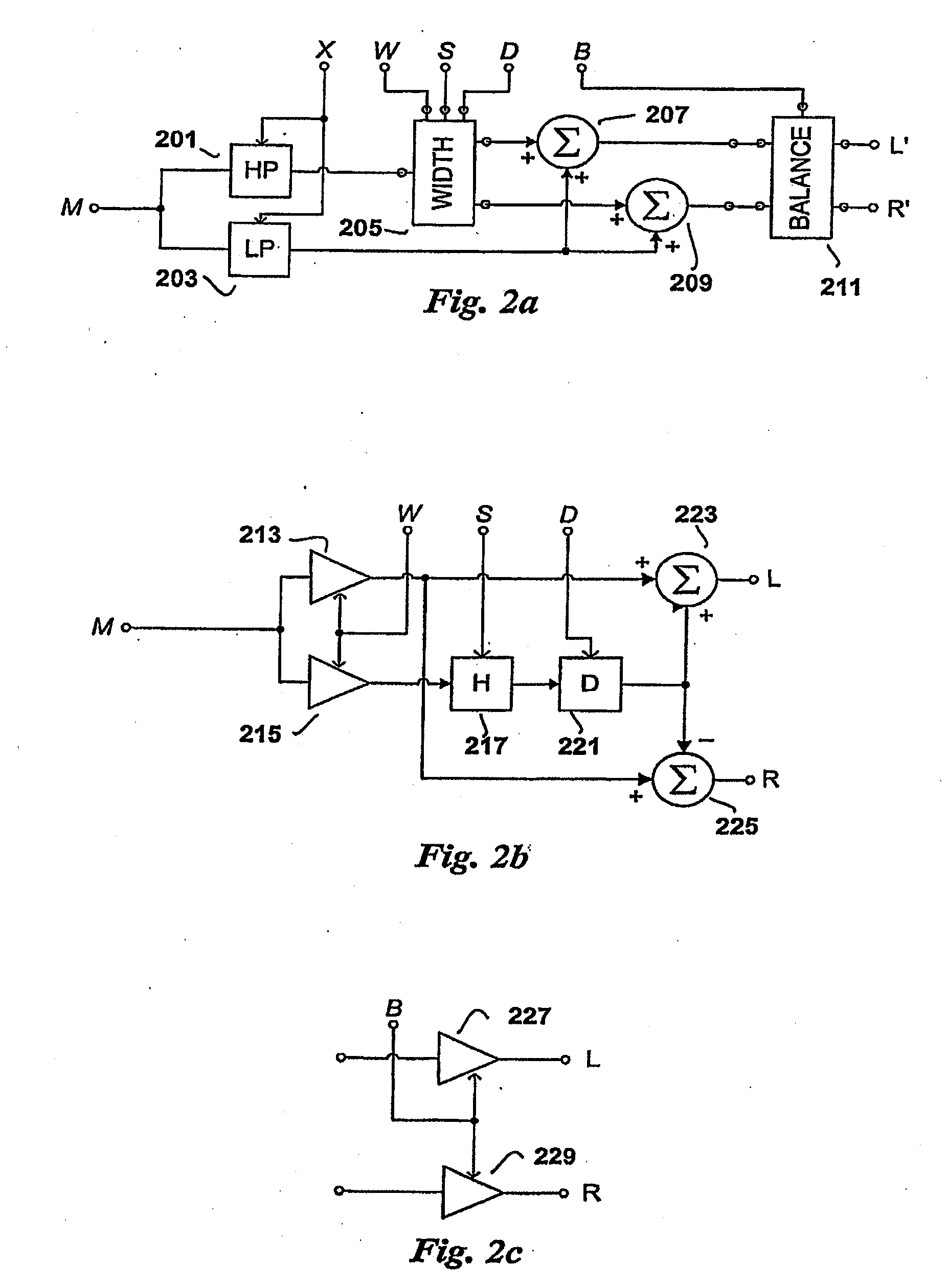
receiver decodes the mono signal, and applies the proper amount of stereo-width, using a pseudo-stereo generator, which is controlled by said parameter. As a special case, a mono input signal is signaled as zero stereo width, and correspondingly no stereo synthesis is applied in the decoder. According to the invention, useful measures of the stereo-width can be derived e.g. from the difference signal or from the cross-correlation of the original left and right channel. The value of such computations can be mapped to a small number of states, which are transmitted at an appropriate fixed rate in time, or on an as-needed basis. The invention also teaches how to filter the synthesized stereo components, in order to reduce the risk of unmasking
coding artifacts which typically are associated with low bitrate coded signals.
[0009]Alternatively, the overall stereo-balance or localization in the stereo field is detected in the
encoder. This information, optionally together with the above width-parameter, is efficiently transmitted as a balance-parameter, along with the encoded mono signal. Thus, displacements to either side of the sound stage can be recreated at the decoder, by correspondingly altering the gains of the two output channels. According to the invention, this stereo-balance parameter can be derived from the quotient of the left and right signal powers. The transmission of both types of parameters requires very few bits compared to full stereo coding, whereby the total bitrate demand is kept low. In a more elaborate version of the invention, which offers a more accurate
parametric stereo depiction, several balance and stereo-width parameters are used, each one representing separate frequency bands.
[0010]The balance-parameter generalized to a per frequency-band operation, together. with a corresponding per band operation of a level-parameter, calculated as the sum of the left and right signal powers, enables a new, arbitrary detailed, representation of the power
spectral density of a stereo signal. A particular benefit of this representation, in addition to the benefits from stereo redundancy that also S / D-systems take
advantage of, is that the balance-signal can be quantized with less precision than the level ditto, since the quantization error, when converting back to a stereo
spectral envelope, causes an “error in space”, i.e. perceived localization in the stereo
panorama, rather than an error in level. Analogous to a traditional switched L / R- and S / D-
system, the level / balance-scheme can be adaptively switched off, in favor of a levelL / levelR-signal, which is more efficient when the overall signal is heavily offset towards either channel. The above
spectral envelope coding scheme can be used whenever an efficient coding of power spectral envelopes is required, and can be incorporated as a tool in new stereo source codecs. A particularly interesting application is in HFR systems that are guided by information about the original signal highband envelope. In such a
system, the lowband is coded and decoded by means of an arbitrary codec, and the highband is regenerated at the decoder using the decoded lowband signal and the transmitted highband envelope information [PCT WO 98 / 57436]. Furthermore, the possibility to build a scalable HFR-based stereo codec is offered, by locking the envelope coding to level / balance operation. Hereby the level values are fed into the primary
bitstream, which, depending on the implementation, typically
decodes to a mono signal. The balance values are fed into the secondary
bitstream, which in addition to the primary
bitstream is available to receivers close to the
transmitter, taking an IBOC (In-Band On-Channel) digital AM-
broadcasting system as an example. When the two bitstreams are combined, the decoder produces a stereo output signal. In addition to the level values, the primary bitstream can contain stereo parameters, e.g. a width parameter. Thus, decoding of this bitstream alone already yields a stereo output, which is improved when both bitstreams are available.


 Login to View More
  Login to View More