
Plasma processing apparatus
a processing apparatus and plasma technology, applied in the direction of electrical apparatus, electrical discharge tubes, basic electric elements, etc., can solve the problem of inability to control uniform temperature of electrode samples, in-plane temperature of electrode samples to be processed, etc., to inhibit excessive heat exchange
- Summary
- Abstract
- Description
- Claims
- Application Information
AI Technical Summary
Benefits of technology
Problems solved by technology
Method used
Image

Examples
first embodiment
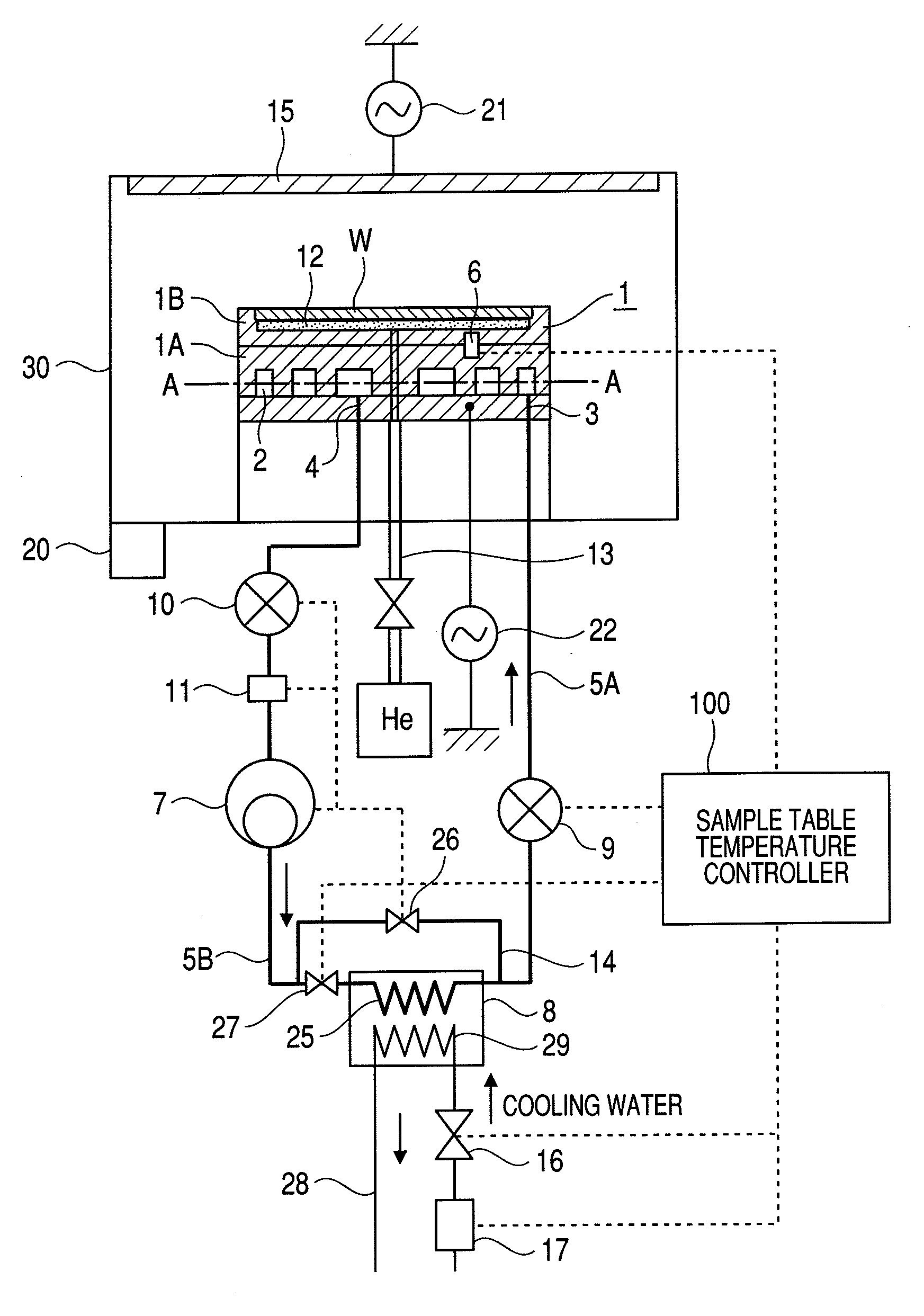
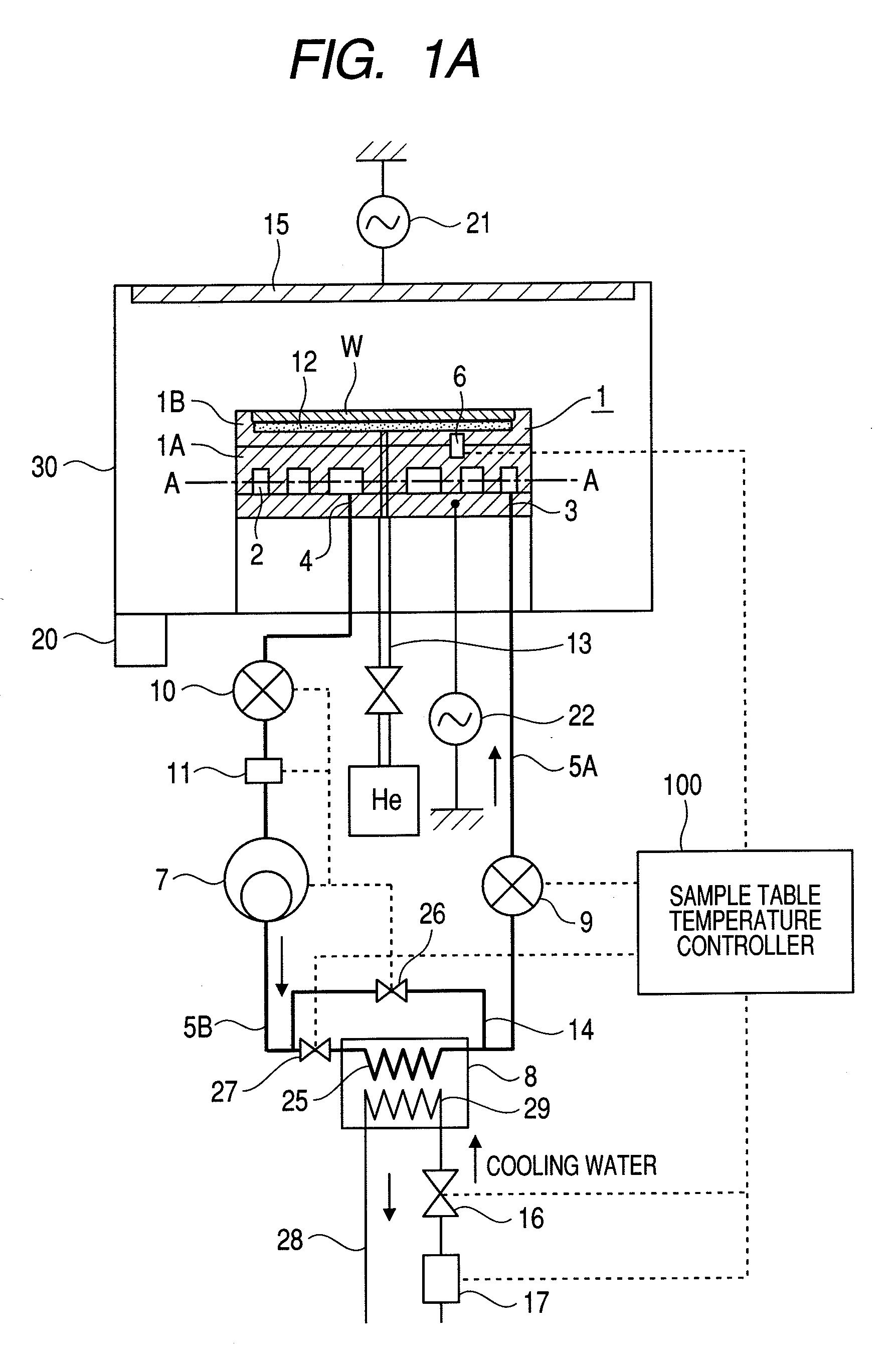
[0032]A first embodiment wherein the present invention is applied to a plasma processing apparatus as a cooling cycle to control the temperature of a sample table is explained in reference to FIGS. 1A to 5C.
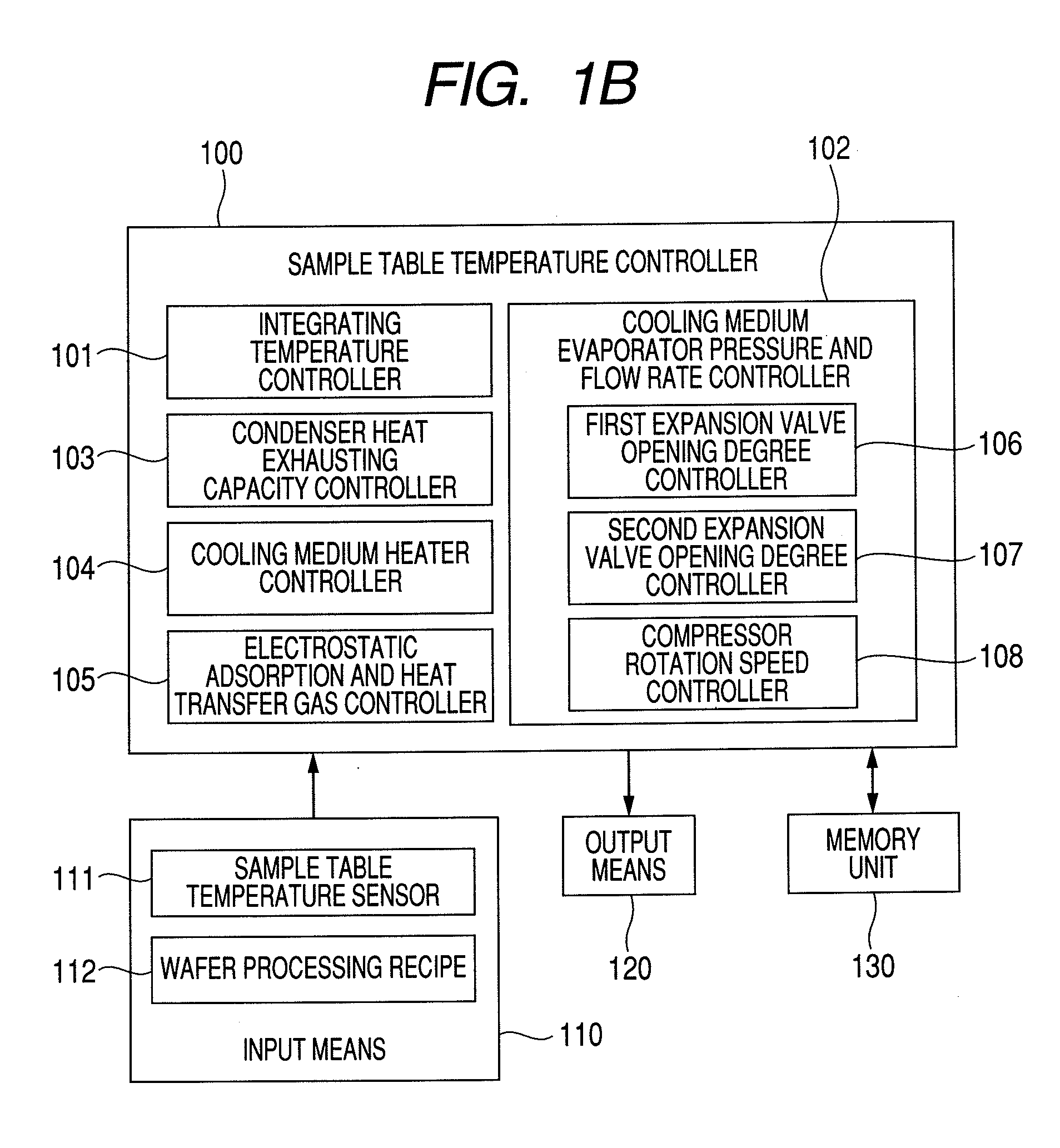
[0033]FIG. 1A is a schematic diagram showing a general system configuration of a plasma processing apparatus according to the first embodiment of the present invention. The plasma processing apparatus has a processing chamber 30 installed in a vacuum chamber and a sample table 1 having an electrostatic adsorption electrode is placed in the processing chamber 30. Further, a vacuum evacuator 20, such as a vacuum pump, to evacuate and decompress the interior thereof is connected to the processing chamber 30. An electrode plate 15 is installed at the upper part of the processing chamber 30 and an antenna power source 21 to supply high-frequency power is connected to the electrode plate 15. Here, at the upper part of the processing chamber 30, a gas introducing means, such as a shower...
second embodiment
[0069]As the second embodiment according to the present invention, an embodiment wherein the present invention is applied to a plasma processing apparatus as a heat pump cycle to control temperature in both heating and cooling of a sample table is explained in reference to FIGS. 6 (FIGS. 6A and 6B) and 7.
[0070]When a heat pump cycle is used as a cooling cycle in the second embodiment, the basic configuration and function are the same as those of the cycle adopted in the first embodiment (refer to FIG. 1). An example of a switching mechanism of supply / discharge ports connected to a refrigerant flow passage 2 and controlled by a refrigerant supply / discharge direction switching control means 142 is shown in FIG. 6. The heat pump cycle includes a first heat exchanger (a refrigerant flow passage formed in a sample table 1) 2, a compressor 7, a second heat exchanger (a condenser) 8, a first expansion valve 9, a second expansion valve 10, and a refrigerant evaporating heater 11 (in a direc...
third embodiment
[0081]As the third embodiment of the present invention, an example of a direct-expansion type cycle equipped with void ratio measuring devices is explained in reference to FIGS. 8 to 10.
[0082]Firstly, the flow mode of the refrigerant used in the present embodiment is shown in FIG. 8. In FIG. 8, (a) shows the relationship between a degree of dryness and a heat transfer coefficient, (b) shows the relationship between a degree of dryness and a void ratio, and (c) shows the flow mode of the refrigerant in a cooling cycle. In general, a refrigerant of a hydrofluorocarbon type used in a cooling cycle shows the same trend as shown in FIG. 8. In the cooling cycle, the flow mode of the refrigerant changes from a liquid to a gas-liquid two-phase and then to a gas. On this occasion, bubbles, namely a void ratio, increases in the refrigerant in proportion to the change of the flow mode. The void ratio is 0 when the refrigerant is a liquid and is 1 when the refrigerant is thoroughly a gas. Conse...
PUM
| Property | Measurement | Unit |
|---|---|---|
| temperature | aaaaa | aaaaa |
| temperature | aaaaa | aaaaa |
| temperature controllability | aaaaa | aaaaa |
Abstract
Description
Claims
Application Information
 Login to View More