Di- and mono-alkoxysilane functionalized polymers and their application in the bayer process
- Summary
- Abstract
- Description
- Claims
- Application Information
AI Technical Summary
Benefits of technology
Problems solved by technology
Method used
Image

Examples
example 1
Polypropylene bottles and a temperature controlled rotary water bath were used under isothermal conditions for batch desilication experiments. Synthetic spent Bayer liquor was prepared on the same day or one day prior to the experiment. Typical analysis for the synthetic liquor used was:
Alumina (A): 84.62 g / L as Al2O3;
Caustic (C): 238.42 g / L as Na2CO3;
Ratio of A to C, 0.355.
A series of tests were conducted by adding a silane based polymer to the bottles containing synthetic spent Bayer liquor (50 mL). The synthetic liquor was heated in the water bath and as the desired temperature (95° C.) was reached, sodium metasilicate solution was added. (A calculated amount to give the starting SiO2 concentration of 0.05M was added.) The resulting solutions were heated and held at 95° C. for the duration of the test (4 hours). Samples of the synthetic liquor were then removed.
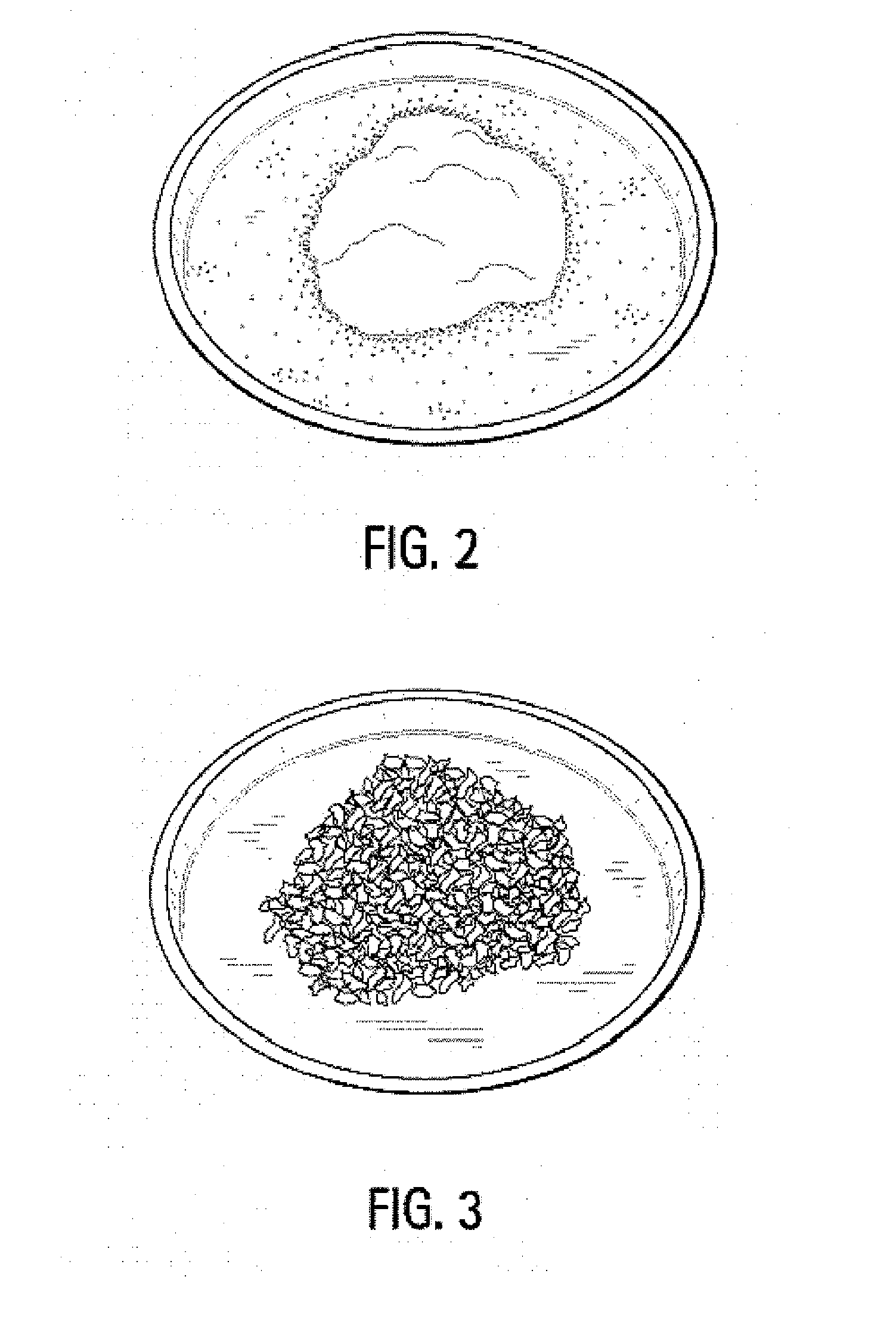
Morphology was assessed by visual inspection of the crystalline material resulting from each test.
One of the polymer inh...
example 2
Another dialkoxysilane modified polymer was synthesized by a method similar to the method disclosed in Example 2 of Published International Patent Application WO 2008 / 045677. 10.0 g of polyethyleneimine (Lupasol WF, BASF) is first diluted in 10.0 g of ethyl alcohol to reduce the viscosity, and then mixed with 2.19 g of glycidoxypropylmethyldimethoxysilane (instead of the trialkyloxy polymer used in WO2008 / 045677), and 0.64 g glycidyl 4-nonylphenylether. The mixture was maintained at 60° C. for 1 hour and then dissolved in 2% NaOH to make a 10% dialkyloxysilane modified polyethyleneimine. In contrast, whether it was or was not diluted with alcohol, the reaction mixture gelled in 45 minutes if glycidoxypropyltrimethoxysilane is used. The gelled product is very difficult to dissolve in NaOH and therefore very difficult to transfer out of reactors.
The dialkyloxysilane modified polyethyleneimine was tested in true Bayer process spent liquor. The true Bayer liquor had a caustic concentrat...
example 3
Referring now to FIGS. 4, 5 and 6 there are shown SEM (Scanning Electron Microscope) images of DSP from true Bayer process liquor. FIG. 4 shows DSP from a control sample with no scale inhibitor. The untreated DSP in the control is small fine particles which easily accumulate on process equipment. FIG. 6 shows DSP treated by the prior art inhibitor disclosed in WO2008 / 045677 and FIG. 7 shows DSP treated by the inventive dialkyloxy silane polymer. In both FIGS. 6 and 7 it is shown that the inhibitors reduce the fouling effects of DSP by altering its morphology and size. The inhibited DSP particles are much larger spheres which aggregate into flakes that do not accumulate as readily on Bayer process equipment. A side effect of the treatment of Bayer liquor with these inhibitors is the production of cubes of sodium aluminum silicate crystals.
While this invention may be embodied in many different forms, there are shown in the drawings and described in detail herein specific preferred emb...
PUM
 Login to View More
 Abstract
Description
Claims
Application Information
 Login to View More
 - R&D
- Intellectual Property
- Life Sciences
- Materials
- Tech Scout
- Unparalleled Data Quality
- Higher Quality Content
- 60% Fewer Hallucinations
Browse by: Latest US Patents, China's latest patents, Technical Efficacy Thesaurus, Application Domain, Technology Topic, Popular Technical Reports.
© 2025 PatSnap. All rights reserved.Legal|Privacy policy|Modern Slavery Act Transparency Statement|Sitemap|About US| Contact US: help@patsnap.com