Unlock instant, AI-driven research and patent intelligence for your innovation.

Cochlear implant with improved electrode array and controller

a controller and electrode array technology, applied in the field of cochlear implants, can solve the problems of significantly impaired or non-existent auditory response, very different operation from the natural hearing mechanism of the ear, and distortion initiates electrical impulses in the hair cells

Active Publication Date: 2011-04-28
NEW YORK UNIV
View PDF0 Cites 21 Cited by
  • Summary
  • Abstract
  • Description
  • Claims
  • Application Information

AI Technical Summary

Benefits of technology

[0012]In another aspect, the invention provides a method of inserting a cochlear implant. The method includes providing a multi-joint robot comprised of a series of actuator units, placing the deformable and stretchable flexible strip about the outer surface of the multi-joint robot, guiding the multi-joint robot into an inner ear of a patient, monitoring the position of the multi-joint robot relative to a non-conductive portion of the patient; and applying current to the multi-joint robot so as to adjust one of the yaw and pitch position of one or more of the actuator units.

Problems solved by technology

It is believed that such distortion initiates electrical impulses in the hair cells.
When this occurs, though the structures of the cochlea may otherwise be substantially intact, and the auditory nerve may be partially or completely intact, the auditory response is significantly impaired or non-existent.
First, its operation is very different from the natural hearing mechanism of the ear.
For example, the conventional electrode assembly cannot stimulate auditory nerve fibers throughout the full length of the basilar membrane.
This accounts for reported limitations regarding sound frequencies that a user of the implant can perceive.
Another significant disadvantage of the conventional cochlear implant is that the installation of the cochlear implant can damage cochlear structures.
During initial insertion, for example, the basilar membrane may be injured.
Furthermore, additional damage may result inside the cochlea when the endolymph is perturbed.
The resulting damage to the cochlear structure, including the basilar membrane, may make replacement of the implant, or substitution of an improved implant that may be developed in the future, difficult, if not impossible, and may cause permanent loss of residual hearing.
Obviously, this strategy cannot be used in a patient with normal hearing in the high frequency range, having poor or no hearing of low frequency sounds.
Conventional techniques such as intra-operative and post-hoc imaging using low resolution computer tomography are insufficient to prevent damage to the basilar membrane during insertion.
Further, missing from the art is a cochlear implant having an array of electrodes that achieve a finer frequency resolution across a wider band.

Method used

the structure of the environmentally friendly knitted fabric provided by the present invention; figure 2 Flow chart of the yarn wrapping machine for environmentally friendly knitted fabrics and storage devices; image 3 Is the parameter map of the yarn covering machine
View more

Image

Smart Image Click on the blue labels to locate them in the text.
Viewing Examples
Smart Image
  • Cochlear implant with improved electrode array and controller
  • Cochlear implant with improved electrode array and controller
  • Cochlear implant with improved electrode array and controller

Examples

Experimental program
Comparison scheme
Effect test

Embodiment Construction

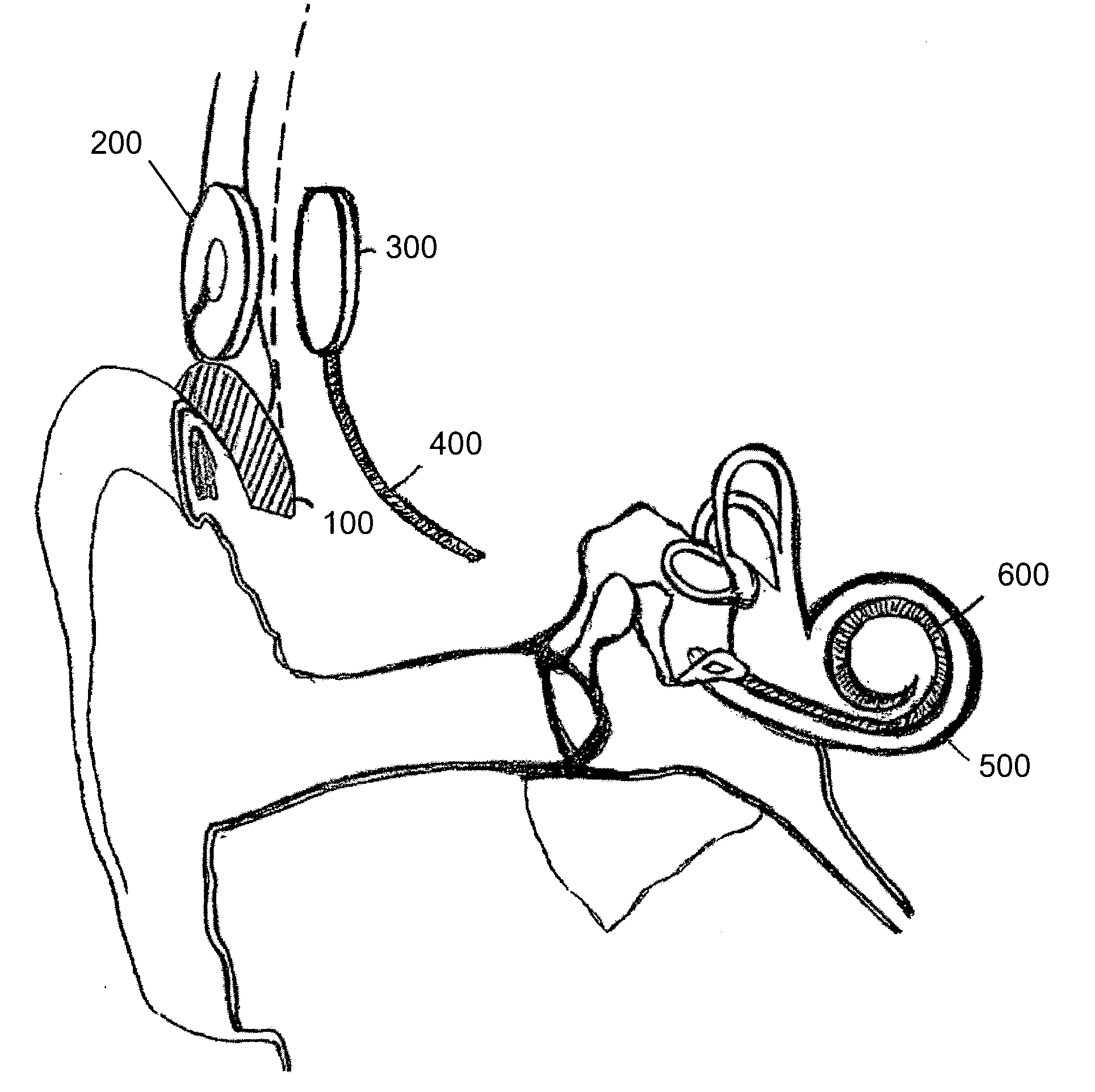
[0026]By way of overview and introduction, embodiments of the invention address the spiral ganglion cells with more electrodes to achieve a finer frequency resolution. To achieve this finer signal, a large number of electrodes are desirable. Accordingly, embodiments of the invention are directed to a spiral strip cochlear implant, which can have hundreds of electrodes located on the outside surface. Using microlithography as a fabrication method for 2D patterning, microlithography-based micro electrode arrays are able to provide the cochlear implant with more electrodes than in conventional methods. However, because microlithography is a fabrication method for 2D patterning, additional methods such as rolling or wrapping are necessary to build a 3D tubular structure that will fit the cochlear duct. Combining hundreds of electrodes and an optimized electrode configuration, a cochlear implant embodying the invention can pass more finely tuned current to auditory nerves for a greater f...

the structure of the environmentally friendly knitted fabric provided by the present invention; figure 2 Flow chart of the yarn wrapping machine for environmentally friendly knitted fabrics and storage devices; image 3 Is the parameter map of the yarn covering machine
Login to View More

PUM

No PUM Login to View More

Abstract

A cochlear implant device includes a deformable and stretchable flexible strip composed of a biological compatible material and positioned about a longitudinal axis so as to form a spiral. The implant device has a plurality of conductive strips with electrode windows formed so as to expose a segment of each conductive strip. A density of the electrode windows is sufficient to monitor a distance of the flexible strip from a non-conductive tissue of a patient in a 360 degree field of view about the longitudinal axis. A method of inserting a cochlear implant includes providing a multi-joint robot comprised of a series of actuator units, guiding the multi-joint robot into an inner ear of a patient, monitoring the position of the multi-joint robot relative to a non-conductive portion of the patient; and applying current to the multi-joint robot so as to adjust the position of the actuator units.

Description

FIELD OF THE INVENTION[0001]The present invention relates generally to a cochlear implant, and more particularly to a cochlear implant with an increased array of electrodes so as to achieve a finer frequency resolution.BACKGROUND OF THE INVENTION[0002]The cochlea of the human ear contains hair cells that are essential to the perception of sound. These hair cells are found along substantially the full length of the spiral path followed by the cochlea. Sound vibrations distort certain structures of the cochlea which in turn distort the hair cells. It is believed that such distortion initiates electrical impulses in the hair cells. These impulses are conveyed to the fibers of the auditory nerve and ultimately to the brain.[0003]Some instances of human hearing loss are attributed to extensive destruction of the hair cells. When this occurs, though the structures of the cochlea may otherwise be substantially intact, and the auditory nerve may be partially or completely intact, the audito...

Claims

the structure of the environmentally friendly knitted fabric provided by the present invention; figure 2 Flow chart of the yarn wrapping machine for environmentally friendly knitted fabrics and storage devices; image 3 Is the parameter map of the yarn covering machine
Login to View More

Application Information

Patent Timeline
no application Login to View More
Patent Type & Authority Applications(United States)
IPC IPC(8): A61F11/04A61N1/05A61B19/00
CPCA61B2562/125A61N1/0541A61B19/2203H05K2201/051H05K1/118A61B34/30
Inventor LLINAS, RODOLFO R.WATANABE, HIROBUMISUGIMORI, MUTSUYUKINAKAO, MASAYUKI
Owner NEW YORK UNIV
Features
  • R&D
  • Intellectual Property
  • Life Sciences
  • Materials
  • Tech Scout
Why Patsnap Eureka
  • Unparalleled Data Quality
  • Higher Quality Content
  • 60% Fewer Hallucinations
Social media
Patsnap Eureka Blog
Learn More