
FIBER-OPTIC, DIGITAL SYSTEM FOR LASER DOPPLER VIBROMETERS (LDVs)
a fiber optic and laser doppler technology, applied in the direction of instruments, using reradiation, and analysing solids using sonic/ultrasonic/infrasonic waves. it can solve the problems of small undesired vestigial sidebands, large inherent optical power loss, and high cos
- Summary
- Abstract
- Description
- Claims
- Application Information
AI Technical Summary
Benefits of technology
Problems solved by technology
Method used
Image

Examples
Embodiment Construction
[0021]I. System Overview
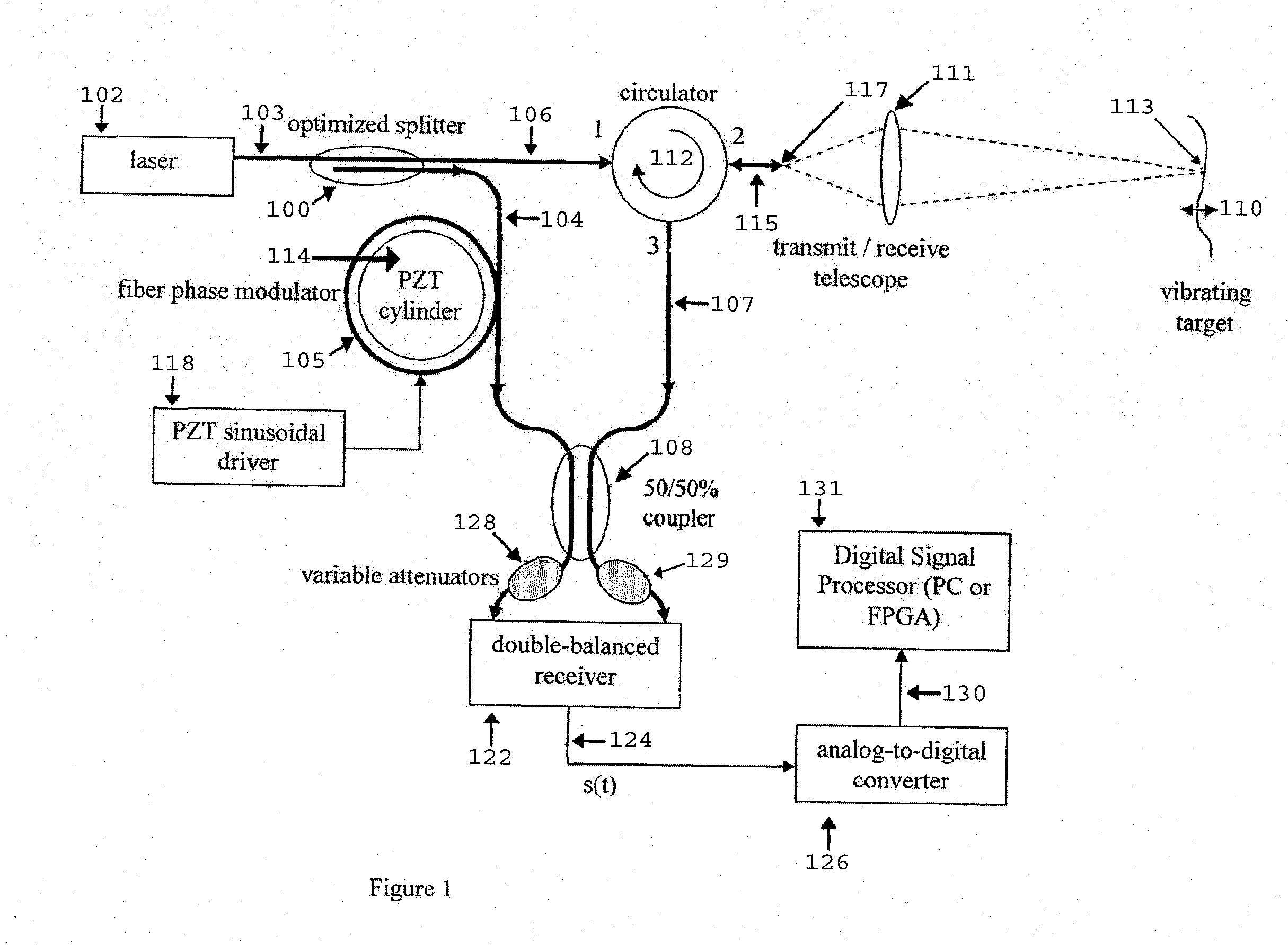
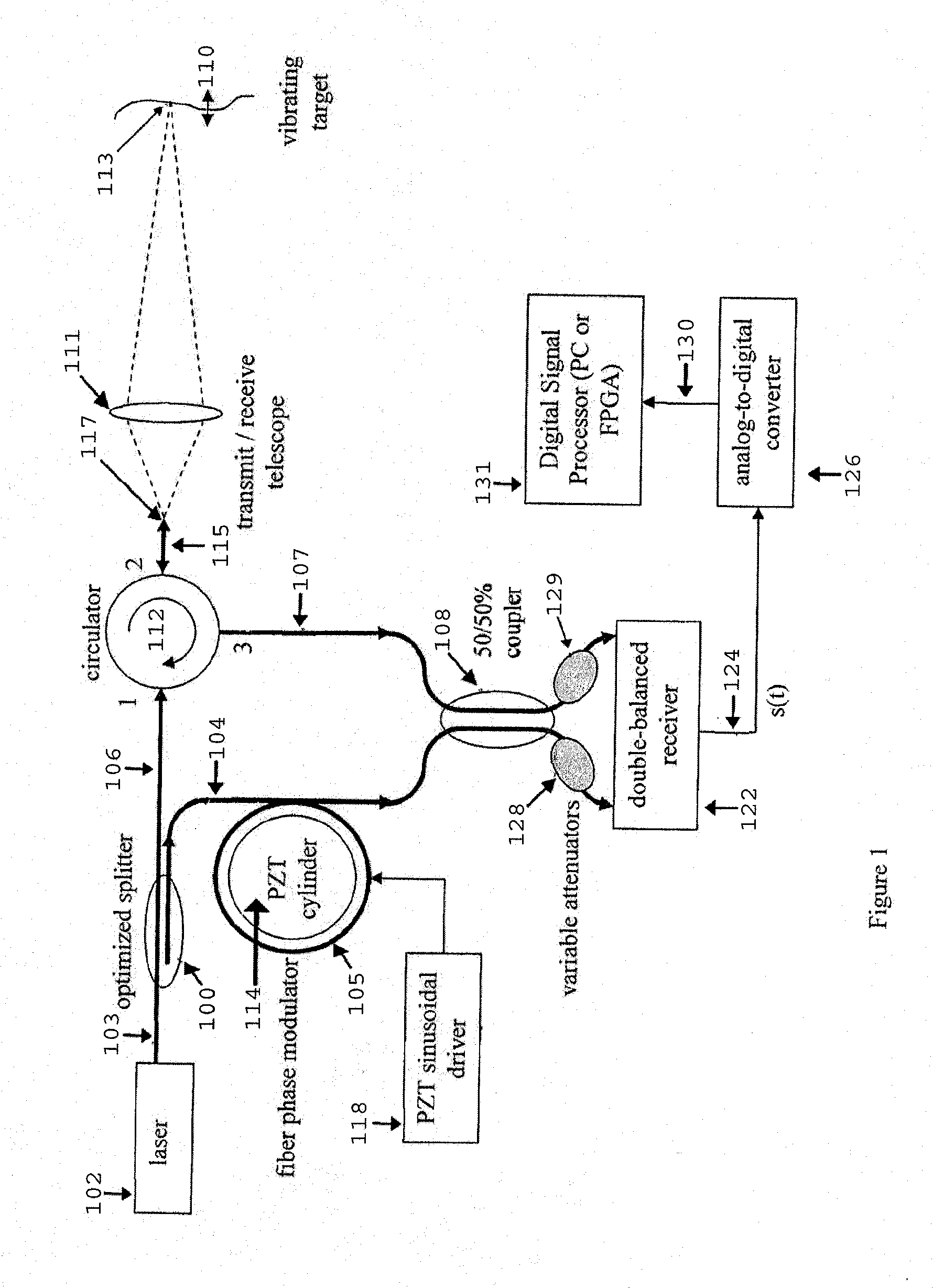
[0022]Interferometer: An interferometer based on a variant of the Mach-Zender interferometer includes a laser 102. A first beam splitter 100 in the interferometer separates a portion of a laser output 103 into a heterodyne reference beam 104 and a target beam 106. All beams described herein and in FIG. 1 are fundamental guided modes within polarization-maintaining single-mode fiber, except for the free-space portion indicated by dashed lines. A small portion of a source power is distributed to the reference beam 104 to overcome receiver noise; more than this amount causes unwanted shot-noise. The remaining power is distributed to the target beam 106 where it is necessary to overcome scattering and absorption, and path propagation loss from a target surface 110. Instead of a beam splitter directing energy to the target 110, a non-reciprocal optical circulator 112 is used. The non-reciprocal optical circulator 112 has the property of routing a reflected beam 11...
PUM
 Login to View More
 Abstract
Description
Claims
Application Information
 Login to View More