
Identification card apparatus
a technology of identification card and card body, which is applied in the direction of electrical devices, instruments, computing, etc., can solve the problems of short transmission range between the antenna and the reader, increasing inconvenience of use, and restricted overall dimensions and weight of the active rfid tag, so as to improve the connection relationship, extend the transmission range, and optimize the configuration of internal components
- Summary
- Abstract
- Description
- Claims
- Application Information
AI Technical Summary
Benefits of technology
Problems solved by technology
Method used
Image

Examples
first embodiment
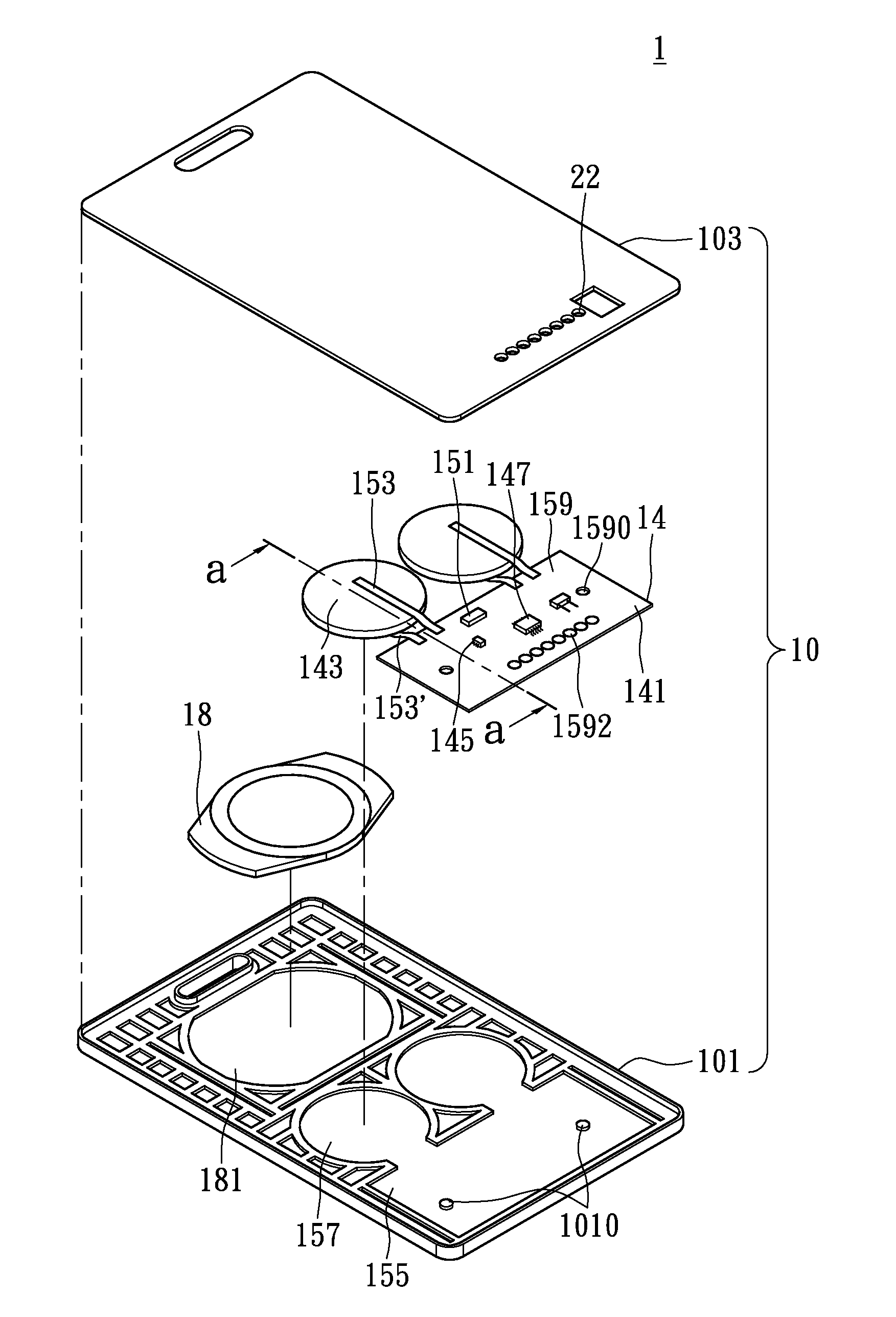
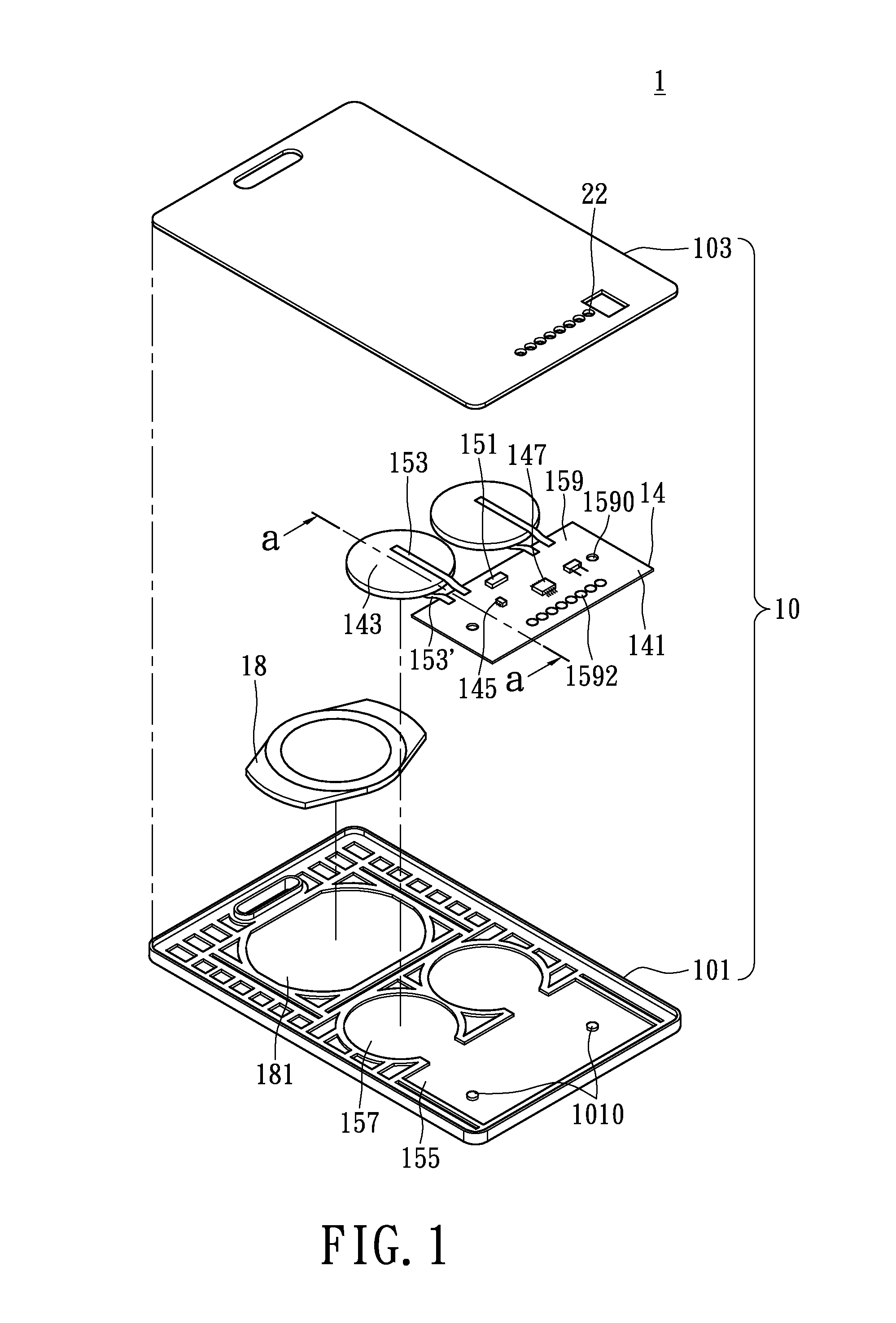
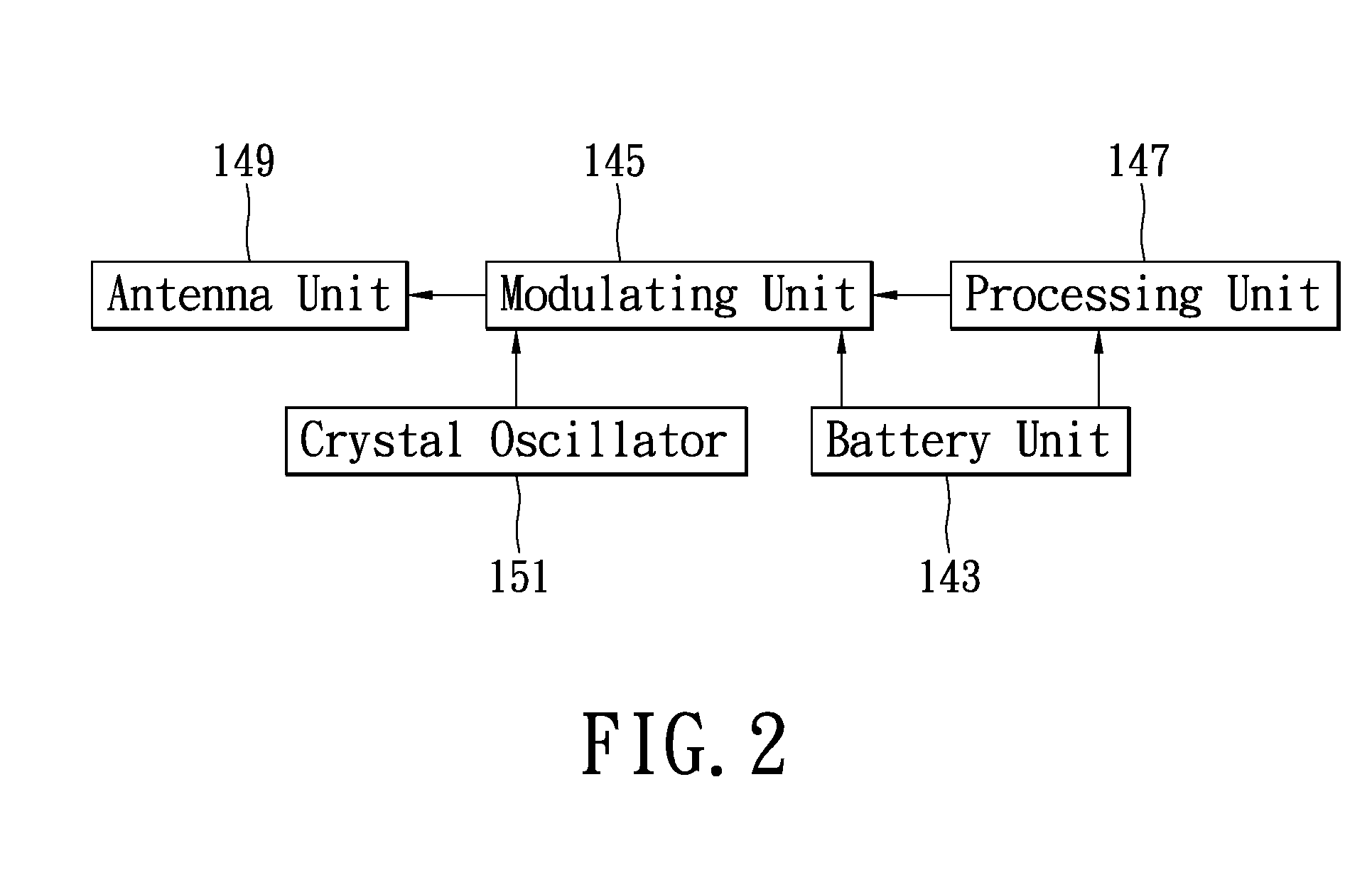
[0023]Next please refer to FIG. 2 in conjunction with FIG. 1, in which a block diagram of the first embodiment in accordance with the identification card apparatus according to the present invention is demonstrated. The circuit design of the integrated circuit board 141 includes a plurality of electrical elements for storing, processing, and transmitting identification signals automatically. The processing unit 147 of the integrated circuit board 141 disposed on the printed circuit board 159, and electrically connected with the battery unit 143 for power supply, transmits a radio frequency signal automatically within a predetermined period to the modulating unit 145. The modulating unit 145 disposed on the printed circuit board 159, and electrically connected with the battery unit 143, the processing unit 147, and the crystal oscillator 151. The frequency, the phase, or the amplitude associated with the audio frequency signal outputted from the processing unit 147 is modulated by th...
second embodiment
[0029]Next please refer to FIG. 4, in which an exploded diagram of the identification card apparatus in accordance with certain aspects of the present technique is demonstrated. The connection relationship of an identification card apparatus 1a is identical to that of FIG. 1 except of that the structure design of the second housing member 103a is altered by adding an opening 1030. The position of the opening 1030 of the second housing member 103a is designed with respect to the location of the third accommodating space 181 in the first housing member 101. Per user's specific needs, the passive radio frequency identification module 18 can be disposed inside the third accommodating space 181 thru the opening 1030 designed on the second housing member 103a.
[0030]As shown in FIG. 5, the identification card apparatus 1a can not only be used as a general identification card, but also used as an accessing card to certain specific areas which have higher security. For example, while facult...
third embodiment
[0031]Next please refer to FIG. 6 in conjunction with FIG. 1, in which an exploded diagram of the identification card apparatus in accordance with certain aspects of the present technique is demonstrated. The connection relationship of the identification card apparatus 1 is identical to that of FIG. 1 except of adding an overlay 16. A side of the overlay 16 has a back adhesive for attaching on the second housing member 103, and the other side of the overlay is printed with a text 161, an image 163, or a barcode 165, etc. Thus, the identification card apparatus 1 can not only apply both the active radio frequency identification module and the passive radio frequency identification module, but also incorporate with the barcode 165 to extend the application field. For example, the card according to the embodiment can be used as a library card, or the like. It is worth mentioning that as the overlay 16 attached on the second housing member 103, the plurality of through holes 22 can also...
PUM
 Login to View More
 Abstract
Description
Claims
Application Information
 Login to View More