
Method for producing fluorine-containing polyether carboxylic acid amide
a technology of polyether carboxylic acid and amide, which is applied in the direction of additives, lubricant compositions, organic chemistry, etc., can solve the problems of difficult scaling up production, disadvantageous reaction steps, and high cost of compound production, and achieves no coloring, easy production, and good yield
- Summary
- Abstract
- Description
- Claims
- Application Information
AI Technical Summary
Benefits of technology
Problems solved by technology
Method used
Image



Examples
example 1
[0026]In a flask equipped with a T-shaped connector for nitrogen sealing, a stirring blade, a condenser, a dropping funnel, a thermometer, and a mantle heater for heating, 1,020 g of perfluoropolyether carboxylic acid fluoride of the formula:
CF3CF2CF2O[CF(CF3)CF2O]mCF(CF3)COF[0027]m: 12 (the number average polymerization degree of hexafluoropropylene oxide determined by F-NMR; distributed to some extent) was charged and stirred. A mixture of 51 g (372 mmol) of 2-aminobenzimidazole and 9 g (89 mmol) of triethylamine was slowly added dropwise thereto at room temperature. The temperature of the mantle heater was adjusted so that the internal temperature after completion of the dropwise addition was 92±1° C., and further adjusted so that the internal temperature after 48 hours was 96±1° C. Then, stirring under heating was further carried out for 24 hours. After the disappearance of the COF signal at 1,885 cm−1 was confirmed by the IR spectrum, 250 mL of fluorine-based organic solvent (A...
example 2
[0039]In Example 1, as the perfluoropolyether carboxylic acid fluoride, 500 g of one of the formula:
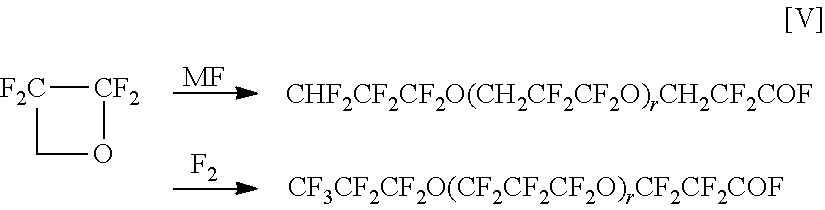
CF3CF2CF2O(CF2CF2CF2O)mCF2CF2COF[0040]m: 20 (the number average polymerization degree of hexafluoropropylene oxide determined by F-NMR; distributed to some extent)
was used, and the amounts of 2-aminobenzimidazole and triethylamine were changed to 18.8 g (137 mmol) and 3.3 g (33 mmol), respectively. Then, stirring under heating was similarly carried out. After the disappearance of the COF signal at 1,880 cm−1 was confirmed by the IR spectrum, 100 mL of fluorine-based organic-solvent (AK-225) was added to the reaction mixture and sufficiently dissolved by stirring. Thereafter, insoluble components, such as amine-hydrofluoric acid salt, were removed by a membrane filter.
[0041]To the filtrate, 100 mL of the same fluorine-based organic-solvent (AK-225) and 600 g of methanol were added, and the mixture was sufficiently mixed. The operation of extracting the lower layer was performed three t...
example 3
[0051]In Example 1, 35 g (372 mmol) of 4-aminopyridine was used in place of the 2-aminobenzimidazole, the internal temperature after completion of the dropwise addition was changed to 90±1° C., and the internal temperature after 48 hours was changed to 95±1° C. As a result, 998 g (yield: 94.8%) of the following uncolored fluorine-containing compound was obtained.
[0052]m: 12 (the number average polymerization degree of hexafluoropropylene oxide determined by F-NMR; distributed to some extent)[0053]F-NMR (acetone-d6, CFCl3)[0054]−146.0 to −145.1 ppm; —OCF(CF3)CF2O—[0055]−132.8 ppm; —CF(CF3)CONH—[0056]−131.2 ppm; CF3CF2CF2O—[0057]−86.0 to −74.6 ppm; —OCF(CF3)CF2O—,CF3CF2CF2O—[0058]−84.1 ppm; CF3CF2CF2O—[0059]−81.3 ppm; —OCF(CF3)CF2O—[0060]−81.2 ppm; —CF(CF3)CONH—[0061]H-NMR (acetone-d6, TMS)[0062]δ6.50; —C═CH—CH═N—[0063]δ8.01; —C═CH—CH═N—
PUM
| Property | Measurement | Unit |
|---|---|---|
| temperature | aaaaa | aaaaa |
| reaction temperature | aaaaa | aaaaa |
| temperature | aaaaa | aaaaa |
Abstract
Description
Claims
Application Information
 Login to View More