Unlock instant, AI-driven research and patent intelligence for your innovation.

Serdes jitter tolerance bist in production loopback testing with enhanced spread spectrum clock generation circuit

a technology of spread spectrum clock and jitter tolerance, which is applied in the direction of instruments, electric/magnetic computing, computation using denominational number representation, etc., can solve the problems of jitter cutting into the timing recovery margin of the cdr, the test method and equipment targeted for volume production ate applications are not widely available, and the jitter free loopback test rarely represents the real application environmen

Active Publication Date: 2012-07-26
AVAGO TECH INT SALES PTE LTD
View PDF6 Cites 15 Cited by
  • Summary
  • Abstract
  • Description
  • Claims
  • Application Information

AI Technical Summary

Problems solved by technology

However, a jitter free loopback test rarely represents the real application environment.
However when the periodic jitter frequency goes higher than the CDR tracking band, the jitter cuts into the timing recovery margin for the CDR.
Despite the importance of jitter testing, test methods and equipment targeted for volume production ATE applications are not widely available.
Although the PCB traces used in loopback create some ISI type of jitter, such jitter typically is not sufficient to provide a rigorous CDR stress test.
It is typically difficult to control or even quantify the amount of ISI generated through these PCB traces.
And because of layout constraints, it may not be possible to tune the traces length for a large number of SerDes ports on the same PCB.
Therefore, loopback functional test alone is inadequate for CDR test coverage.
As a result, the devices with marginal performance can escape from production test and cause system failures for the customers.
Such problems are very difficult to debug once in a system and the replacement cost is extremely high.

Method used

the structure of the environmentally friendly knitted fabric provided by the present invention; figure 2 Flow chart of the yarn wrapping machine for environmentally friendly knitted fabrics and storage devices; image 3 Is the parameter map of the yarn covering machine
View more

Image

Smart Image Click on the blue labels to locate them in the text.
Viewing Examples
Smart Image
  • Serdes jitter tolerance bist in production loopback testing with enhanced spread spectrum clock generation circuit
  • Serdes jitter tolerance bist in production loopback testing with enhanced spread spectrum clock generation circuit
  • Serdes jitter tolerance bist in production loopback testing with enhanced spread spectrum clock generation circuit

Examples

Experimental program
Comparison scheme
Effect test

Embodiment Construction

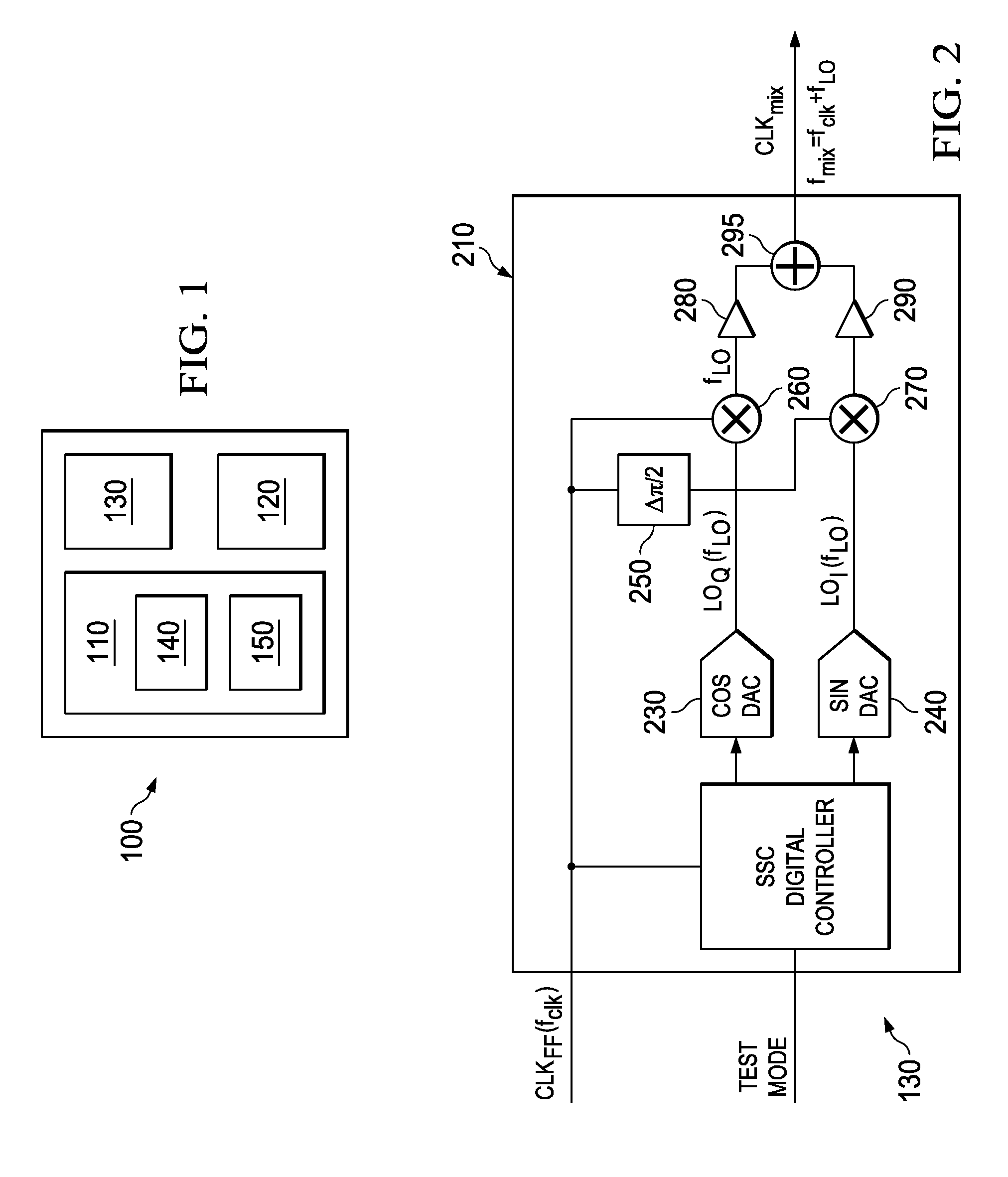
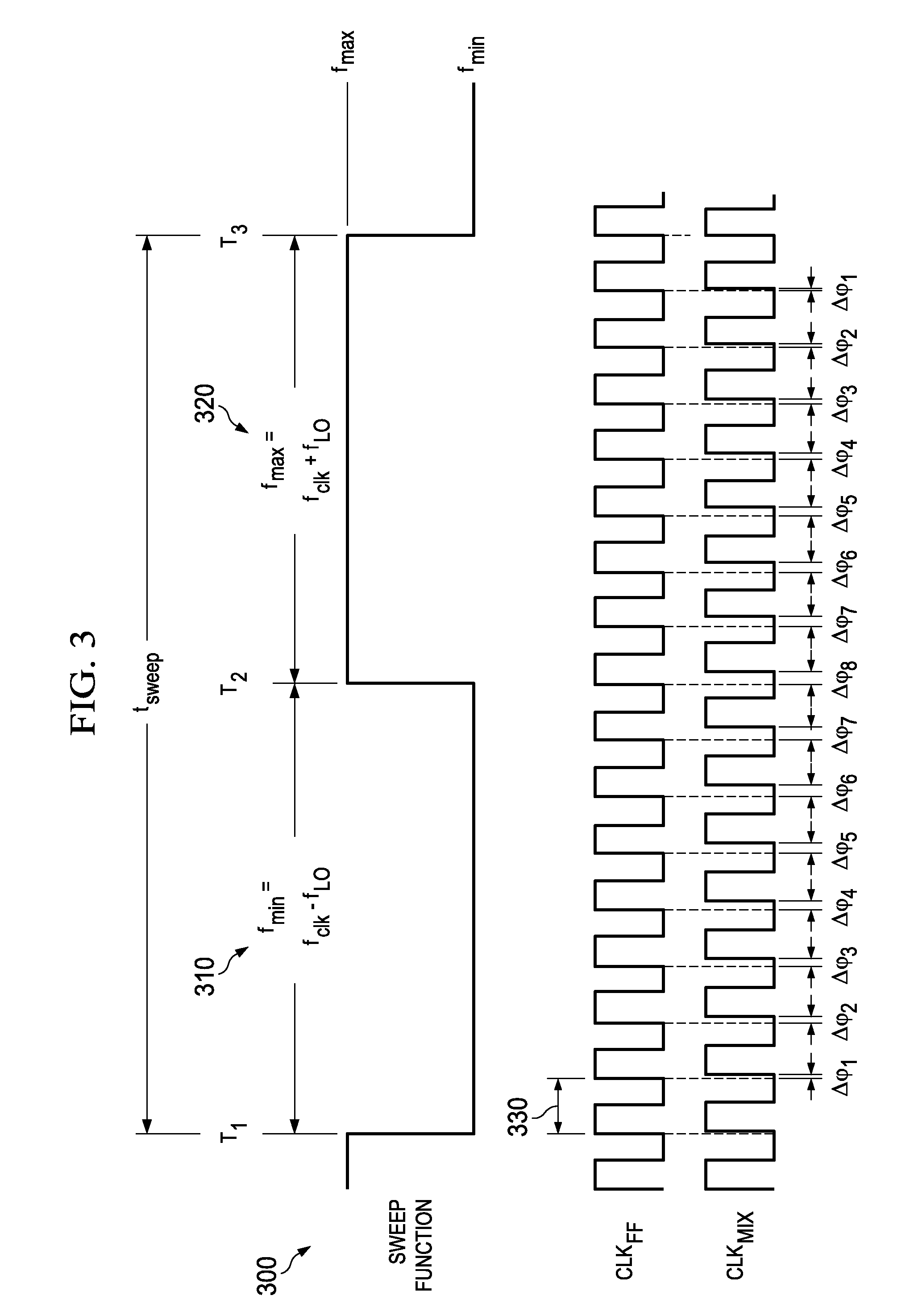
[0020]Some conventional spread-spectrum clocking (SSC) implementations actively modulate the PLL divider ratios to generate the SSC frequency profile for jitter injection. However, such modulation is typically too slow to generate out-of-band jitter frequency needed for more realistic testing of the receiver clock and data recovery circuits. Therefore, the need exists for jitter tolerance test on ATE. It is desirable that such functionality be cost effective and time efficient for high volume production.

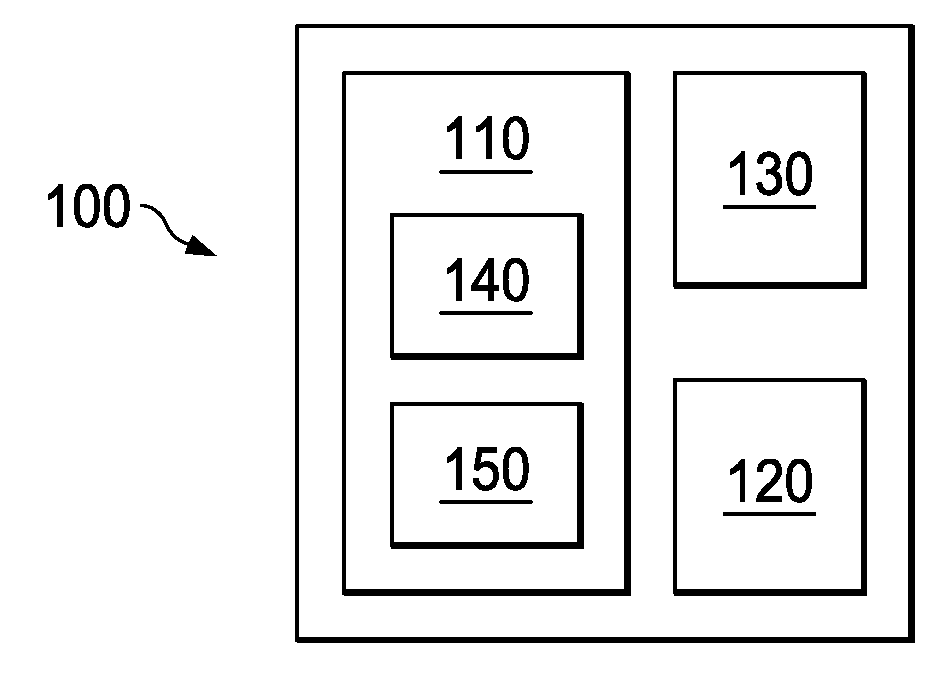
[0021]This disclosure presents an innovative design-for-test (DFT) implementation for jitter tolerance testing in a production loopback mode of an integrated circuit (IC), e.g. a SerDes device. An on-chip circuit leverages existing SSC circuitry to generate jitter that may exceed the bandwidth of receiver clock and data recovery circuits of a receive block on the IC. The jitter generation is implemented such that the jitter appears to an ATE system as an external loopback with no add...

the structure of the environmentally friendly knitted fabric provided by the present invention; figure 2 Flow chart of the yarn wrapping machine for environmentally friendly knitted fabrics and storage devices; image 3 Is the parameter map of the yarn covering machine
Login to View More

PUM

No PUM Login to View More

Abstract

A system for controllably generating jitter in a serial data stream includes a frequency generator and first and second mixers. The frequency generator is configured to output in-phase and quadrature local oscillator signals with a local oscillator frequency of at least about 5 MHz. The local oscillator frequency varies between a selectable minimum frequency and a selectable maximum frequency. The first mixer is configured to mix a fixed frequency clock signal with the in-phase local oscillator signal to output a first mixer output. The second mixer is configured to mix the fixed frequency clock signal with the quadrature local oscillator signal to output a second mixer output. An adder is configured to add the first and second mixer outputs to produce a frequency-modulated clock signal with a frequency that is about the sum of the fixed frequency and the local oscillator frequency and includes a periodic jitter.

Description

CROSS-REFERENCE TO RELATED APPLICATION[0001]This application claims the benefit of U.S. Provisional Application Ser. No. 61 / 434,623, filed by Cai, et al. on Jan. 20, 2011 entitled “SerDes Jitter Tolerance BIST in Production Loopback Testing with Enhanced Spread Spectrum Clock Generation Circuit”, commonly assigned with this application and incorporated herein by reference.TECHNICAL FIELD[0002]This application is directed, in general, to systems and methods for automated testing of electronic devices.BACKGROUND[0003]The evolvement of backplanes from bus-based architectures to fabric / mesh-based architectures has fueled rapid deployment of multi-gigabit serializer and de-serializer (SerDes) devices. The serializer does not transmit a dedicated clock signal. Instead the deserializer needs to have the capability to lock to the received data signal, extract the clock / timing information, retime / resample the received signal with the recovered clock, and make correct detections of the intend...

Claims

the structure of the environmentally friendly knitted fabric provided by the present invention; figure 2 Flow chart of the yarn wrapping machine for environmentally friendly knitted fabrics and storage devices; image 3 Is the parameter map of the yarn covering machine
Login to View More

Application Information

Patent Timeline
no application Login to View More
Patent Type & Authority Applications(United States)
IPC IPC(8): H04L7/00G06G7/16
CPCG01R31/31709H04B15/04H04L7/00G06G7/16
Inventor CAI, YICHAN, IVANFANG, LIMINGOLSEN, MAX J.
Owner AVAGO TECH INT SALES PTE LTD