[0025]In order to maximize L, the fluid film parameter as defined above, and ensure full fluid film
lubrication to minimize contact between the
femoral head and acetabular cup and therefore wear, the following conditions are achieved: The femoral head
diameter is as great as possible, or approximately the diameter of an “organic” femoral head. The preferred embodiment of the present invention includes a 40 mm diameter, but the diameter may range between 20 and 50 mm to approximate different sized organic femoral heads. This is as opposed to
current practice, which is typically 20 to 25 mm. The diametric clearance, which is the difference between the femoral head diameter and the acetabular cup diameter, is reduced, from the
current practice of approximately 100 μm (minimum) to 50 μm or less, with a
lower limit of approximately 20 μm. The
sphericity tolerance of the individual components is maintained to within a fraction (10%) of the diametric clearance, or within 5 μm. The 10% fraction is preferred because at that level (1) the measurement of dimensional errors is a reasonably efficient process, and (2) establishing the
impact of errors below this level on joint performance would likely be obscured by other performance parameters. Such
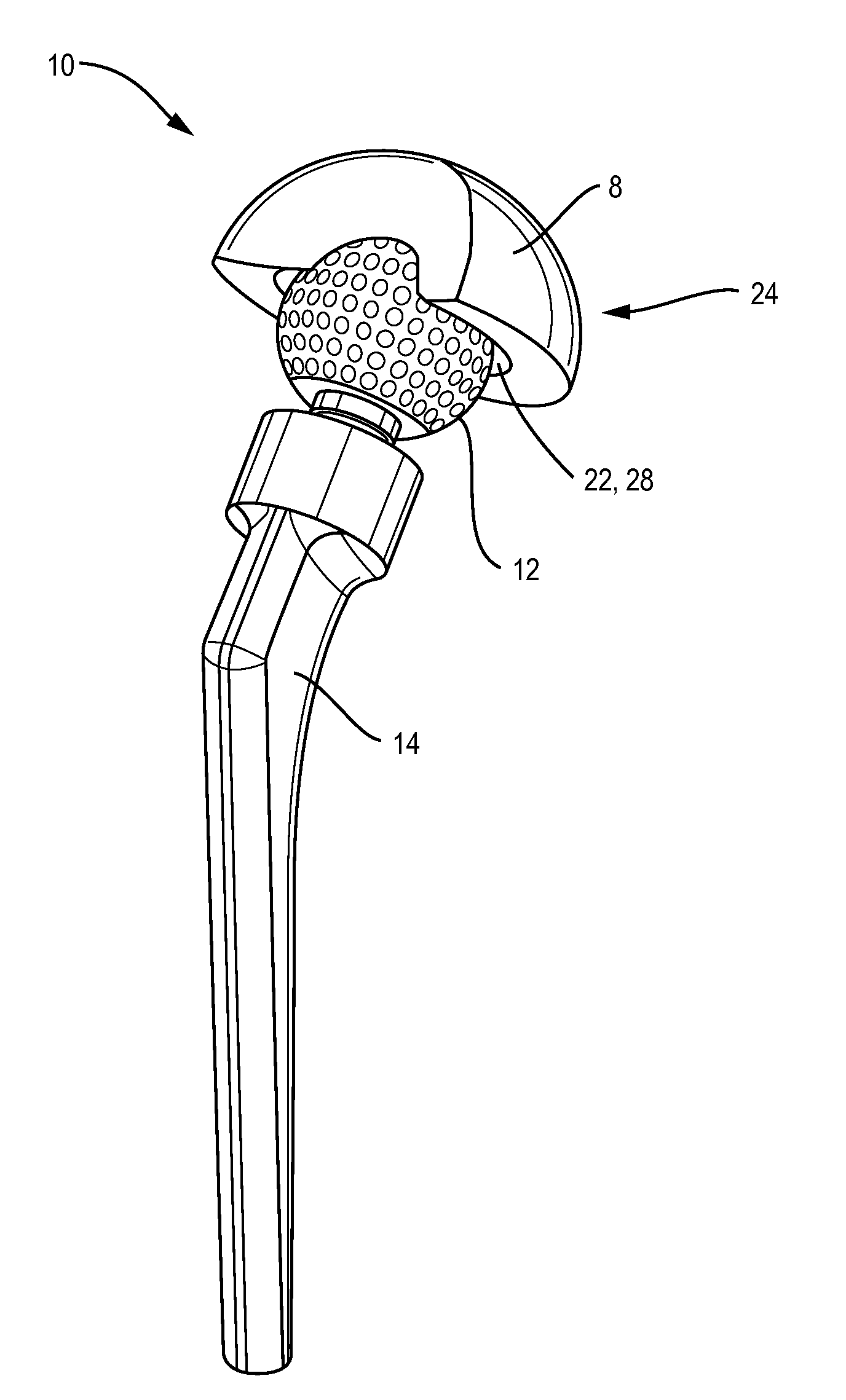
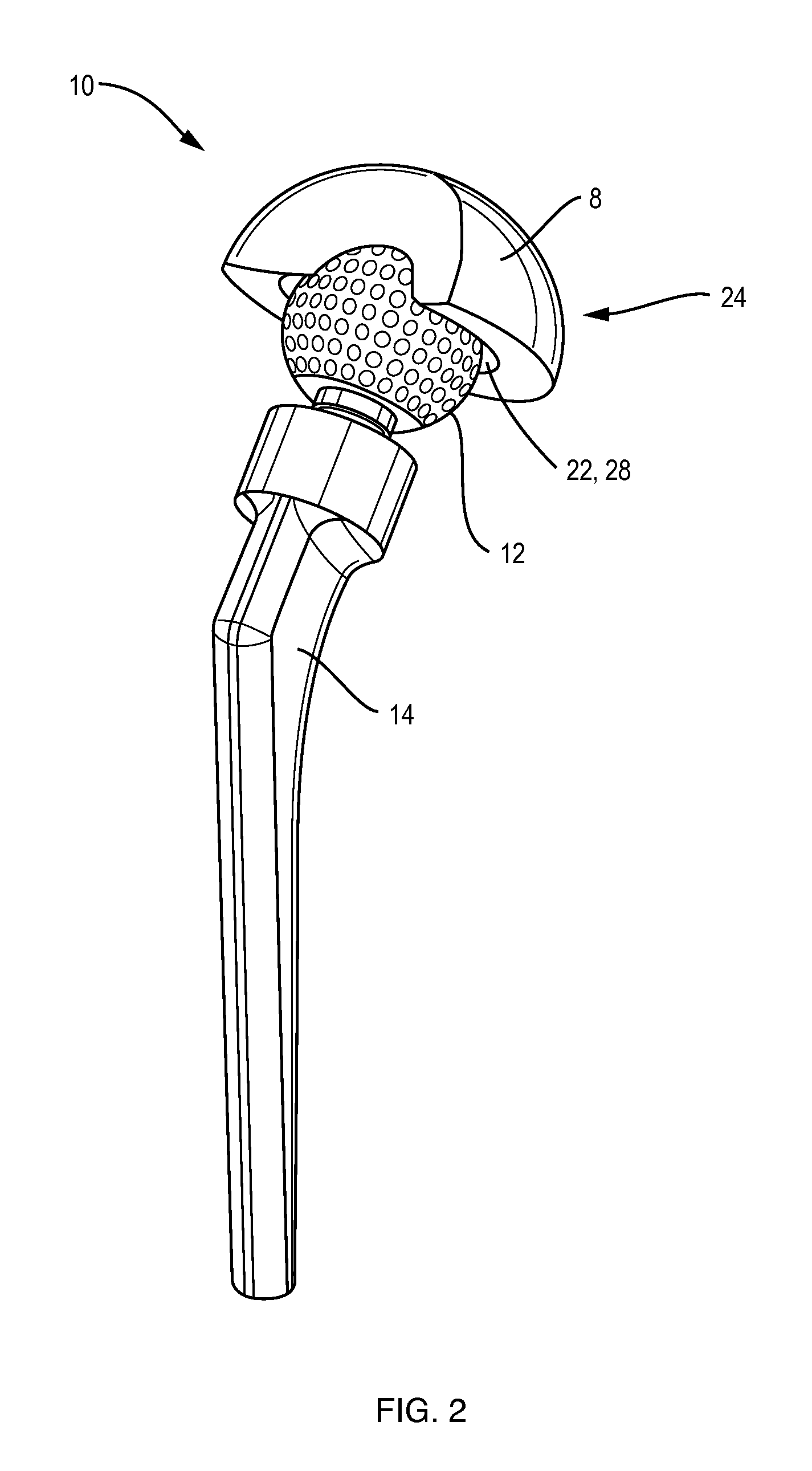
sphericity tolerance is achievable with state-of-the art precision manufacturing equipment. The surface of one of the two wear surfaces, preferably the femoral head is engineered and modified in order to amplify the hydrodynamic effect. The preferred engineered modification is a plurality of concave dimples on the surface of the femoral head where the dimples have a depth approximately equal to the diametric clearance.
Composite surface roughness, Rac, is significantly reduced.
[0027]The femoral head is preferably 40 mm, but may be between 20 and 50 mm, which approximates the range of diameters of organic femoral heads. It is a feature of the present invention to minimize or lower the
composite surface roughness, Rac, which is a function of the femoral
head surface roughness, Rab, and the acetabular cup
surface roughness, Ras, specifically the square root of the sum of their squares. The preferred method of achieving this feature is to reduce the femoral
head surface roughness. Rac is less than 20 nm, and preferably less than 14 nm. As discussed below, it is another feature of the present invention to include an engineered surface, preferably the femoral
head surface, such as a surface including dimples. The reduced femoral head
surface roughness applies to the spaces between the dimples. This is because the greatest interaction between the ball and socket occur here, and any contact / wear will occur here. It is important that the introduction of the dimples not cause perturbations of the wear surface (e.g., at their lip).
[0049]The recent evolution of deterministic
polishing, combined with appropriate
metrology, now enables advances in the execution of advanced, low-wear designs. The combination of small clearances, tight manufacturing tolerances, and the engineered surface enable a hydrodynamic film, whereby
relative motion between the femoral head and acetabular cup generates pressure in the body's own
synovial fluid, which keeps surfaces separated. The
cost savings to the U.S. medical
system in terms of hip
revision surgeries that would not have to occur is in the billions of dollars a year. The savings in pain, suffering, and recuperation for the patients is immeasurable.
[0053]It is a further aspect of the present invention to provide a prosthetic hip joint with improved sphericity.
[0054]It is a further aspect of the present invention to provide a prosthetic hip joint with improved
surface roughness.
[0055]It is a further aspect of the present invention to provide a prosthetic hip joint with an amplified hydrodynamic film for wear minimization.


 Login to View More
  Login to View More