Elevated levels of glucose, hyperglycemia, gradually induce or increase the risk of developing diabetic micro- and macrovascular complications.
Long term risk and complications increase approximately exponentially in relation to a glucose mean level.
Additionally, other complications include infections, metabolic difficulties, impotence, autonomic neuropathy and
pregnancy problems.
This means staying below hyperglycemic levels but above the critical concentration level at which the amount of glucose is not sufficient for vital
energy supply,
hypoglycemia.
When the glucose concentration is too low, symptoms like
unconsciousness,
confusion or seizure that preclude self-treatment set in.
Recurring severe hypoglycemic events increase the risk of
brain damage.
For patients with diabetes, self-management is a lifelong struggle trying to achieve
treatment targets while balancing between the short term risk of
hypoglycemia and the risk of long-term medical complications due to hyperglycemia.
The dynamics and complexity of DM with multiple influencing factors, in combination with insufficient options for treatment, make successful therapy a difficult challenge.
While CGM has proven useful, its use is still limited, partly due to high costs, accuracy and reliability issues.
Despite pharmaceutical and technical advances in treatment of diabetes the means to reach satisfactory blood glucose levels are neither adequate nor sufficient.
Treatment feedback from typical instruments and tools exhibit serious limitations that hampers understanding of the problems involved in the control of diabetes.
As of today, there are no commercially available instruments or tools based on the assumption of glucose data being log-normally distributed or any other distribution, besides the normal
Gaussian distribution.
Thus, presentation, indication and statistics of glucose data are often biased and therefore impairing interpretation, treatment and potential feedback to the observer.
Consequently, current methods, instruments and tools do not take this into account and typically suffer from incorrect bias.
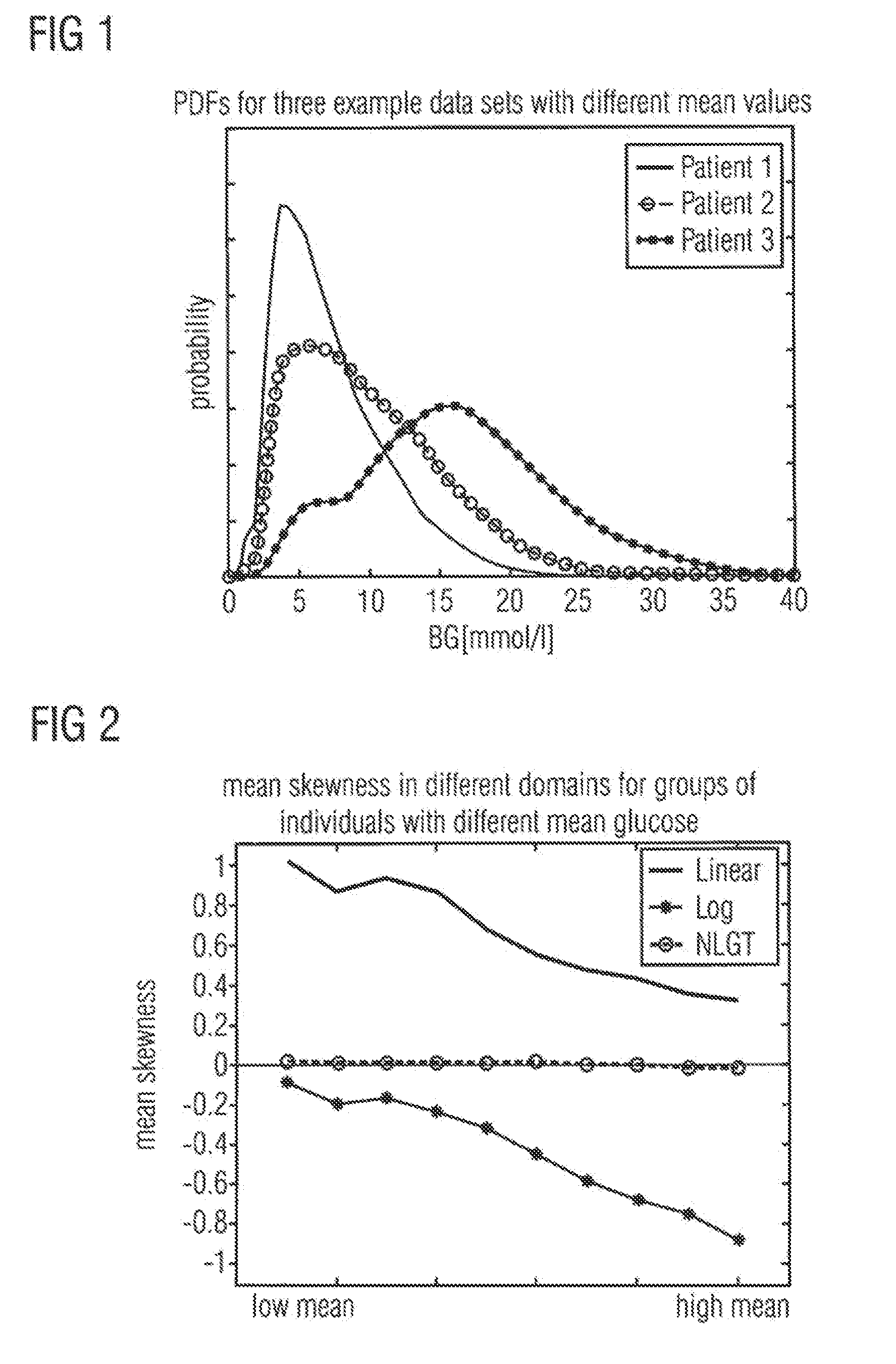
The typical cluster of glucose readings will generally not be symmetrically distributed around the mean—making interpretation of changes in glucose levels difficult and sometimes misleading or obscured for the observer.
Additionally, a universal presentation scale based on the assumption of a typical distribution (normal or even log-normal), will for many patients suppress the resolution in important areas of the blood glucose range such as in the hypo- or hyperglycemic regions, thus obscuring
potential risk assessment.
As the
detector driving the tilt angle of the arrow usually does not take into account the non-linear glucose propagation, the indication is often misleading.
Thus such indicators fail to properly demonstrate the magnitude of the risk posed by a certain glucose level change.
Furthermore, the non-linear glucose propagation impairs the accuracy and reliability of typical alarm
prediction algorithms.
This results in unnecessary and irrelevant alarms and indications in the hyperglycemic range, and too few alarms and too small indications in the hypoglycemic range for certain types of DM patients.
Thus, the true
clinical value of this feature has been somewhat limited.
For asymmetric glucose distributions this renders unreliable results.
From a treatment perspective, the disadvantages of these standard measures imply a reduced accuracy in diagnosis, improper interpretation and inaccurate results.
In conclusion,
user feedback from measurements, diagnosis, analysis, treatment and self-care in the field of diabetes has since its inception been plagued with problems originating from the assumption that blood glucose data is normally distributed (or by some, logarithmically distributed).
Unfortunately, this applies to everything from clinical lab equipment and self-management devices for glucose measurements, to results and statistics presented in clinical studies and scientific research.
Importantly, both terms influence more or less the transformed value, since a piecewise transform having a first portion until a certain border value which is a logarithmic function and having a second portion for higher values than the border value which is a linear function does not accurately reflect the statistics within
glycemic data so that such a “piecewise” transform will not result in a high quality transform having a set of transformed values showing a more accurate
Gaussian normal distribution than the set of values had before the transform.


 Login to View More
  Login to View More