Check patentability & draft patents in minutes with Patsnap Eureka AI!

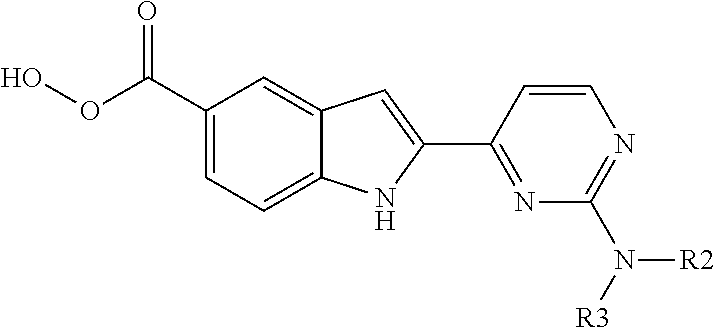
Method for producing 2-(2-aminopyrimidin-4-yl)-1h-indole-5-carboxylic acid derivatives

a technology of indole and carboxylic acid, which is applied in the direction of organic chemistry, bulk chemical production, group 3/13 element organic compounds, etc., can solve the problems of poor isolability and severe reaction conditions required for a full conversion

Active Publication Date: 2012-10-25
SANOFI SA
View PDF1 Cites 2 Cited by
  • Summary
  • Abstract
  • Description
  • Claims
  • Application Information

AI Technical Summary

Benefits of technology

This process allows for the efficient production of indole derivatives suitable for IkB kinase inhibitors, overcoming the challenges of severe reaction conditions and impurity issues, with improved yield and purity through controlled reaction conditions and selective nitrogen protecting group management.

Problems solved by technology

One disadvantage here is the severe reaction conditions which are required for a full conversion.
Secondly, the products of this reaction are obtained in a mixture with the corresponding oligomers, which leads to a poor isolability, especially with regard to the filtration times. Moreover, these oligomers, owing to the low solubility of 2-(2-aminopyrimidin-4-yl)-1H-indole-5-carboxylic acids in organic solvents, can only be removed with difficulty and are entrained as an impurity in the further reactions, in some cases up to the active ingredient.

Method used

the structure of the environmentally friendly knitted fabric provided by the present invention; figure 2 Flow chart of the yarn wrapping machine for environmentally friendly knitted fabrics and storage devices; image 3 Is the parameter map of the yarn covering machine
View more

Image

Smart Image Click on the blue labels to locate them in the text.
Viewing Examples
Smart Image
  • Method for producing 2-(2-aminopyrimidin-4-yl)-1h-indole-5-carboxylic acid derivatives
  • Method for producing 2-(2-aminopyrimidin-4-yl)-1h-indole-5-carboxylic acid derivatives
  • Method for producing 2-(2-aminopyrimidin-4-yl)-1h-indole-5-carboxylic acid derivatives

Examples

Experimental program
Comparison scheme
Effect test

example 1

Synthesis of ethyl 2-(2-chloropyrimidin-4-yl)-1H-indole-5-carboxylate

[0223]

[0224]28 g (114 mmol) of 2-borono-5-ethoxycarbonylindole, 12 g (113 mmol) of sodium carbonate and 17.2 g of 2,4-(113 mmol) dichloropyrimidine were initially charged in 412 ml of ethanol. The clear solution was freed of oxygen by vigorous stirring and passing argon through (20 minutes). At RT, 2.67 g of tetrakis(triphenylphosphine)palladium(0) were added. The mixture was heated to from 65° C. to 70° C. for 2 hours (h). Subsequently, 112 ml of water and 112 ml of 30% hydrochloric acid were added and the mixture was cooled to 0° C. After filtration and drying under reduced pressure, 37.3 g (93% of theory) of ethyl 2-(2-chloropyrimidin-4-yl)-1H-indole-5-carboxylate were obtained (HPLC >96%).

[0225]The purity was determined by high-pressure liquid chromatography (HPLC):

Column:Waters Symetry Shield RP8 3.9 * 150Temperature:40° C.Flow rate:1 ml / minInjection volume:10 μlPressure:90 barUV:254 nmEluent:A: Water / trifluor...

example 2

Synthesis of ethyl 2-(2-methylaminopyrimidin-4-yl)-1H-indole-5-carboxylate

[0226]

[0227]30 g (95.4 mmol) of ethyl 2-(2-chloropyrimidin-4-yl)-1H-indole-5-carboxylate were initially charged and suspended in 150 ml of ethanol. 53.9 g of methylamine solution in ethanol (8 M) were added to this suspension which was heated to from 75° C. to 80° C. in an autoclave for 4 h. After concentration and washing with ethanol, 29.7 g of ethyl 2-(2-methylamino-pyrimidin-4-yl)-1H-indole-5-carboxylate were obtained (97.6 HPLC area %). LCMS: [M+H]⊕ 297.12

[0228]HPLC method as in example 1; retention time of title compound: 5.8 min

example 3

Synthesis of 2-(2-methylaminopyrimidin-4-yl)-1H-indole-5-carboxylic acid sodium salt

[0229]

[0230]25 g of ethyl 2-(2-methylaminopyrimidin-4-yl)-1H-indole-5-carboxylate were admixed with 200 ml of ethanol and 24.5 g of 33% sodium hydroxide solution, and heated to from 65° C. to 70° C. for 4 h. After cooling, the mixture was filtered with suction and the precipitate was washed with 15 ml of ethanol / water (9:1). 24.5 g (87.6% of theory) of 2-(2-methylaminopyrimidin-4-yl)-1H-indole-5-carboxylic acid sodium salt were obtained (98.1 HPLC area %). LCMS: [M+H]⊕ 269.10 HPLC method as in example 1; retention time of title compound: 3.3 min

the structure of the environmentally friendly knitted fabric provided by the present invention; figure 2 Flow chart of the yarn wrapping machine for environmentally friendly knitted fabrics and storage devices; image 3 Is the parameter map of the yarn covering machine
Login to View More

PUM

No PUM Login to View More

Abstract

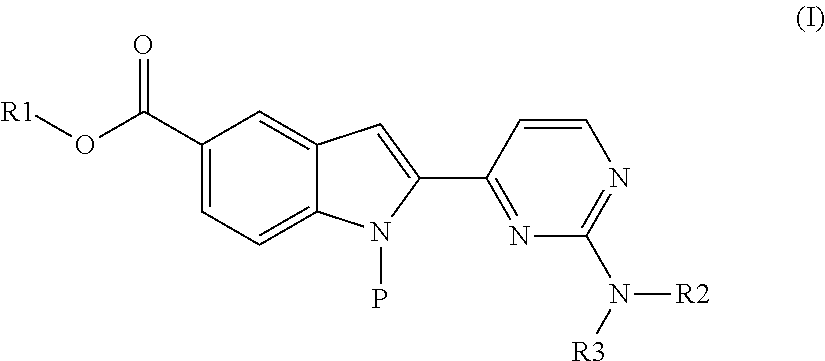
This disclosure relates to a novel process for obtaining a compound of formula I:wherein the values of R1, R2, and R3 and P are as described in the specification, and intermediates thereof.

Description

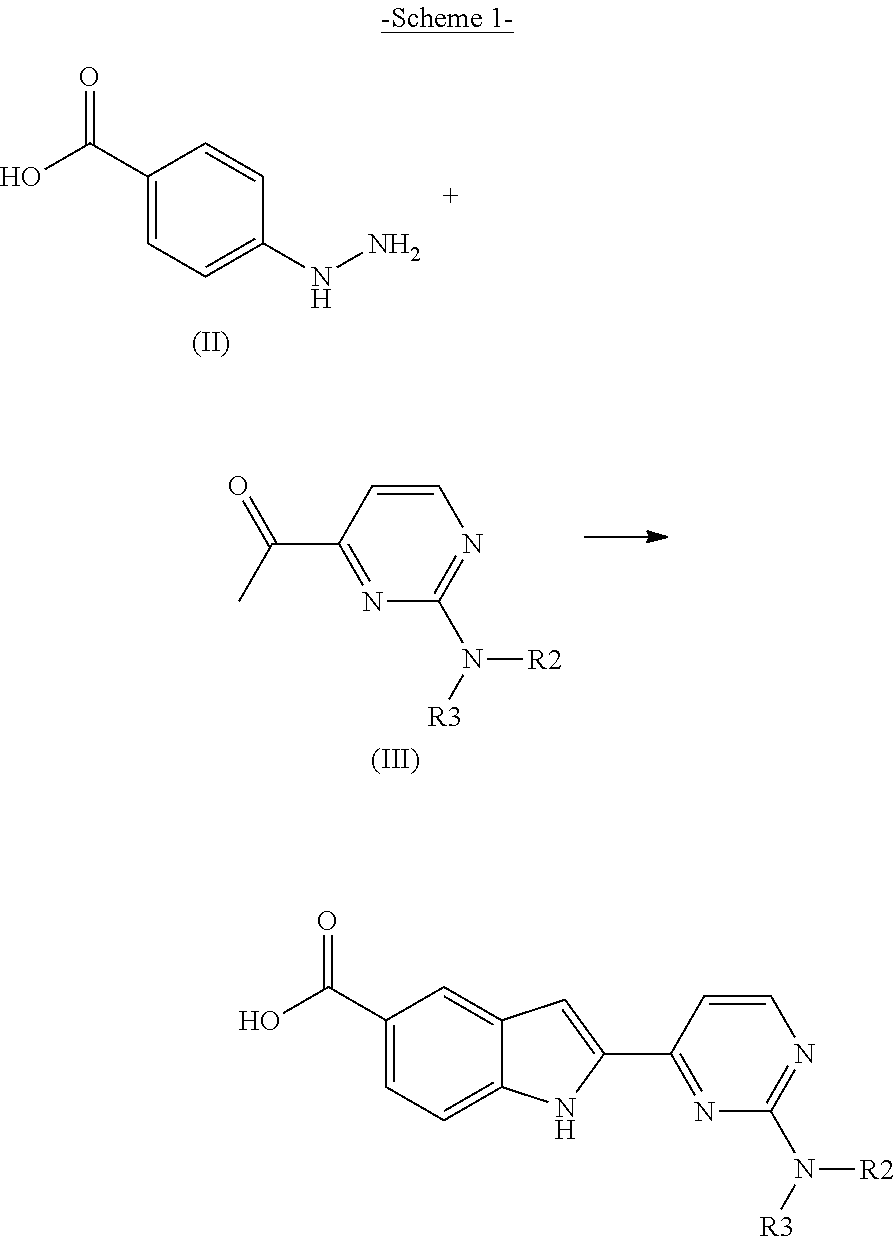
BACKGROUND OF THE INVENTION[0001]It is known that indole derivatives are used as units for the synthesis of active pharmaceutical ingredients. For example, 2-(2-aminopyrimidin-4-yl)-1H-indole-5-carboxylic acids or their salts are important units for the preparation of IkB kinase inhibitors (see WO 01 / 30774 A1):[0002]2-(2-Aminopyrimidin-4-yl)-1H-indole-5-carboxylic acids can be prepared by classical Fischer indole synthesis starting from the corresponding 4-acetylpyrimidines (III) and 4-hydrazinobenzoic acid (II) (see scheme 1):[0003]One disadvantage here is the severe reaction conditions which are required for a full conversion. Secondly, the products of this reaction are obtained in a mixture with the corresponding oligomers, which leads to a poor isolability, especially with regard to the filtration times. Moreover, these oligomers, owing to the low solubility of 2-(2-aminopyrimidin-4-yl)-1H-indole-5-carboxylic acids in organic solvents, can only be removed with difficulty and are...

Claims

the structure of the environmentally friendly knitted fabric provided by the present invention; figure 2 Flow chart of the yarn wrapping machine for environmentally friendly knitted fabrics and storage devices; image 3 Is the parameter map of the yarn covering machine
Login to View More

Application Information

Patent Timeline
no application Login to View More
Patent Type & Authority Applications(United States)
IPC IPC(8): C07D403/04C07D239/42C07F5/04C07F7/10
CPCC07D403/04C07F7/10C07F5/025Y02P20/55
Inventor GRAESER, JOACHIMBILLEN, GUENTERLINKIES, ADOLFMETZENTHIN, TOBIAS
Owner SANOFI SA
Features
  • R&D
  • Intellectual Property
  • Life Sciences
  • Materials
  • Tech Scout
Why Patsnap Eureka
  • Unparalleled Data Quality
  • Higher Quality Content
  • 60% Fewer Hallucinations
Social media
Patsnap Eureka Blog
Learn More