This helps you quickly interpret patents by identifying the three key elements:
Problems solved by technology
Method used
Benefits of technology
Benefits of technology
[1014]Transdermal patches have the added advantage of providing controlled delivery of a compound of the present invention to the body. Such dosage forms can be made by dissolving or dispersing the compound in the proper medium. Absorption enhancers can also be used to increase the flux of the compound across the skin. The rate of such flux can be controlled by either providing a rate controlling membrane or dispersing the active compound in a polymer matrix or gel.
Problems solved by technology
Neovascular AMD is characterized by the abnormal growth of blood vessels under the macula and vascular leakage, resulting in displacement of the retina, hemorrhage and scarring.
This results in a deterioration of sight over a period of weeks to years.
Currently there is no proven medical therapy for dry AMD and many patients with neovascular AMD become legally blind despite current therapy with anti-VEGF agents such as Lucentis.
Method used
the structure of the environmentally friendly knitted fabric provided by the present invention; figure 2 Flow chart of the yarn wrapping machine for environmentally friendly knitted fabrics and storage devices; image 3 Is the parameter map of the yarn covering machine
View more
Image
Smart Image Click on the blue labels to locate them in the text.
Viewing Examples
Smart Image
Click on the blue label to locate the original text in one second.
Reading with bidirectional positioning of images and text.
[1718]To a solution of 2-({[(2S,4R)-1-(1-carbamoyl-1H-indol-3-ylcarbamoyl)-4-fluoro-pyrrolidine-2-carbonyl]-amino}-methyl)-benzoic acid tert-butyl ester (prepared according to Scheme D1 using 2-aminomethyl-benzoic acid tert-butyl ester) (76 mg, 0.145 mm) in CH2Cl2 (1 mL) was added TFA (168 μl, 2.18 mmol) and the resulting solution was stirred at RT overnight. The crude mixture was concentrated to give a solid which was suspended in Et2O and filtered to give the desired material. MS (LC-MS): 468.1 [M+H]+, 490.1 [M+Na]+, 957.2 [2M+Na]+, 466.1 [M−H]−, 423.1 [M−CONH2]−, tR (HPLC conditions a): 2.64 min.
[1720]To a solution of 3-({[(2S,4R)-1-(1-carbamoyl-1H-indol-3-ylcarbamoyl)-4-fluoro-pyrrolidine-2-carbonyl]-amino}-methyl)-benzoic acid tert-butyl ester (prepared according to Scheme D1 using 3-aminomethyl-benzoic acid tert-butyl ester) (21 mg, 0.04 mmol) in CH2Cl2 (0.5 mL) was added TFA (31 μl, 0.4 mmol) and the solution was stirred at RT for 24 h. The solvent was concentrated and the crude residue was purified by preparative HPLC (C18-ODB, 5 μm, 19×50 mm, waters, eluent: CH3CN / H2O+0.1% HCOOH flow: 20 mL / min, standard 20% method) to give after lyophilization of the purified fractions the desired material. MS (LC-MS): 468 [M+H]+, 490 [M+Na]+, 466 [M−H]−, 423.0 [M−CONH2]−; tR (HPLC conditions a): 2.57 min.
[1722]To a suspension of (2S,3S)-2-{[(2S,4R)-1-(1-carbamoyl-1H-indol-3-ylcarbamoyl)-4-fluoro-pyrrolidine-2-carbonyl]-amino}-3-methyl-pentanoic acid tert-butyl ester Example 15 (64 mg, 0.127 mmol) in CH2Cl2 (1 mL) was added TFA (97 μl, 1.27 mmol) and the resulting solution was stirred at RT for 20 h. TFA (1.27 mmol) was added again to ensure completion of the reaction. CH2Cl2 was concentrated and the crude residue was purified by preparative HPLC (C18-ODB, 5 μm, 19×50 mm, waters, eluent: CH3CN / H2O+0.1% HCOOH flow: 20 mL / min, standard 20% method) to give after lyophilization of the purified fractions the desired material which was dissolved in CH3CN and was purified again on trimethylaminopropyl cartridge (Mega Bond Elut-SAX, 1 g, from Varian, conditioned with 20 mL of CH3CN). The column was eluted with CH3CN and the compound was finally released with 10 mL o...
the structure of the environmentally friendly knitted fabric provided by the present invention; figure 2 Flow chart of the yarn wrapping machine for environmentally friendly knitted fabrics and storage devices; image 3 Is the parameter map of the yarn covering machine
Login to View More
PUM
Login to View More
Abstract
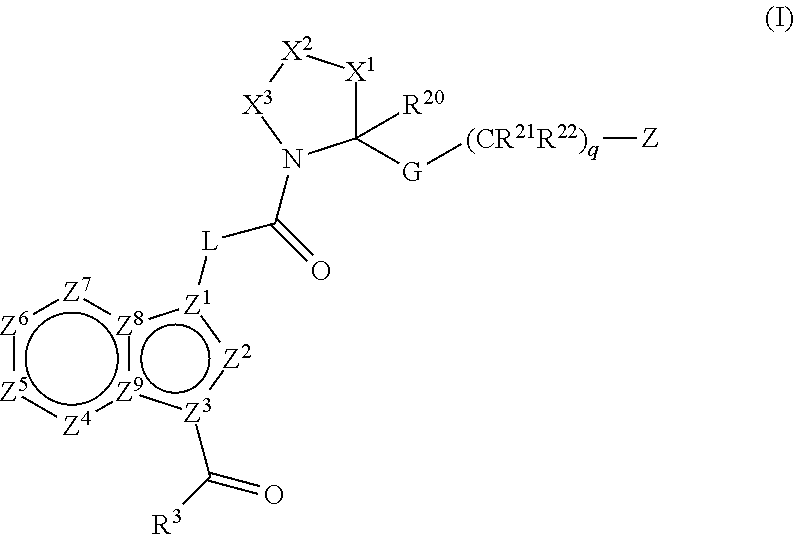
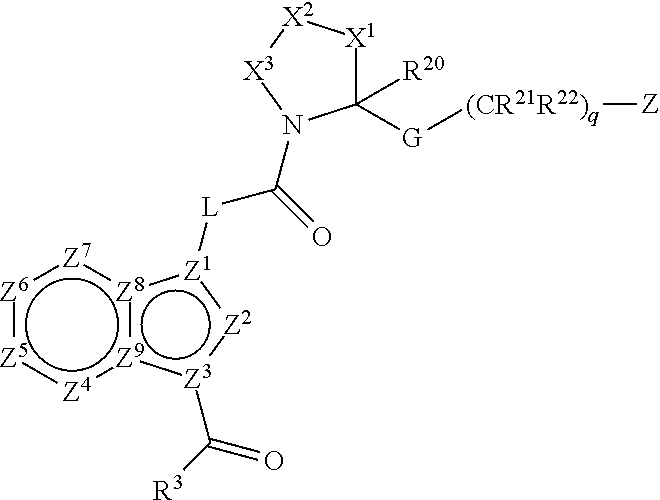
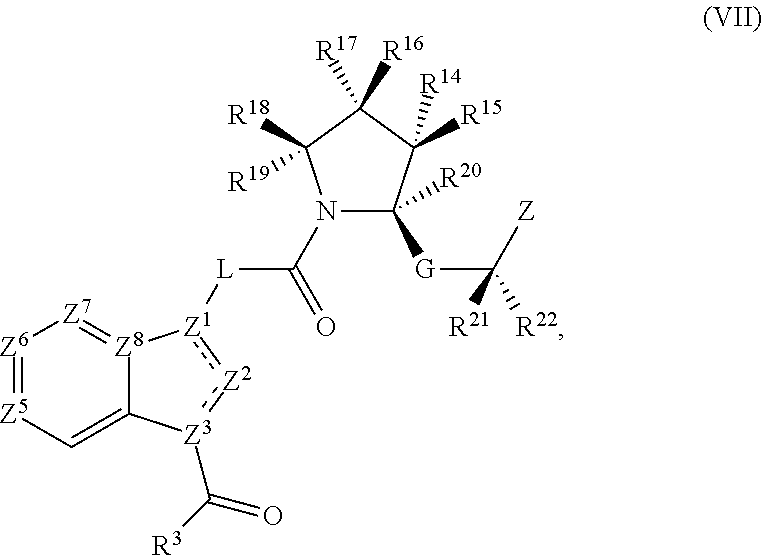
The present invention provides a compound of formula I:a method for manufacturing the compounds of the invention, and its therapeutic uses. The present invention further provides a combination of pharmacologically active agents and a pharmaceutical composition.
Description
FIELD OF THE INVENTION[0001]The invention relates to the inhibition of the complement alternative pathway and particularly to inhibition of Factor D, in patients suffering from conditions and diseases associated with complement alternative pathway activation such as age-related macular degeneration, diabetic retinopathy and related ophthalmic diseases.BACKGROUND OF THE INVENTION[0002]The complement system is a crucial component of the innate immunitysystem and comprises a group of proteins that are normally present in an inactive state. These proteins are organized in three activation pathways: the classical, the lectin, and the alternative pathways (V. M. Holers, In Clinical Immunology: Principles and Practice, ed. R.R. Rich, Mosby Press; 1996, 363-391). Molecules from microorganisms, antibodies or cellular components can activate these pathways resulting in the formation of protease complexes known as the C3-convertase and the C5-convertase. The classical pathway is a calcium / mag...
Claims
the structure of the environmentally friendly knitted fabric provided by the present invention; figure 2 Flow chart of the yarn wrapping machine for environmentally friendly knitted fabrics and storage devices; image 3 Is the parameter map of the yarn covering machine
Login to View More
Application Information
Patent Timeline
Application Date:The date an application was filed.
Publication Date:The date a patent or application was officially published.
First Publication Date:The earliest publication date of a patent with the same application number.
Issue Date:Publication date of the patent grant document.
PCT Entry Date:The Entry date of PCT National Phase.
Estimated Expiry Date:The statutory expiry date of a patent right according to the Patent Law, and it is the longest term of protection that the patent right can achieve without the termination of the patent right due to other reasons(Term extension factor has been taken into account ).
Invalid Date:Actual expiry date is based on effective date or publication date of legal transaction data of invalid patent.


 Login to View More
  Login to View More