
Semiconductor device and method of making the same
a technology of semiconductor devices and semiconductor devices, applied in the direction of semiconductor devices, electrical devices, transistors, etc., to achieve the effects of preventing residual etching solution/chemical solvent adversely affecting the semiconductor device, reducing the damage to the formed structure, and improving the efficiency and performance of the semiconductor devi
- Summary
- Abstract
- Description
- Claims
- Application Information
AI Technical Summary
Benefits of technology
Problems solved by technology
Method used
Image

Examples
first exemplary embodiment
The First Exemplary Embodiment
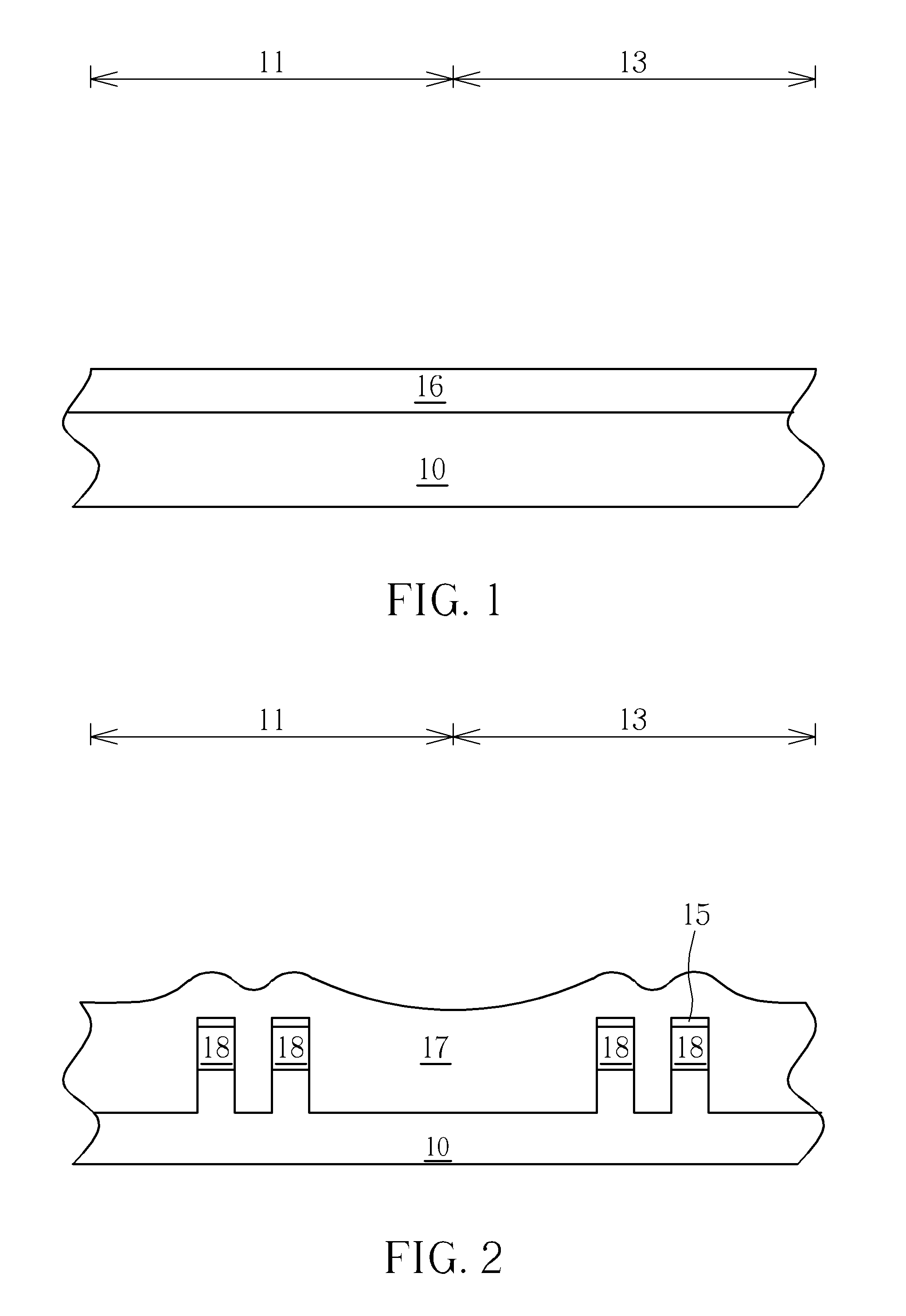
[0018]The entirely formed semiconductor layer 16 includes (Si(1-x-y)GexCy), and the ratio of y to x is larger than 0.1, i.e. y>0.1x. The semiconductor layer 16 has an original tensile stress. In this exemplary embodiment, a patterned mask (not shown) is used to cover the NMOS region 11 and expose the PMOS region 13. Furthermore, an ion implantation process with the dopant of 4A group elements including Ge is performed for modifying the semiconductor layer 16 in the PMOS region 13. Consequently, the semiconductor layer 16 in the PMOS region 13 may be changed to include (Si(1-x-y)GexCy) and y<0.1x; that is, the strained silicon epitaxial layer will have a compressive stress instead of the tensile stress. Afterwards, the patterned mask is removed.
second exemplary embodiment
The Second Exemplary Embodiment
[0019]The entirely formed semiconductor layer 16 includes (Si(1-x-y)GexCy), and the ratio of y to x is smaller than 0.1, i.e. y16 has an original compressive stress. In this exemplary embodiment, a patterned mask (not shown) is used to cover the PMOS region 13 and expose the NMOS region 11. Furthermore, an ion implantation process with the dopant of 4A group elements including C is performed for modifying the semiconductor layer 16 in the NMOS region 11. Consequently, the semiconductor layer 16 in the NMOS region 11 may be changed to include (Si(1-x-y)GexCy) and y>0.1x; that is, the strained silicon epitaxial layer will have a tensile stress instead of the compressive stress. Afterwards, the patterned mask is removed.
third exemplary embodiment
The Third Exemplary Embodiment
[0020]The entirely formed semiconductor layer 16 includes (Si(1-x-y)Gex), i.e. the semiconductor layer 16 has original compressive stress. In this exemplary embodiment, a patterned mask (not shown) is used to cover the PMOS region 13 and expose the NMOS region 11. Furthermore, an ion implantation process with the dopant of 4A group elements including C is performed for modifying the semiconductor layer 16 in the NMOS region 11. Consequently, the semiconductor layer 16 in the NMOS region 11 may be changed to include (Si(1-x-y)GexCy) and y>0.1x; that is, the strained silicon epitaxial layer will have a tensile stress instead of the compressive stress. Afterwards, the patterned mask is removed.
PUM
 Login to View More
 Abstract
Description
Claims
Application Information
 Login to View More