
Copper powder for conductive paste and method for producing same
a technology of copper powder and conductive paste, which is applied in the direction of non-conductive materials with dispersed conductive materials, conductors, transportation and packaging, etc. it can solve the problems of insufficient use of copper fine particles for internal electrodes, insufficient control of particle diameter, and inability to produce fine particles of copper, so as to achieve stable production of copper powder, avoid bad influence on electric characteristics of electrodes, and thin electrode films
- Summary
- Abstract
- Description
- Claims
- Application Information
AI Technical Summary
Benefits of technology
Problems solved by technology
Method used
Image

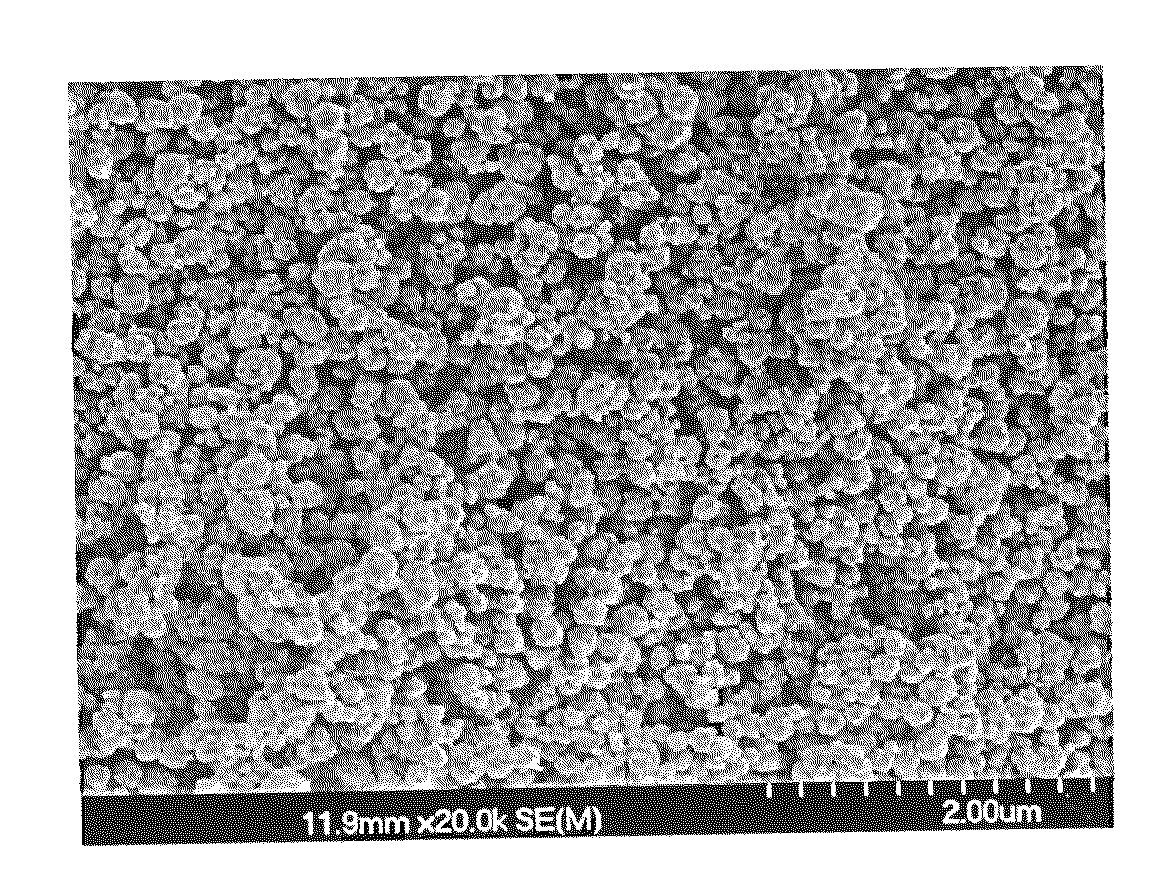
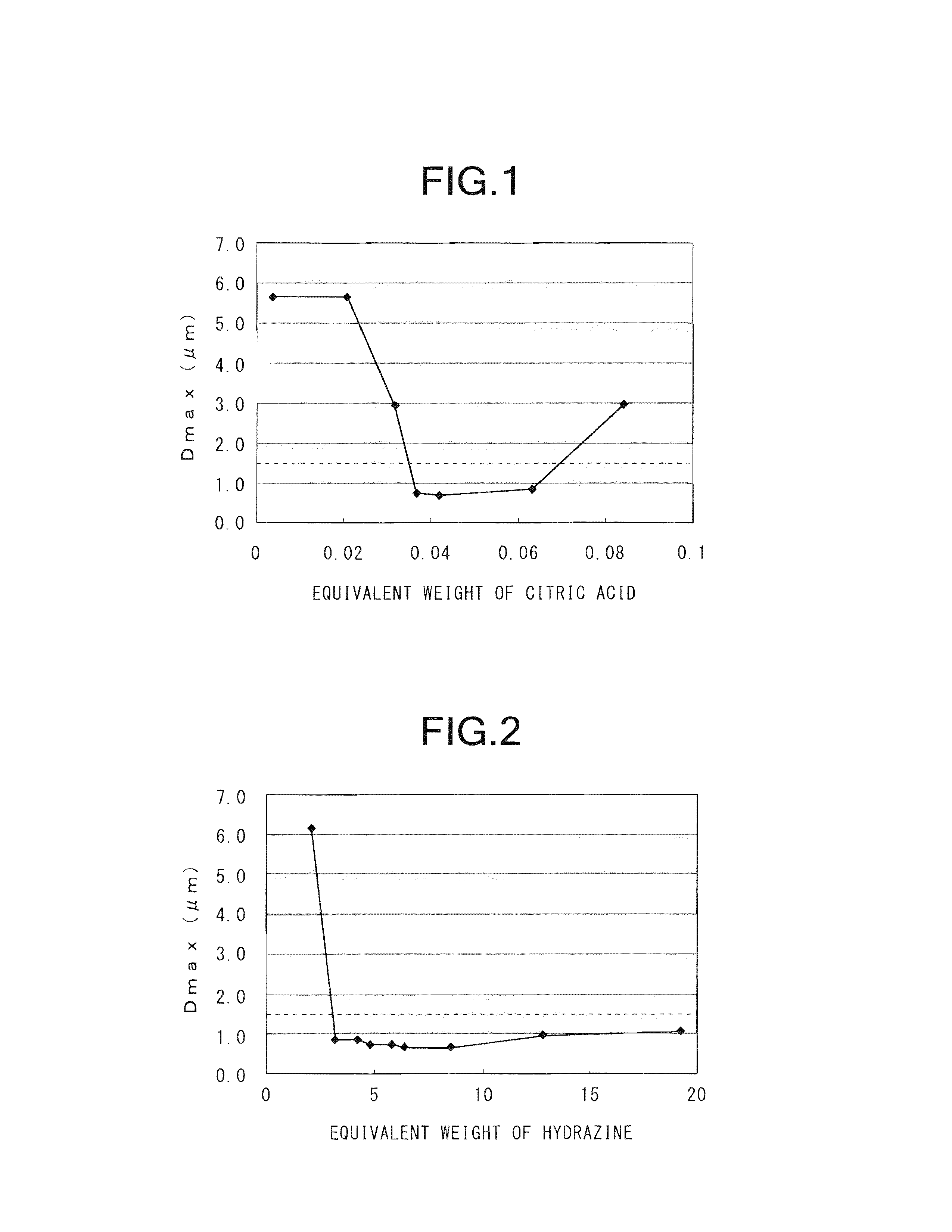
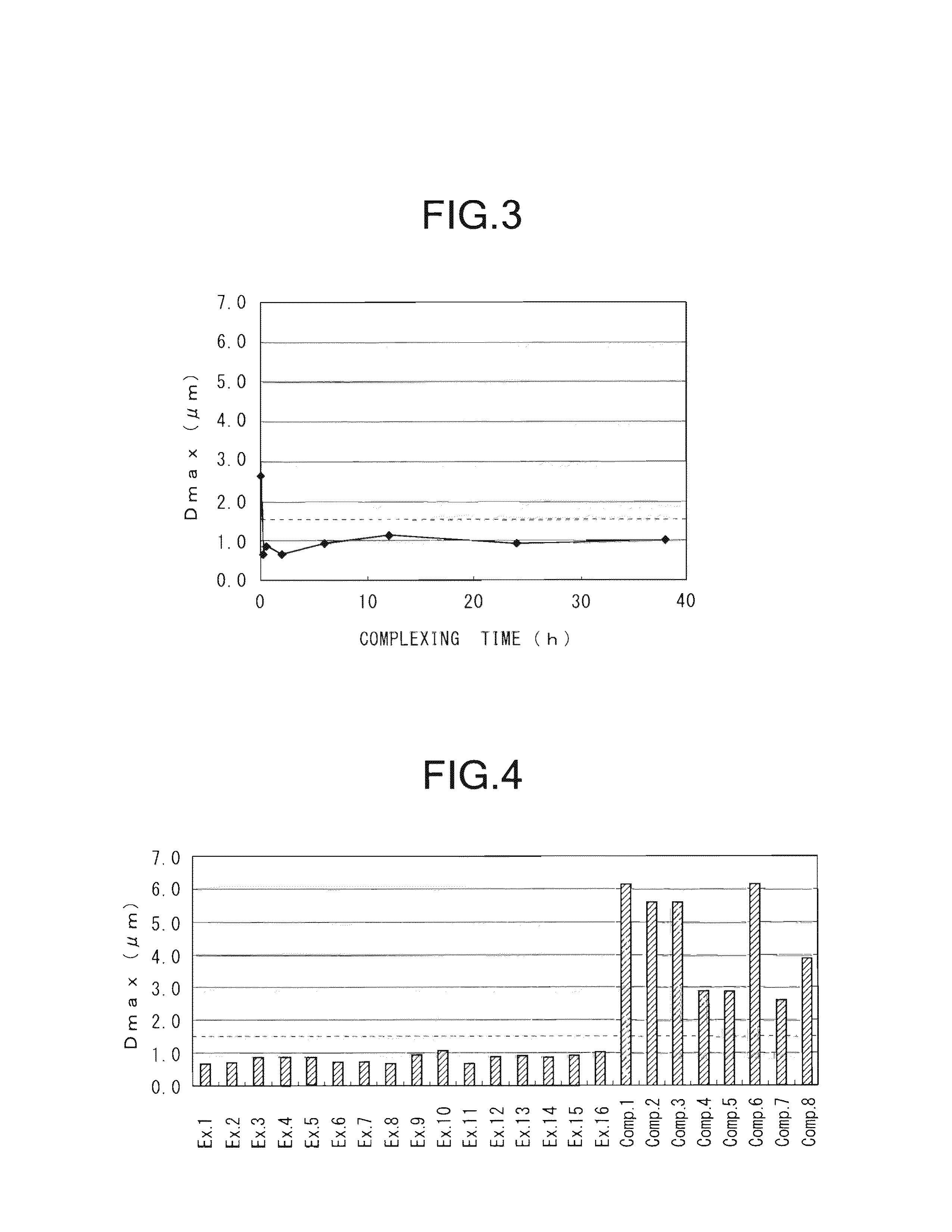
Examples
example 1
[0049]After 3800 g of pure water was placed in a 5 L of reaction vessel, air was blown into the reaction vessel at a flow rate of 0.5 L / min from the bottom thereof, and a stirring bar arranged in the reaction vessel was rotated. Then, 5.33 g (equivalent weight of 0.042) of citric acid (produced by FUSO CHEMICAL CO., LTD.) was introduced to the reaction vessel, and 43.17 g of cuprous oxide (NC-301 produced by NISSIN CHEMCO Co., Ltd., mean particle diameter of 2.5 micrometers) was introduced to the reaction vessel to allow a reaction at 30° C., for 2 hours to carry out a complexing treatment. Thereafter, the supply of air was stopped, and nitrogen gas was fed into the reaction vessel at a flow rate of 2.0 L / min from the top thereof. Then, the temperature in the reaction vessel was raised to 90° C., and 40.2 g (equivalent weight of 8.54) of hydrazine hydrate (80% hydrazine hydrate produced by Otsuka Chemical Co., Ltd.) was introduced to the reaction vessel to allow a reduction to be he...
example 2
[0050]Fine particles of copper were obtained by the same method as that in Example 1, except that the amount of the introduced citric acid was 4.70 g (equivalent weight of 0.037).
example 3
[0051]Fine particles of copper were obtained by the same method as that in Example 1, except that the amount of the introduced citric acid was 8.00 g (equivalent weight of 0.063).
PUM
| Property | Measurement | Unit |
|---|---|---|
| BET specific surface area | aaaaa | aaaaa |
| particle diameter | aaaaa | aaaaa |
| particle diameter | aaaaa | aaaaa |
Abstract
Description
Claims
Application Information
 Login to View More