Method and compositions for improving performance properties of magnesium oxychloride cements

a technology of magnesium oxychloride cement and performance properties, which is applied in the direction of climate sustainability, solid waste management, sustainable waste treatment, etc., can solve the problems of limited utility of moc cements as binder systems, and inability to meet the requirements of us

a technology of magnesium oxychloride cement and performance properties, which is applied in the direction of climate sustainability, solid waste management, sustainable waste treatment, etc., can solve the problems of limited utility of moc cements as binder systems, and inability to meet the requirements of us

US20130263759A1Active Publication Date: 2013-10-10PREMIER MAGNESIA

Image

Smart Image Click on the blue labels to locate them in the text.
Viewing Examples
Smart Image
  • Method and compositions for improving performance properties of magnesium oxychloride cements
  • Method and compositions for improving performance properties of magnesium oxychloride cements
  • Method and compositions for improving performance properties of magnesium oxychloride cements

Examples

Experimental program
Comparison scheme
Effect test

Embodiment Construction

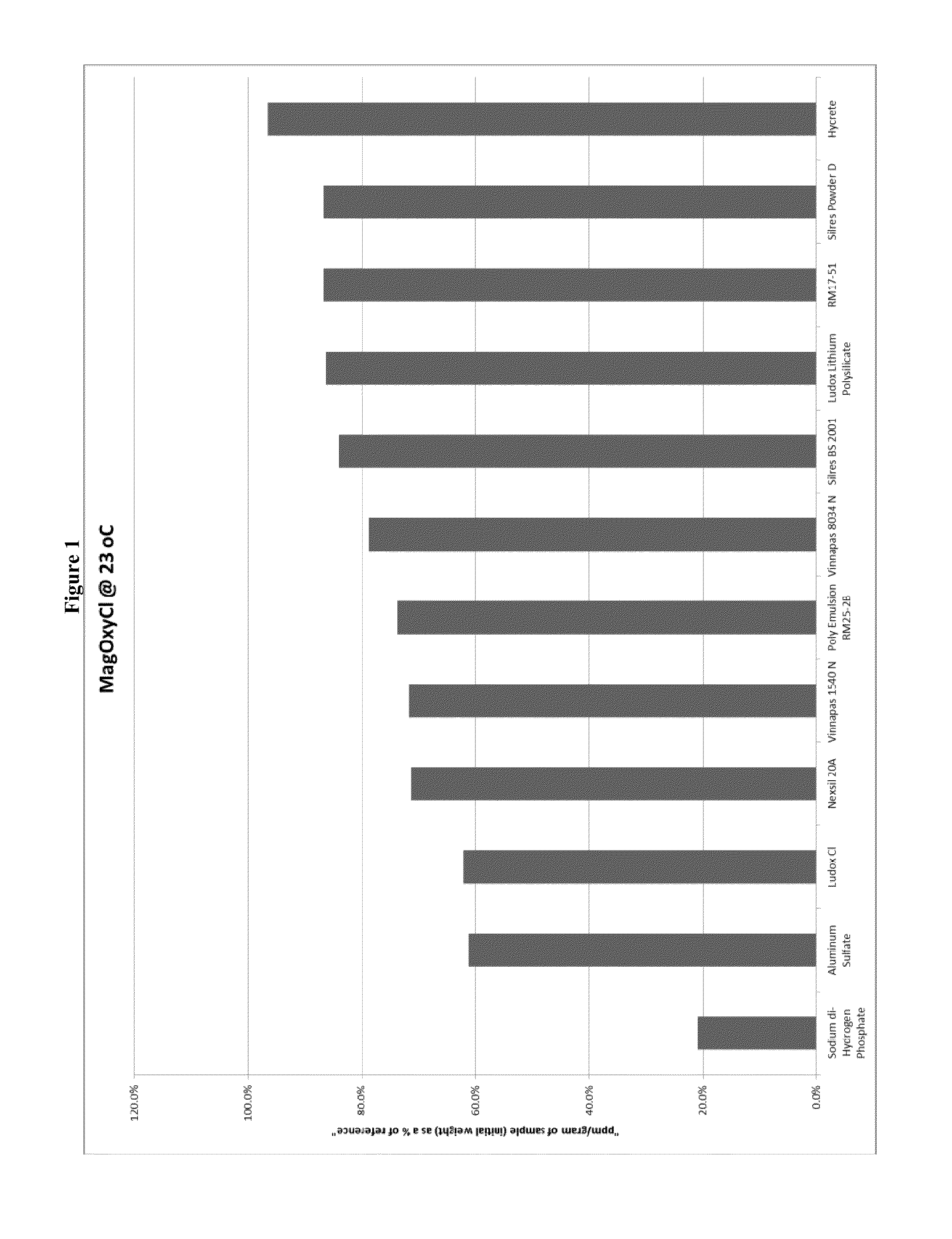
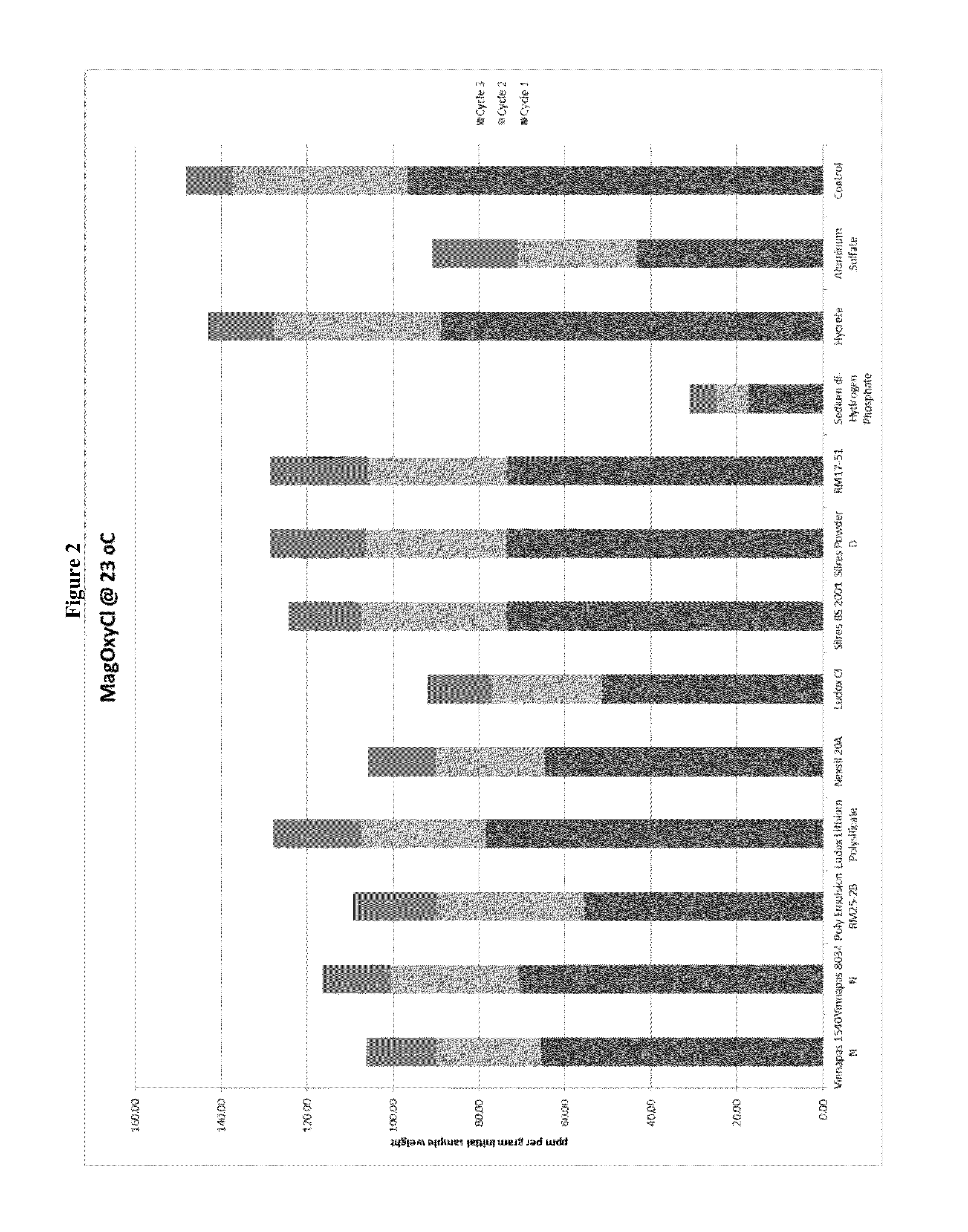
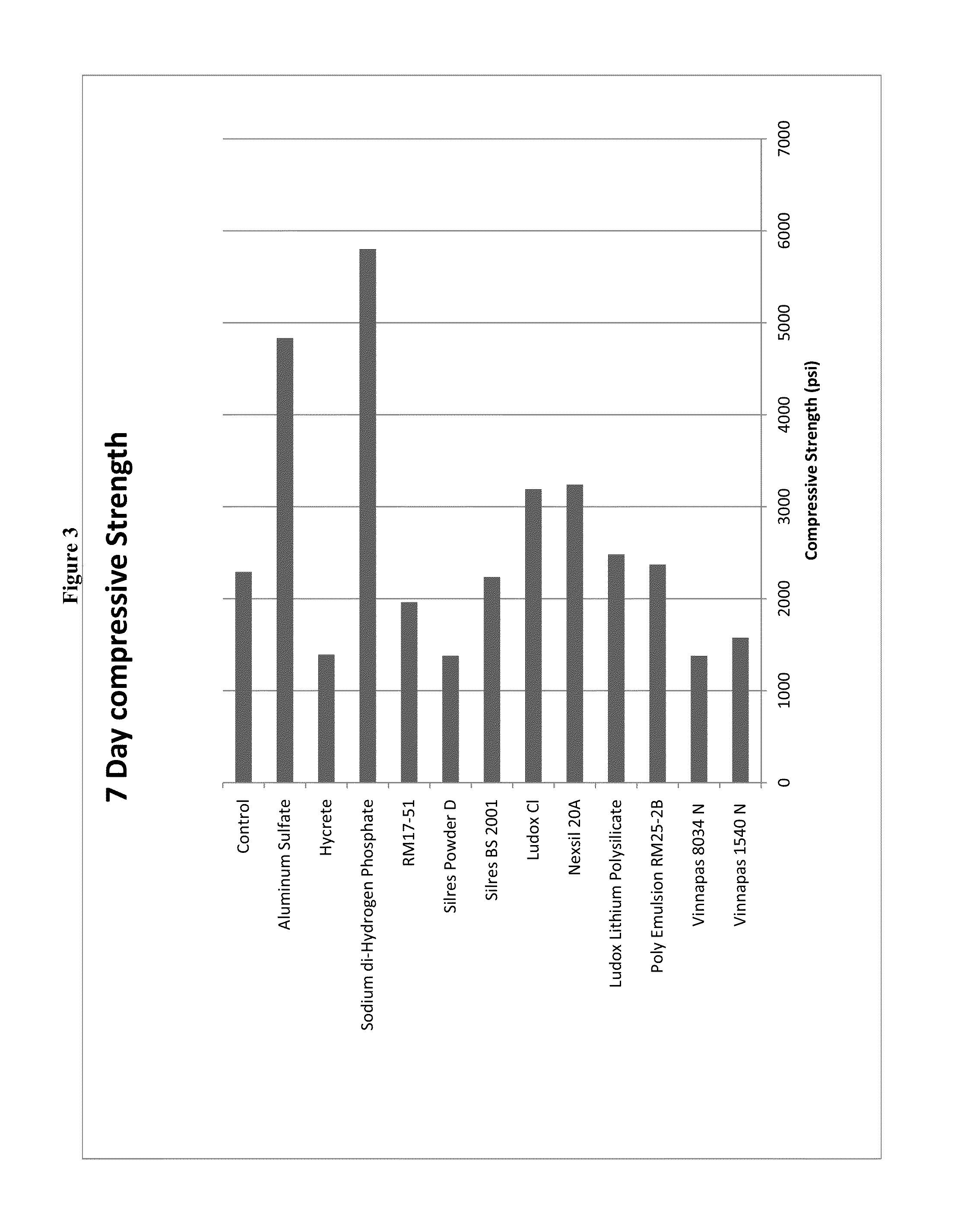
[0018]In an effort to address the inherent issues associated with Magnesium OxyChloride (MOC) cements and concretes, a multitude of experiments were run to find the answer to these age old problems. Therefore, various MOC mix designs were tested with molar mix ratios of Magnesium Oxide:Magnesium Chloride:Water ranging from about 1:1:7 to about 10:1:22. The most typical ratios commonly used for MOC cements range from 3, 5 and 7:1 ratios of MgO:MgCl2 and are referred to as a 3 phase, 5 phase and 7 phase MOC cement mix. As is known, the 5 phase formed includes a MgO:MgCl2:H2O molar ratio of 5:1:13, with a slight excess of MgO and an amount of water as close as possible to theoretical required for formation of the 5 phase and hydration of the excess MgO to form Mg(OH)2. There are a variety of grades of magnesium oxide that are effective in these MOC cements that range from light burned through dead burned grades, and calcined form natural or synthetic magnesite sources. As an illustrati...

the structure of the environmentally friendly knitted fabric provided by the present invention; figure 2 Flow chart of the yarn wrapping machine for environmentally friendly knitted fabrics and storage devices; image 3 Is the parameter map of the yarn covering machine
Login to View More

PUM

PropertyMeasurementUnit
molar ratioaaaaaaaaaa
compressive strengthsaaaaaaaaaa
RHaaaaaaaaaa
Login to View More

Abstract

Despite the excellent properties associated with Magnesium OxyChloride (Sorel) based cements and Magnesium OxySulfate based cements, water and corrosion resistance has been limiting factors for achieving greater commercial applications. Such issues can be addressed by incorporating various alkali metal phosphates, such as Magnesium mono- or dihydrogen phosphate (MgHPO4 or MgH2PO4) with alkali metal fatty acids; such as Magnesium Stearate; and metal or alkali metal sulfates such as Aluminum Sulfate or Magnesium Sulfate. Water resistance is further enhanced by either pre-carbonating the mix water or the liquid magnesium chloride phase of the cements, or by adding a carbonate into the powder phase. Accelerated cure of this system has also been obtained by using various inorganic metal oxides. Additionally, improved corrosion resistance is achieved through the use of certain phosphates, zeolites, nitrites and other novel additives.

Description

BACKGROUND OF THE DISCLOSURE[0001]Magnesium OxyChloride (“MOC”) cement was developed by Stanislaus Sorel in 1867. This cement binder technology provides inherently excellent properties such as fire retardancy; mold, algae and insect resistance; high compressive strengths, tenacious bonding characteristics and unmatched impact resistance. Due to these and other excellent properties, MOC cements have found good, but limited utility when used as the binder system for a multitude of applications ranging from high strength construction boards, industrial monolithic flooring concretes, patch repair concretes and mortars, as the binder system for billiards balls and many other applications. The biggest limiting factor for increased use of MOC binder systems has been the inherent lack of water resistance during the early cure stages, e.g., during the first months of curing. This limiting performance property is accentuated when finished products are used for outdoor applications, or where e...

Claims

the structure of the environmentally friendly knitted fabric provided by the present invention; figure 2 Flow chart of the yarn wrapping machine for environmentally friendly knitted fabrics and storage devices; image 3 Is the parameter map of the yarn covering machine
Login to View More

Application Information

Patent Timeline
10 Oct 2013
Publication
US20130263759A1
IPC
C04B9/02; C04B14/00; C04B24/08; C04B16/02; C04B24/14; C04B14/06; C04B18/06; C04B14/38; C04B16/08; C04B16/00; C04B9/04; C04B14/22
CPC
C04B28/32; C04B9/04; C04B14/047; C04B14/06; C04B14/062; C04B14/08; C04B14/18; C04B14/24
Inventors
RADEMAN, JERRY ELLIOT; WARDLE, RONALD