Check patentability & draft patents in minutes with Patsnap Eureka AI!

Process for preparing 2,2'-biphenols using selenium dioxide and halogenated solvent

a technology of biphenol and selenium dioxide, which is applied in the field of process for preparing 2, 2′biphenol using selenium dioxide and a halogenated solvent, can solve the problems of difficult scale-up, high cost of some of the apparatus, and inability to scale up to the ton scale, which is typically required in the industry,

Inactive Publication Date: 2015-11-26
EVONIK DEGUSSA GMBH
View PDF1 Cites 8 Cited by
  • Summary
  • Abstract
  • Description
  • Claims
  • Application Information

AI Technical Summary

Benefits of technology

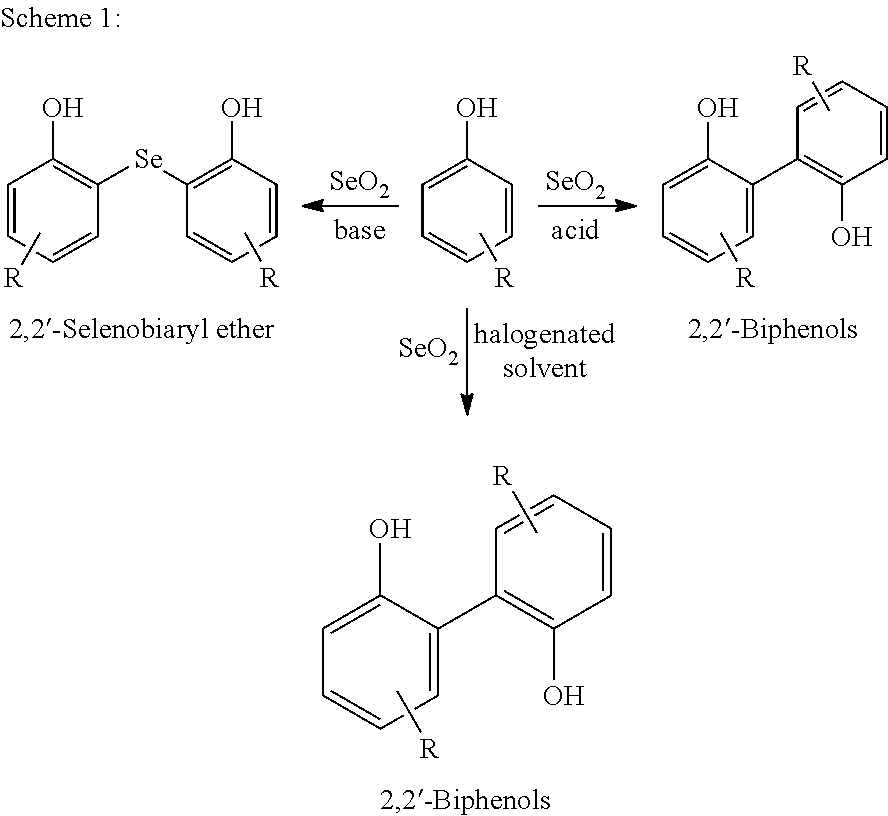
The present invention provides a process for selectively preparing 2,2′-biphenols with minimal by-products, which can be used on an industrial scale. The process involves adding two phenols to a reaction mixture, adding selenium dioxide, and adding a fluorinated or chlorinated solvent. The heating of the reaction mixture converts the first and second phenols into 2,2′-biphenol.

Problems solved by technology

The direct coupling of phenols to give the corresponding biphenol derivatives which are of great industrial interest continues to be a challenge since these reactions are often neither regio- nor chemoselective.
A disadvantage of these electrochemical methods is the cost of some of the apparatus, which has to be manufactured specially.
Moreover, scale-up to the ton scale, as is typically required in industry, is sometimes very complex and in some cases even impossible.
In this case, leaving functionalities and often toxic, conjugated transition metal catalysts based on palladium, for example, are used.
A great disadvantage of the abovementioned methods for phenol coupling is the need for dry solvents and for exclusion of air.
Both mean a high level of complexity, specifically when the process is to be used on the industrial scale.
Furthermore, the reactions described in the related art often give rise to toxic by-products which have to be removed from the desired product in a complex manner and disposed of at great cost.
The increasing scarcity of raw materials (for example boron and bromine) and the rising relevance of environmental protection is increasing the cost of such transformations.
Particularly in the case of utilization of multistage syntheses, an exchange of various solvents is necessary, which constitutes a high level of complexity and is an additional cost factor.

Method used

the structure of the environmentally friendly knitted fabric provided by the present invention; figure 2 Flow chart of the yarn wrapping machine for environmentally friendly knitted fabrics and storage devices; image 3 Is the parameter map of the yarn covering machine
View more

Image

Smart Image Click on the blue labels to locate them in the text.
Viewing Examples
Smart Image
  • Process for preparing 2,2'-biphenols using selenium dioxide and halogenated solvent
  • Process for preparing 2,2'-biphenols using selenium dioxide and halogenated solvent
  • Process for preparing 2,2'-biphenols using selenium dioxide and halogenated solvent

Examples

Experimental program
Comparison scheme
Effect test

examples

[0094]Analysis

[0095]NMR Spectroscopy

[0096]The mass spectroscopy studies were conducted on multi-nucleus resonance spectrometers of the AC 300 or AV II 400 type from Bruker, Analytische Messtechnik, Karlsruhe. The solvent used was CDCl3. The 1H and 13C spectra were calibrated according to the residual content of undeuterated solvent using the NMR Solvent Data Chart from Cambridge Isotopes Laboratories, USA. Some of the 1H and 13C signals were assigned with the aid of H,H-COSY, H,H-NOESY, H,C-HSQC and H,C-HMBC spectra. The chemical shifts are reported as δ values in ppm. For the multiplicities of the NMR signals, the following abbreviations were used: s (singlet), bs (broad singlet), d (doublet), t (triplet), q (quartet), m (multiplet), dd (doublet of doublets), dt (doublet of triplets), tq (triplet of quartets). All coupling constants J were reported in hertz (Hz) together with the number of bonds covered. The numbering given in the assignment of signals corresponds to the numbering ...

the structure of the environmentally friendly knitted fabric provided by the present invention; figure 2 Flow chart of the yarn wrapping machine for environmentally friendly knitted fabrics and storage devices; image 3 Is the parameter map of the yarn covering machine
Login to View More

PUM

PropertyMeasurementUnit
molar ratioaaaaaaaaaa
temperatureaaaaaaaaaa
Login to View More

Abstract

2,2′-biphenol is prepared in a process using selenium dioxide and a halogenated solvent.

Description

BACKGROUND OF THE INVENTION[0001]1. Field of the Invention[0002]The invention relates to a process for preparing 2,2′-biphenol using selenium dioxide and a halogenated solvent.[0003]2. Discussion of the Background[0004]The direct coupling of phenols to give the corresponding biphenol derivatives which are of great industrial interest continues to be a challenge since these reactions are often neither regio- nor chemoselective.[0005]The term “phenols” is used as a generic term in this application and therefore also encompasses substituted phenols.[0006]One possible way of synthesizing these biphenols is by means of electrochemical processes. In this case, carbon electrodes such as graphite, glassy carbon, BDD or transition metals such as platinum are used (cf. F. Stecker, A. Fischer, I. M. Malkowsky, S. R. Waldvogel, A. Kirste, WO 2010139687 A1 and A. Fischer, I. M. Malkowsky, F. Stecker, S. R. Waldvogel, A. Kirste WO 2010023258 A1). A disadvantage of these electrochemical methods is...

Claims

the structure of the environmentally friendly knitted fabric provided by the present invention; figure 2 Flow chart of the yarn wrapping machine for environmentally friendly knitted fabrics and storage devices; image 3 Is the parameter map of the yarn covering machine
Login to View More

Application Information

Patent Timeline
no application Login to View More
Patent Type & Authority Applications(United States)
IPC IPC(8): C07F11/00C07C37/11
CPCC07C37/11C07F11/00C07C391/02C07C39/15
Inventor DYBALLA, KATRIN MARIEFARNKE, ROBERTFRIDAG, DIRKWALDVOGEL, SIEGFRIED R.QUELL, THOMASMIRION, MICHAEL
Owner EVONIK DEGUSSA GMBH
Features
  • R&D
  • Intellectual Property
  • Life Sciences
  • Materials
  • Tech Scout
Why Patsnap Eureka
  • Unparalleled Data Quality
  • Higher Quality Content
  • 60% Fewer Hallucinations
Social media
Patsnap Eureka Blog
Learn More