Pattern forming method as well as production methods for processed substrate, optical component, circuit board, electronic component and imprint mold
Active Publication Date: 2017-10-05
CANON KK
View PDF1 Cites 19 Cited by
Summary
Abstract
Description
Claims
Application Information
AI Technical Summary
This helps you quickly interpret patents by identifying the three key elements:
Problems solved by technology
Method used
Benefits of technology
Benefits of technology
The present invention provides a method for forming a uniform pattern on a substrate using a specific technology. This technology improves throughput, resulting in a more efficient and uniform pattern forming process. Overall, the invention provides an improved pattern forming method with high throughput and uniformity.
Problems solved by technology
The photo-nanoimprint technology disclosed in Japanese Patent No. 4791357 has involved a problem in that a time period (filling time) from the initiation of the contact of the mold to the completion of the spread and the fill is long, and hence throughput is low.
Method used
the structure of the environmentally friendly knitted fabric provided by the present invention; figure 2 Flow chart of the yarn wrapping machine for environmentally friendly knitted fabrics and storage devices; image 3 Is the parameter map of the yarn covering machine
View more
Image
Smart Image Click on the blue labels to locate them in the text.
Viewing Examples
Smart Image
Click on the blue label to locate the original text in one second.
Reading with bidirectional positioning of images and text.
Smart Image
Examples
Experimental program
Comparison scheme
Effect test
example 1
[0178](1) Preparation of Curable Composition (A1-1)
[0179]A component (a1), a component (b1), a component (c1), and a component (d1) described below were blended, and the blend was filtered with a 0.2-micrometer filter made of ultrahigh-molecular weight polyethylene to prepare a curable composition (A1-1) of Example 1.
(1-1) Component (a1):100parts by weight in totalTrimethylolpropane triacrylate100parts by weight(manufactured by Sigma-Aldrich,abbreviation: TMPTA):(1-2) Component (b1):0parts by weight in total
[0180]The component (b1) was not added.
(1-3) Component (c1)0 parts by weight in total
[0181]The component (c1) was not added.
(1-4) Component (d1):33,000parts by weight in totalPropylene glycol monomethyl ether33,000parts by weightacetate (manufactured by TokyoChemical Industry Co., Ltd.,abbreviation: PGMEA):
[0182](2) Preparation of Curable Composition (A2-1)
[0183]A component (a2), a component (b2), a component (c2), and a component (d2) described below were blended, and the blend ...
example 2
[0192](1) to (3) Curable Compositions (A1) and (A2)
[0193]The same compositions as that of Example 1 were used as a curable composition (A1) and (A2).
[0194](4) Discussion on Prespread Promoting Effect
[0195]It is hypothesized that the residual ratio of the component (d1) serving as a solvent in the film of the curable composition (A1-1) is 10 wt %. The surface tension of the film of the curable composition (A1-1) is 35.1 mN / m, and is higher than the surface tension of the curable composition (A2-1), i.e., 32.7 mN / m by 2 mN / m or more. Accordingly, a strong prespread promoting effect can be obtained.
[0197]Similarly, it is hypothesized that the residual ratio of the component (d1) serving as a solvent in the film of the curable composition (A1-1) is 10 wt %. The volatility of the component (a1) is low and an influence of the volatilization of the component (d1) serving as a solvent is slight. Accordingly, the Marangoni ef...
the structure of the environmentally friendly knitted fabric provided by the present invention; figure 2 Flow chart of the yarn wrapping machine for environmentally friendly knitted fabrics and storage devices; image 3 Is the parameter map of the yarn covering machine
Login to View More
PUM
Property
Measurement
Unit
Dynamic viscosity
aaaaa
aaaaa
Volume
aaaaa
aaaaa
Fraction
aaaaa
aaaaa
Login to View More
Abstract
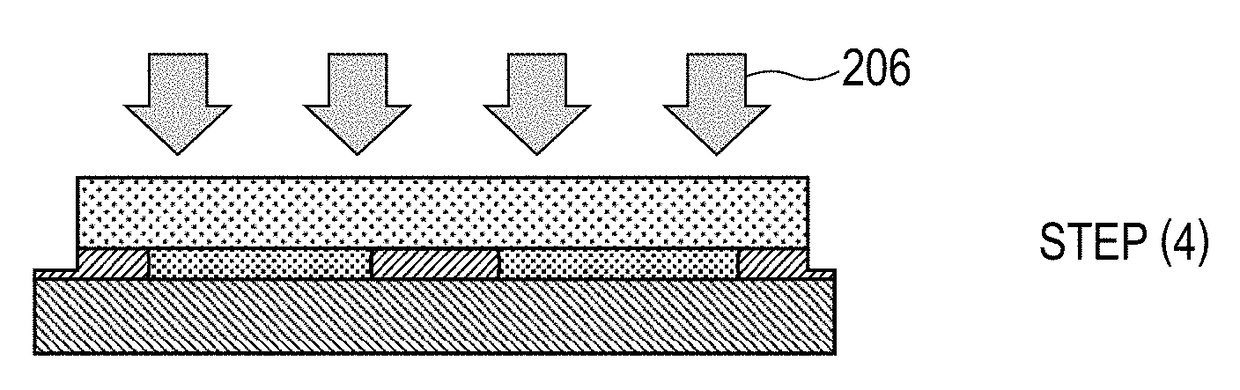
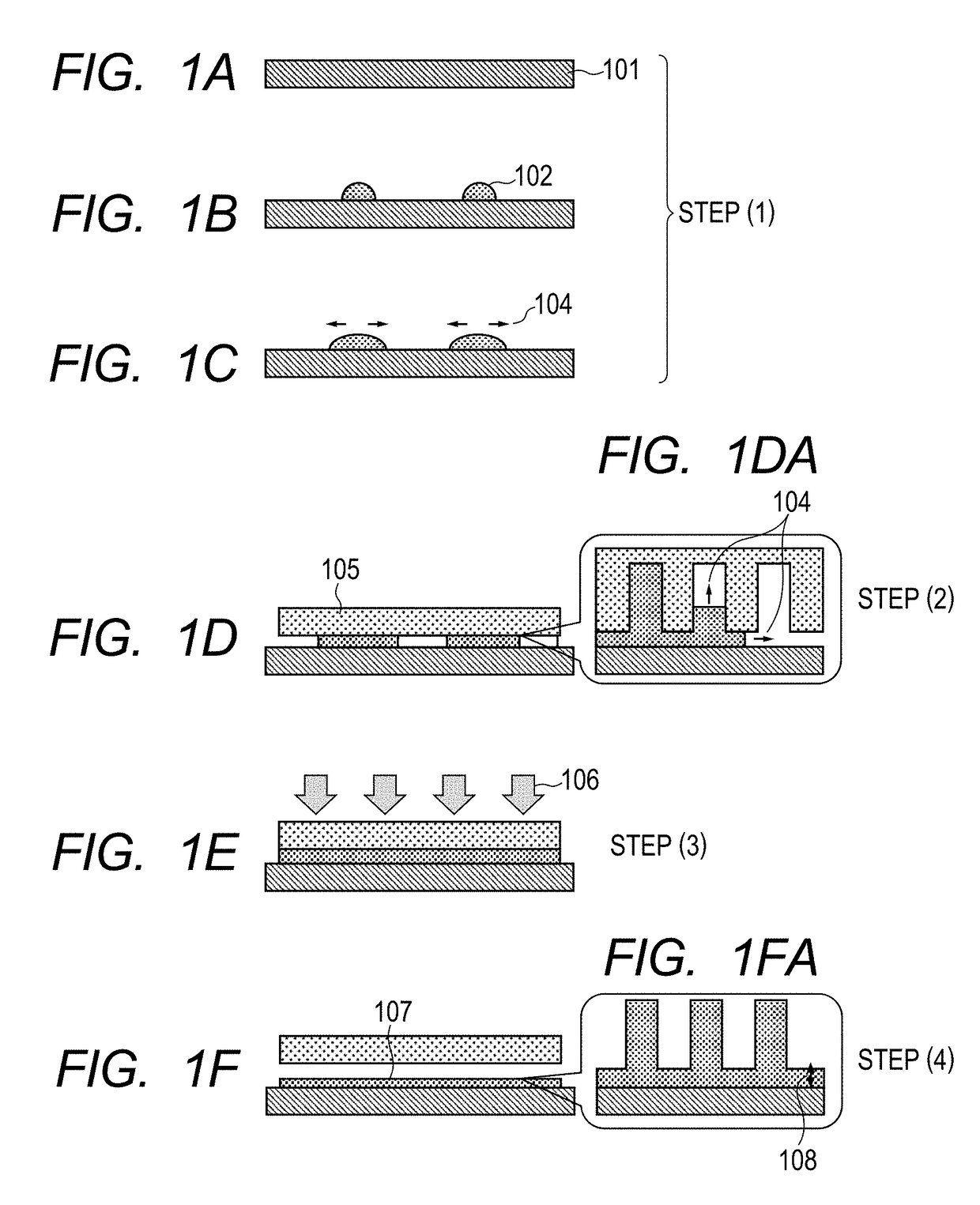
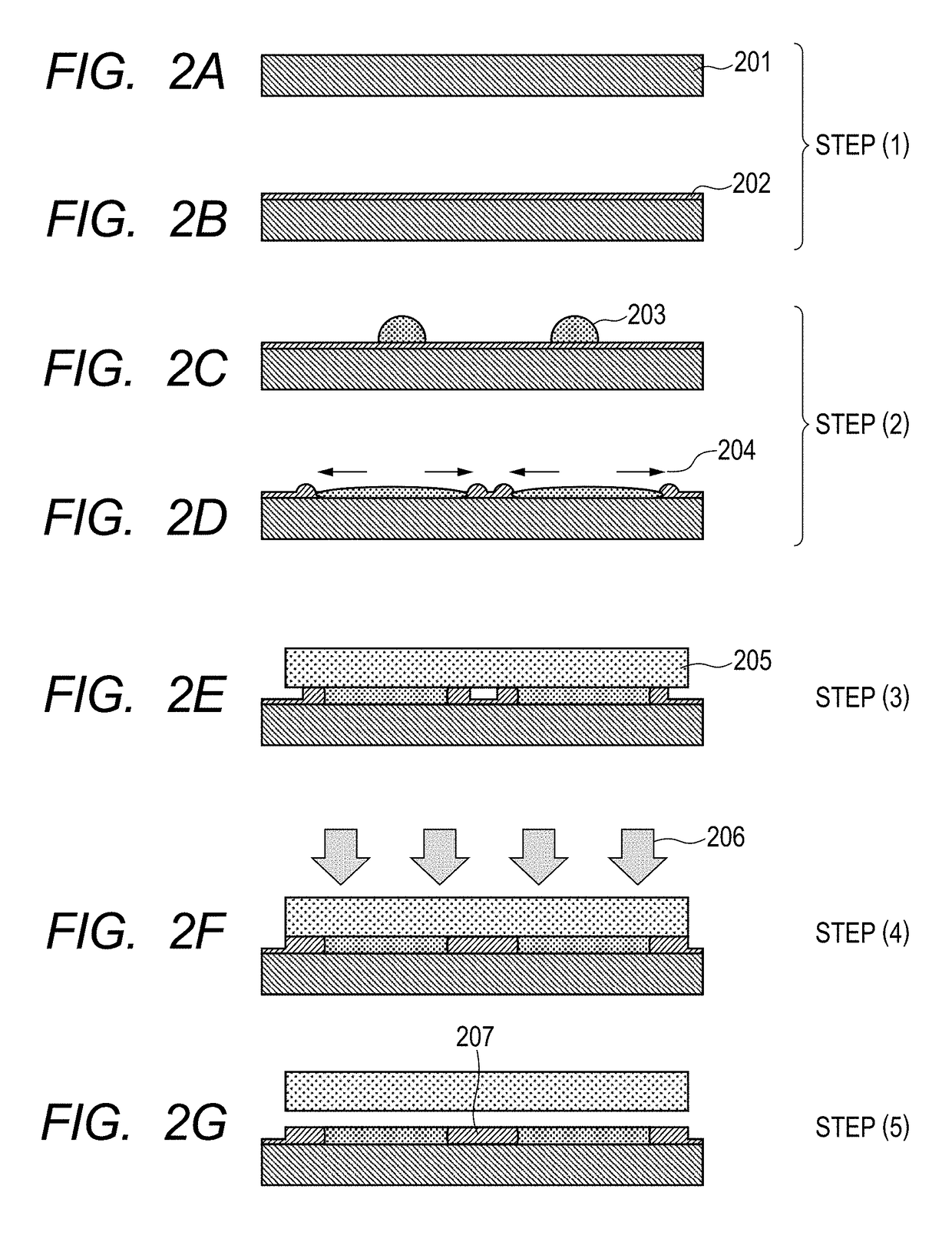
A pattern is formed on a substrate with forming a layer of a curable composition (A1) containing a component (a1) serving as a polymerizable compound and a component (d1) serving as a solvent on a surface of the substrate, then dispensing droplets of a curable composition (A2) containing at least a component (a2) serving as a polymerizable compound dropwise discretely onto the layer of the curable composition, subsequently sandwiching a mixture layer of the curable composition (A1) and the curable composition (A2) between a mold and the substrate, then irradiating the mixture layer with light to cure the layer, and releasing the mold from the mixture layer after the curing.
Description
BACKGROUND OF THE INVENTIONField of the Invention[0001]The present invention relates to a pattern forming method, a method of producing a processed substrate, a method of producing an optical component, a method of producing a circuit board, a method of producing an electronic component, and a method of producing an imprint mold.Description of the Related Art[0002]There has been a growing requirement for miniaturization in a semiconductor device, a MEMS, or the like, and hence a photo-nanoimprint technology has been attracting attention as a microfabrication technology.[0003]In the photo-nanoimprint technology, a photocurable composition (resist) is cured in a state in which a mold having a fine groove / land pattern formed on its surface is pressed against a substrate (wafer) having applied thereto the photocurable composition. Thus, the groove / land pattern of the mold is transferred onto the cured film of the photocurable composition and hence the pattern is formed on the substrate....
Claims
the structure of the environmentally friendly knitted fabric provided by the present invention; figure 2 Flow chart of the yarn wrapping machine for environmentally friendly knitted fabrics and storage devices; image 3 Is the parameter map of the yarn covering machine
Login to View More
Application Information
Patent Timeline
Application Date:The date an application was filed.
Publication Date:The date a patent or application was officially published.
First Publication Date:The earliest publication date of a patent with the same application number.
Issue Date:Publication date of the patent grant document.
PCT Entry Date:The Entry date of PCT National Phase.
Estimated Expiry Date:The statutory expiry date of a patent right according to the Patent Law, and it is the longest term of protection that the patent right can achieve without the termination of the patent right due to other reasons(Term extension factor has been taken into account ).
Invalid Date:Actual expiry date is based on effective date or publication date of legal transaction data of invalid patent.


 Login to View More