Usually, when there are abnormal heart rates observed, it is difficult to distinguish whether the
abnormality is from atrium or
ventricle by merely studying the waveforms of the arterial pulses.
Consequently, the user is unable to know how serious the observed symptom is.
Also, since arterial pulses measured at limbs are actually heartbeats transmitted to limbs through blood in blood vessels, the accuracy thereof is incomparable to an electrocardiogram.
Thus, even if a
sphygmomanometer indeed can conveniently screen some arrhythmic symptoms, unavoidably, the final determination of arrhythmia can only be done by observing an electrocardiogram.
If the pressure is too high, the amplitude of arterial pulses might be decreased due to the pressed blood vessels, and
pulse measurement performed at this time may have omission that leads to erroneous determination.
It is thus clear that when we use a
sphygmomanometer's cuff to measure arterial pulses, there are many operational limitations, wherein it has to be consider the
impact of the pressure variation from the cuff on the blood vessels, and it also has to consider that, for determination of arrhythmia, whether the diagnosis based on this is reliable.
While hand operation is quite convenient, it brings about a huge challenge to accuracy.
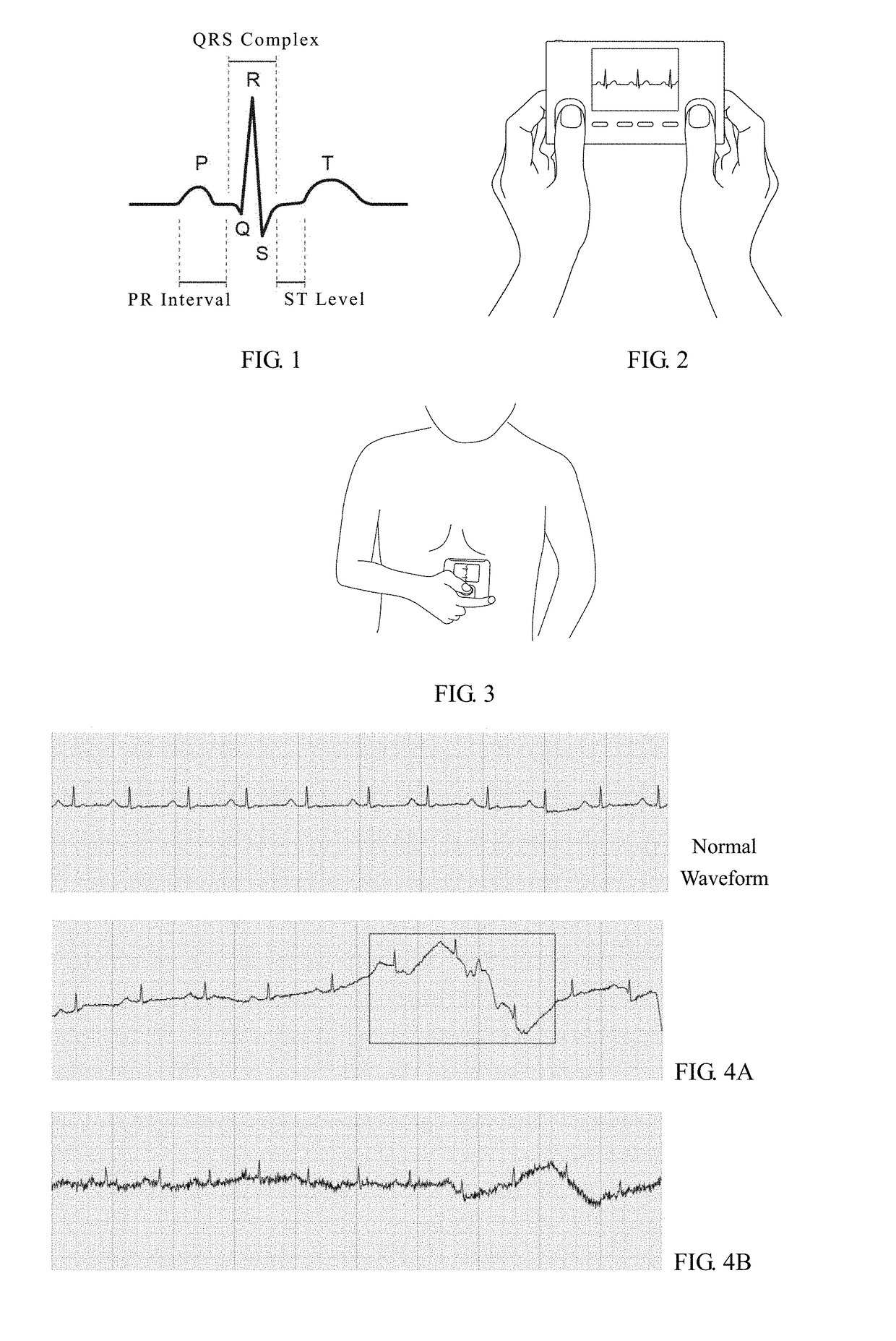
When the measurement is taken by making the electrodes contact a user's both hands, as shown in FIG. 2, since the user's hands may shake and tremble during measurement, the operation stability is problematic, and the measured electrocardiograms may have
baseline shift and waveform deformation, as marked in FIG. 4A.
Compared to the normal waveform of electrocardiographic signals, such
baseline shift and waveform deformation can cause incorrect analytic results.
Besides, when the user tries to stabilize his / her hands which causes
muscle tension, or to make a special effort to ensure the contact between his / her hands and the electrodes, it will be very easy to generate electromyographic signals, as shown in FIG. 4B, thereby decreasing the
signal quality and thus leading to incorrect electrocardiogram analytic results.
However, its operation disadvantageously requires the user to remove his / her clothing over the chest, and this terribly limits where the measurement can be taken.
Additionally, chest displacement due to
respiration can also cause relative movement between the electrode contacting the chest and the electrode contacting the hand, and may similarly lead to
baseline shift that makes the resulting electrocardiograms inaccurate.
For example, electromagnetic
waves in the environment where the measurement is taken can cause noises in the obtained electrocardiographic signals, and electromyographic signals caused by instable contact or overtense muscles during measurement can also be artifacts.
These all have adverse effects on
signal quality.


 Login to View More
  Login to View More