Unlock instant, AI-driven research and patent intelligence for your innovation.
Composition for encapsulating organic light emitting element and organic light emitting element display device manufactured therefrom
Active Publication Date: 2018-11-29
SAMSUNG SDI CO LTD
View PDF0 Cites 4 Cited by
Summary
Abstract
Description
Claims
Application Information

AI Technical Summary
This helps you quickly interpret patents by identifying the three key elements:
Problems solved by technology
Method used
Benefits of technology
The present invention provides a composition for encapsulation of an organic light emitting device that has good plasma resistance and low modulus. It can be used in flexible displays and has a high photocuring rate. The composition can easily form an organic barrier layer and has high light transmittance.
Problems solved by technology
Such an organic light emitting device can suffer from deterioration in light emitting properties upon contact with external moisture and / or oxygen.
When the organic barrier layer is etched, an encapsulation function of the organic barrier layer can be damaged.
As a result, the organic light emitting device can suffer from deterioration in light emitting properties and reliability.
Method used
the structure of the environmentally friendly knitted fabric provided by the present invention; figure 2 Flow chart of the yarn wrapping machine for environmentally friendly knitted fabrics and storage devices; image 3 Is the parameter map of the yarn covering machine
View more
Image
Smart Image Click on the blue labels to locate them in the text.
Viewing Examples
Smart Image
Click on the blue label to locate the original text in one second.
Reading with bidirectional positioning of images and text.
Smart Image
Examples
Experimental program
Comparison scheme
Effect test
example 2
Preparative Example 2
[0118]A monomer represented by Formula 9 was obtained in the same manner as in Preparative Example 1 except that 25 g of 3-phenyl-1,1,3,5,5-pentamethyltrisiloxane (Gelest Inc.) was used instead of 21 g of 3,3-diphenyl-1,1,5,5-tetramethyltrisiloxane.
example 3
Preparative Example 3
[0119]In a 1,000 ml flask provided with a cooling tube and a stirrer, 300 ml of ethyl acetate, 25 g of 3-phenyl-1,1,1,3,5,5-hexamethyltrisiloxane (Gelest Inc.) and 47 g of allyl alcohol were placed, followed by nitrogen purging for 30 minutes. Next, 72 ppm of Pt-on-carbon blackpowder (Aldrich GmbH) was added thereto, followed by heating the flask to 80° C. and stirring the components for 4 hours. The remaining solvent was removed by distillation, thereby obtaining a compound. 65.5 g of the obtained compound and 48 g of triethylamine were sequentially added to 300 ml of dichloromethane, followed by slowly adding 31.3 g of methacryloyl chloride while stirring the mixture at 0° C. The remaining solvent was removed by distillation, thereby obtaining a monomer represented by Formula 13 and having a purity of 97% as determined by HPLC (molecular weight: 410.73 g / mol). (1H NMR: 67.61, m, 3H: δ7.12, m, 2H: δ6.25, d, 1H: δ6.02, dd, 1H: δ3.87, m, 2H: δ2.82, s, 3H: δ1.54,...
example 4
Preparative Example 4
[0120]A monomer represented by Formula 14 and having a purity of 96% as determined by HPLC (molecular weight: 410.73 g / mol) was obtained in the same manner as in Preparative Example 3 except that 25 g of 3-phenyl-1,1,1,5,5,5-hexamethyltrisiloxane (Gelest Inc.) was used instead of 25 g of 3-phenyl-1,1,1,3,5,5-hexamethyltrisiloxane (Gelest Inc.). (1H NMR: 67.61, m, 3H: δ7.12, m, 2H; 56.25, d, 1H: δ6.02, dd, 1H: δ3.87, m, 2H: δ2.82, s, 3H δ1.54, m, 2H: δ0.58, m, 2H: δ0.02, m, 18H).
[0121]Details of components used in Examples and Comparative Examples were as follows.
the structure of the environmentally friendly knitted fabric provided by the present invention; figure 2 Flow chart of the yarn wrapping machine for environmentally friendly knitted fabrics and storage devices; image 3 Is the parameter map of the yarn covering machine
Login to View More
PUM
Property
Measurement
Unit
Fraction
aaaaa
aaaaa
Fraction
aaaaa
aaaaa
Pressure
aaaaa
aaaaa
Login to View More
Abstract
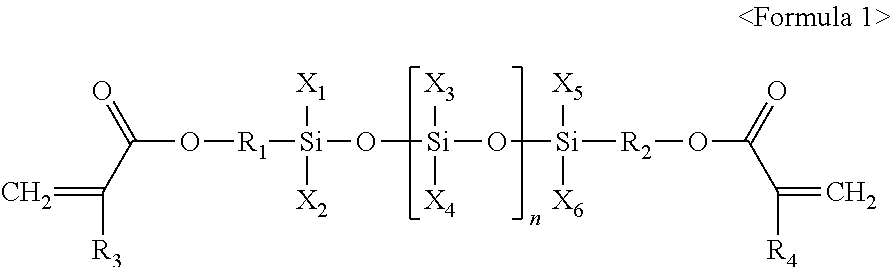
Provided are a composition for encapsulating an organic light emitting element and an organic light emitting element display device manufactured therefrom, the composition comprising: (A) a non-silicone-based photocurable multifunctional monomer; (B) a silicone-based photocurable multifunctional monomer; (C) a non-silicone-based photocurable monofunctional monomer; (D) a silicone-based photocurable monofunctional monomer; and (E) an initiator, wherein the silicone-based photocurable multifunctional monomer (B) is represented by chemical formula 1.
Description
TECHNICAL FIELD[0001]The present invention relates to a composition for encapsulation of an organic light emitting device and an organic light emitting display fabricated using the same.BACKGROUND ART[0002]An organic light emitting display includes an organic light emitting device. Such an organic light emitting device can suffer from deterioration in light emitting properties upon contact with external moisture and / or oxygen. Thus, the organic light emitting device must be encapsulated with an encapsulation composition. The organic light emitting device is encapsulated in a multilayer structure including an inorganic barrier layer and an organic barrier layer. The inorganic barrier layer is formed by plasma deposition, which can cause the organic barrier layer to be etched by plasma. When the organic barrier layer is etched, an encapsulation function of the organic barrier layer can be damaged. As a result, the organic light emitting device can suffer from deterioration in light em...
Claims
the structure of the environmentally friendly knitted fabric provided by the present invention; figure 2 Flow chart of the yarn wrapping machine for environmentally friendly knitted fabrics and storage devices; image 3 Is the parameter map of the yarn covering machine
Login to View More
Application Information
Patent Timeline
Application Date:The date an application was filed.
Publication Date:The date a patent or application was officially published.
First Publication Date:The earliest publication date of a patent with the same application number.
Issue Date:Publication date of the patent grant document.
PCT Entry Date:The Entry date of PCT National Phase.
Estimated Expiry Date:The statutory expiry date of a patent right according to the Patent Law, and it is the longest term of protection that the patent right can achieve without the termination of the patent right due to other reasons(Term extension factor has been taken into account ).
Invalid Date:Actual expiry date is based on effective date or publication date of legal transaction data of invalid patent.