
Stem Cell-Derived Exosomes Containing a High Amount of Growth Factors
- Summary
- Abstract
- Description
- Claims
- Application Information
AI Technical Summary
Benefits of technology
Problems solved by technology
Method used
Image

Examples
example 1
on of Mesenchymal Stem Cells and Collection of Culture
[0070]Human umbilical cord blood-derived mesenchymal stem cells (UCB-MSCs), human adipose-derived mesenchymal stem cells (AD-MSCs), and human bone marrow-derived mesenchymal stem cells (BM-MSCs) were cultured under the following conditions.
[0071]As a serum-free medium, UCB-MSCs, AD-MSCs, and BM-MSCs were dispensed at a concentration of 2×10⁵ cells into each T25 flask, where Dulbecco's Modified Eagle's Medium (DMEM) was contained without a pH indicator (e.g., phenol red, etc.), and cultured in a 37° C. incubator with 5% CO2 for 2 days. Then, the existing culture was removed and the cells were washed with PBS, and the medium was replaced with DMEM containing EGF and FGF or DMEM not containing EGF and FGF, in a 2.5-fold volume of the existing culture. The cells were cultured for 4 days in the replaced medium, and thereby the UCB-MSC, AD-MSC, and BM-MSC cultures were obtained.
example 2
of Exosomes from Cultures
[0072]Each of the cultures obtained in Example 1 was transferred into a 50 mL tube and centrifuged at 2,000 rpm for 5 minutes. The resulting pellet of each cell culture was discarded and only the supernatant of each cell culture was collected and transferred into a 50 mL tube and centrifuged at 2,000×g for 30 minutes. Each supernatant separated by centrifugation was again transferred into a fresh 50 mL tube.
[0073]Then, the Exosome Isolation Reagent (Invitrogen, Cat. No. 4478359) was added to each of the separated supernatants in a ratio of 500 μL:1 mL and incubated at 4° C. After 24 hours, each mixture was centrifuged at 10,000×g for 60 minutes and each pellet formed was resuspended in 1×PBS to prepare isolated exosomes.
Experimental Example 1. Analysis of Active Ingredients in Isolated Exosomes
Experimental Example 1-1. Confirmation of Presence of Active Ingredient
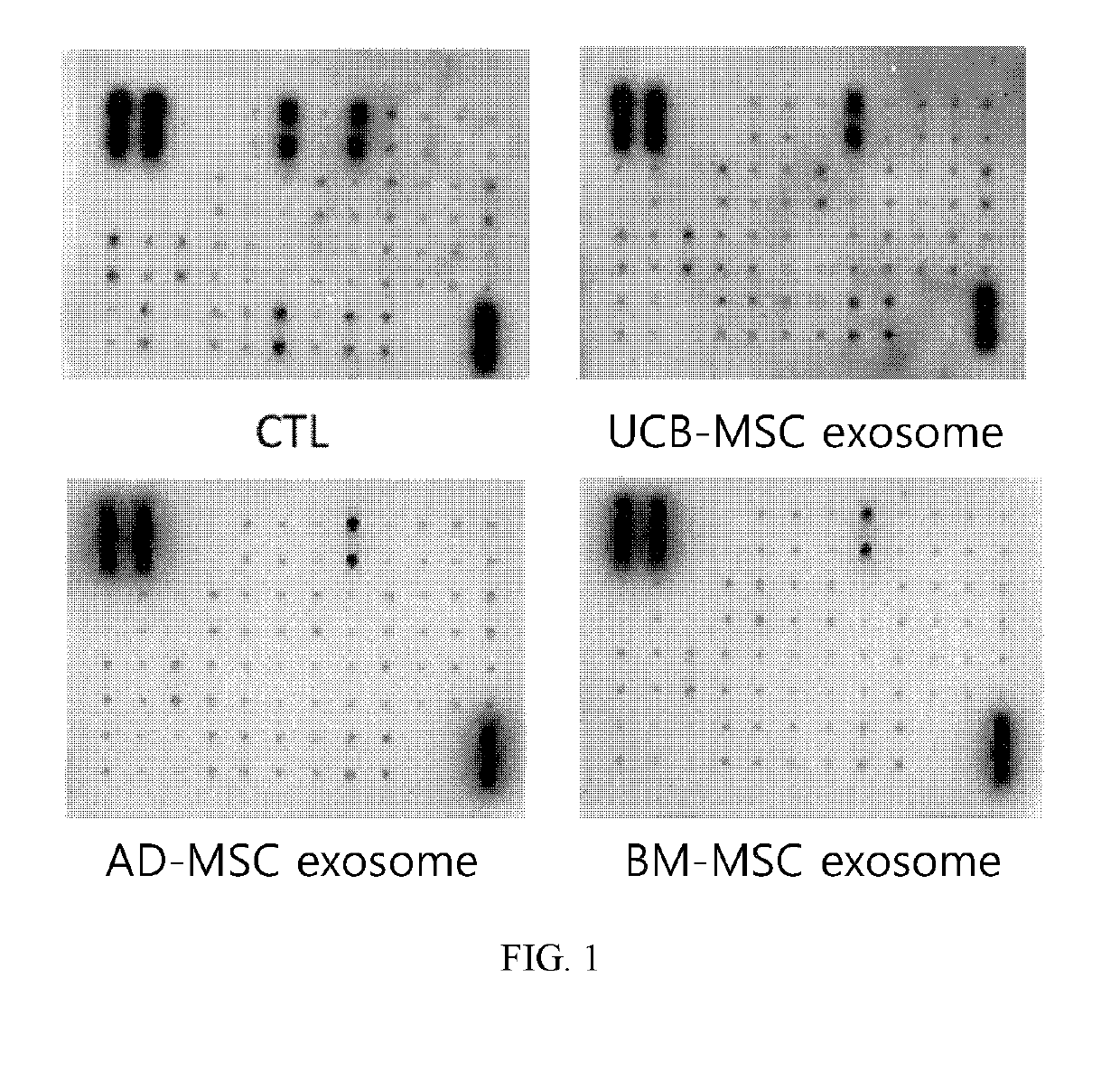
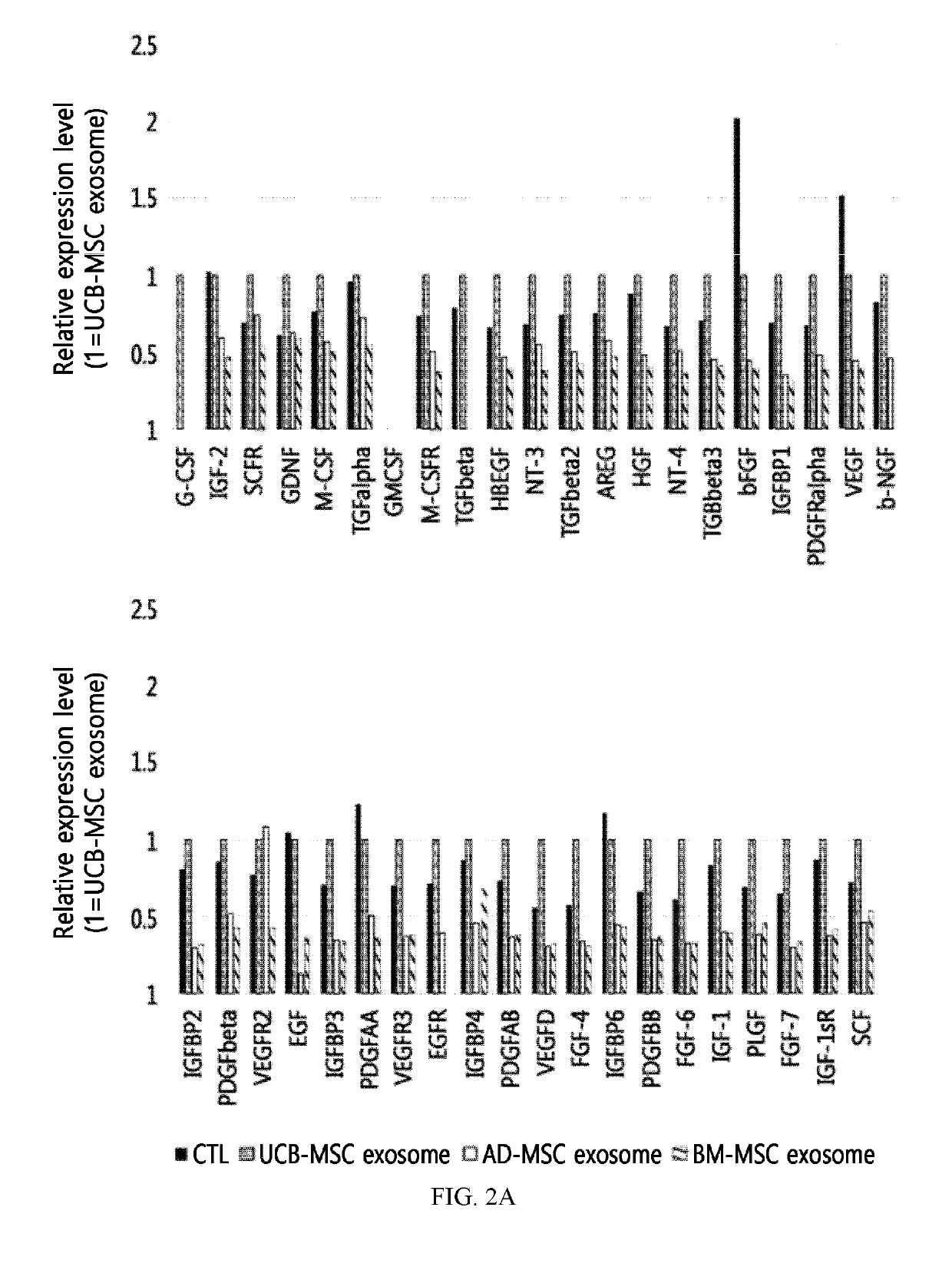
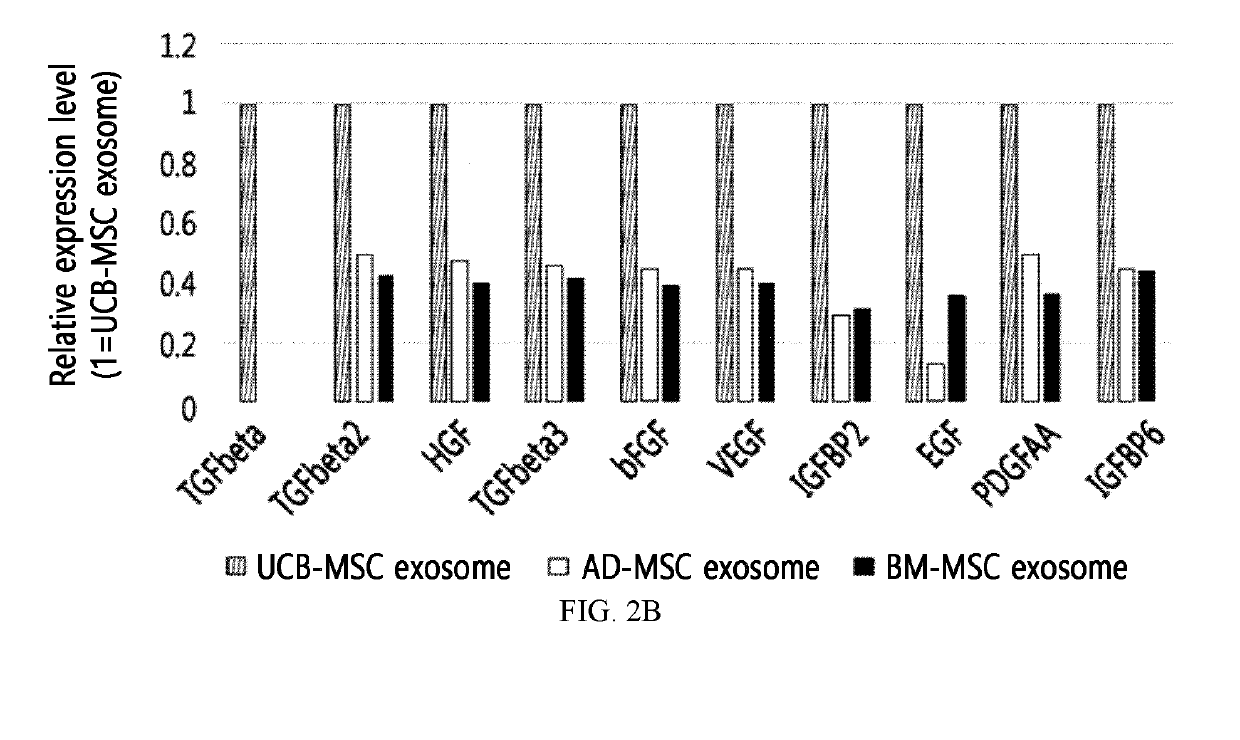
[0074]To confirm the presence of ingredients of exosomes isolated from each culture of stem cell...
experimental example 2
ngredients in Exosomes According to Culture Conditions
[0078]To develop a method for further increasing the amount of active ingredients in exosomes, the UCB-MSCs were cultured under the conditions where the growth factors EGF and FGF were added or not added, and the amount of active ingredients in exosomes isolated from the cultured UCB-MSCs was compared through the Human Growth Factor Antibody Array.
[0079]As a result, it was confirmed that the “UCB-MSC exosome”, under the conditions of a medium where EGF and FGF were added, showed an increase in the amounts of all of the growth factors (e.g., transforming growth factor-beta 2 (TGFβ2), HGF, transforming growth factor-beta 3 (TGFβ3), bFGF, VEGF, EGF, platelet-derived growth factor-AA (PDGFAA), etc.) by 1.5- to 2-fold, as shown in FIG. 3. From these results, it was confirmed that when UCB-MSCs were cultured using EGF and FGF, the amount of exosomes derived from the cells described above could be further increased.
Experimental Example ...
PUM
 Login to View More
 Abstract
Description
Claims
Application Information
 Login to View More