Method for the detection of legionella
a detection method and legionella technology, applied in the field of legionella detection, can solve the problems of waterborne infection, significant threat to human health, and approximately 98,000 deaths, and achieve rapid and effective diagnosis and treatment, sufficient variation, and rapid and easy-to-interpret effects
- Summary
- Abstract
- Description
- Claims
- Application Information
AI Technical Summary
Benefits of technology
Problems solved by technology
Method used
Image



Examples
example 1
Real-Time PCR Assay for the Detection of Legionella pneumophila Serogroup 1
[0157]In Silico Target Identification
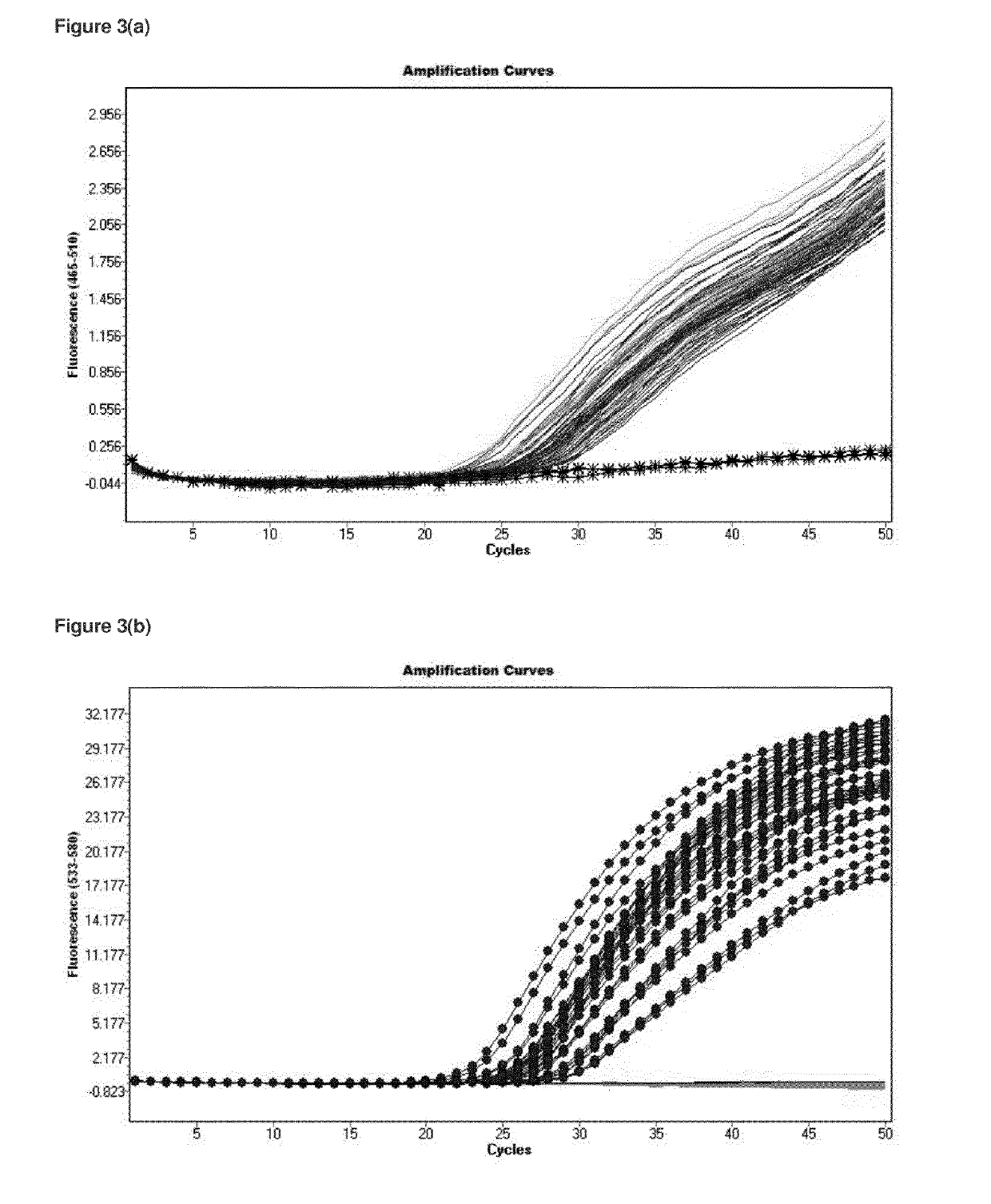
[0158]Publicly available whole genome sequence information was retrieved from the National Center for Biotechnology Information website (www.ncbi.nlm.nih.gov / ) for Legionella pneumophila serogroup 1 and Legionella pneumophila serogroup 6 and serogroup 12. Regions potentially unique to L. pneumophila serogroup 1 were identified using WEBACT (www.webact.org / ). This resulted in a number of regions of difference in L. pneumophila serogroup 1. Each identified putative target nucleotide sequence was BLAST analysed (blast.ncbi.nlm.nih.gov / Blast.cgi) to determine if they were present in all L. pneumophila serogroup 1 and absent in all other L. pneumophila serogroups or closely related Legionella species. One region was present in all L. pneumophila serogroup 1 analysed with very low or no sequence similarity to other L. pneumophila serogroups or closely related Legionella species....
example 2
Assay for the Detection of Legionella pneumophila
[0170]In Silico Analysis
[0171]Publicly available smpB gene nucleotide sequence information was retrieved from the National Center for Biotechnology Information website (www.ncbi.nlm.nih.gov / ) for Legionella pneumophila and aligned using ClustalW (www.ebi.ac.uk / Tools / msa / clustalw2 / ). Partial gene sequence was also generated for a number of culture collection strains using sequencing primers and then aligned. All publicly available and generated nucleotide sequences for Legionella pneumophila sequences were subsequently aligned which demonstrated sufficient nucleotide similarity to design oligonucleotide primers and probes.
[0172]In this example, the following exemplary real-time PCR assay primers and probe for the smpB gene nucleotide sequence (SEQ ID NO. 6) were used: smpB forward primer (SEQ ID NO. 7), smpB reverse primer (SEQ ID NO. 8), smpB probe (SEQ ID NO. 9). Optionally an alternative smpB reverse primer (SEQ ID No. 13) could be...
example 3
An Internally Controlled Multiplex Real-Time PCR for the Detection and Identification of Legionella Species, Legionella pneumophila (Serogroup 1-16) and Legionella pneumophila Serogroup 1
[0184]Diagnostic Target Identification
[0185]A number of housekeeping genes which are highly conserved throughout the Legionella genus were evaluated to identify, in silico, a potential diagnostic target which could be used to detect all members of this genus and for the detection of Legionella pneumophila strains. The optimal diagnostic target chosen in this study for detection of the Legionella genus was the ssrA gene. The ssrA gene codes for tmRNA and has been identified in all bacterial species. The function of tmRNA in bacteria is to rescue stalled ribosomes and to clear the cell of incomplete polypeptides. In silico alignment of publically available nucleotide sequences indicated that while sufficient nucleotide sequence heterogeneity exists between different Legionella species, sufficient nucl...
PUM
 Login to View More
 Abstract
Description
Claims
Application Information
 Login to View More
 - R&D
- Intellectual Property
- Life Sciences
- Materials
- Tech Scout
- Unparalleled Data Quality
- Higher Quality Content
- 60% Fewer Hallucinations
Browse by: Latest US Patents, China's latest patents, Technical Efficacy Thesaurus, Application Domain, Technology Topic, Popular Technical Reports.
© 2025 PatSnap. All rights reserved.Legal|Privacy policy|Modern Slavery Act Transparency Statement|Sitemap|About US| Contact US: help@patsnap.com