Unlock instant, AI-driven research and patent intelligence for your innovation.

Method and apparatus for determining a smoothed data point within a stream of data points

a data point and stream technology, applied in the field of methods and apparatus for determining smoothed data points within stream of data points, can solve the problems of invalid or missing values seriously affecting the results of data point recording, sequence error reduction problems are considered, and unsatisfactory, so as to achieve smoothing out noise, improve accuracy, and improve data spacing

Active Publication Date: 2020-04-23
EYESENSE AG
View PDF3 Cites 4 Cited by
  • Summary
  • Abstract
  • Description
  • Claims
  • Application Information

AI Technical Summary

Benefits of technology

The method effectively reduces noise and maintains accuracy in real-time data processing, minimizing power consumption and sensor exposure, while handling gaps and varying data spacing, providing reliable smoothed data points even with short data sets and missing values.

Problems solved by technology

However, this situation which is known from practical experience is particularly unsatisfying in a situation when a measurement has been scheduled to provide real-time or nearly-real time information, for example when determining one or more body functions of a user, such as a patient who is under permanent surveillance in an intensive care unit.
Particularly in a situation where the real-time or nearly real-time information is required to trigger any further devices and / or to make a decision, invalid or missing values may seriously influence the results of the recording of the data points, in some situations even in an unintentional direction.
Hereby, an error reduction problem is considered for a sequence of related data values, particularly related to a time-series measurement of an observable, which is expected to follow a pattern which may not be known beforehand but which could be drafted in a two-dimensional representation and in which an error can be assumed to occur primarily in one of the two dimensions.
The more data points are used for the procedure, the better turns out the removal of random errors which is, however, achieved at cost of introducing a systematic error by an application of the procedure itself.
However, such polynomial regression based on this method may also lead to delays and distortions.
However, such filters are not applicable in a case where such a model is missing or inappropriate.
As an example, when monitoring physiological data of a user in a real-life setting, it is not feasible to provide an appropriate physical model which could reasonably describe parameters like a glucose concentration behavior with respect to an insulin intake.
Although this algorithm calculates the current best parameter from the data points in a given time interval in the past, there always remains a considerable risk that unforeseen physiological conditions or unusual sensor behavior leads to unexpected and possibly hazardous errors in the reporting of a set of smoothed data.
Irrespective of their potential applicability for this purpose, Wiener filters suffer from the fact that they are based on complicated mathematical algorithms which impede their implementation.
As will be explained below in further detail, it has, however, been found that this method as proposed by Roark, faces severe problems when a large number of missing values is comprised within the stream of data points, in which case intolerable errors are introduced into the smoothing process.

Method used

the structure of the environmentally friendly knitted fabric provided by the present invention; figure 2 Flow chart of the yarn wrapping machine for environmentally friendly knitted fabrics and storage devices; image 3 Is the parameter map of the yarn covering machine
View more

Image

Smart Image Click on the blue labels to locate them in the text.
Viewing Examples
Smart Image
  • Method and apparatus for determining a smoothed data point within a stream of data points
  • Method and apparatus for determining a smoothed data point within a stream of data points
  • Method and apparatus for determining a smoothed data point within a stream of data points

Examples

Experimental program
Comparison scheme
Effect test

first embodiment

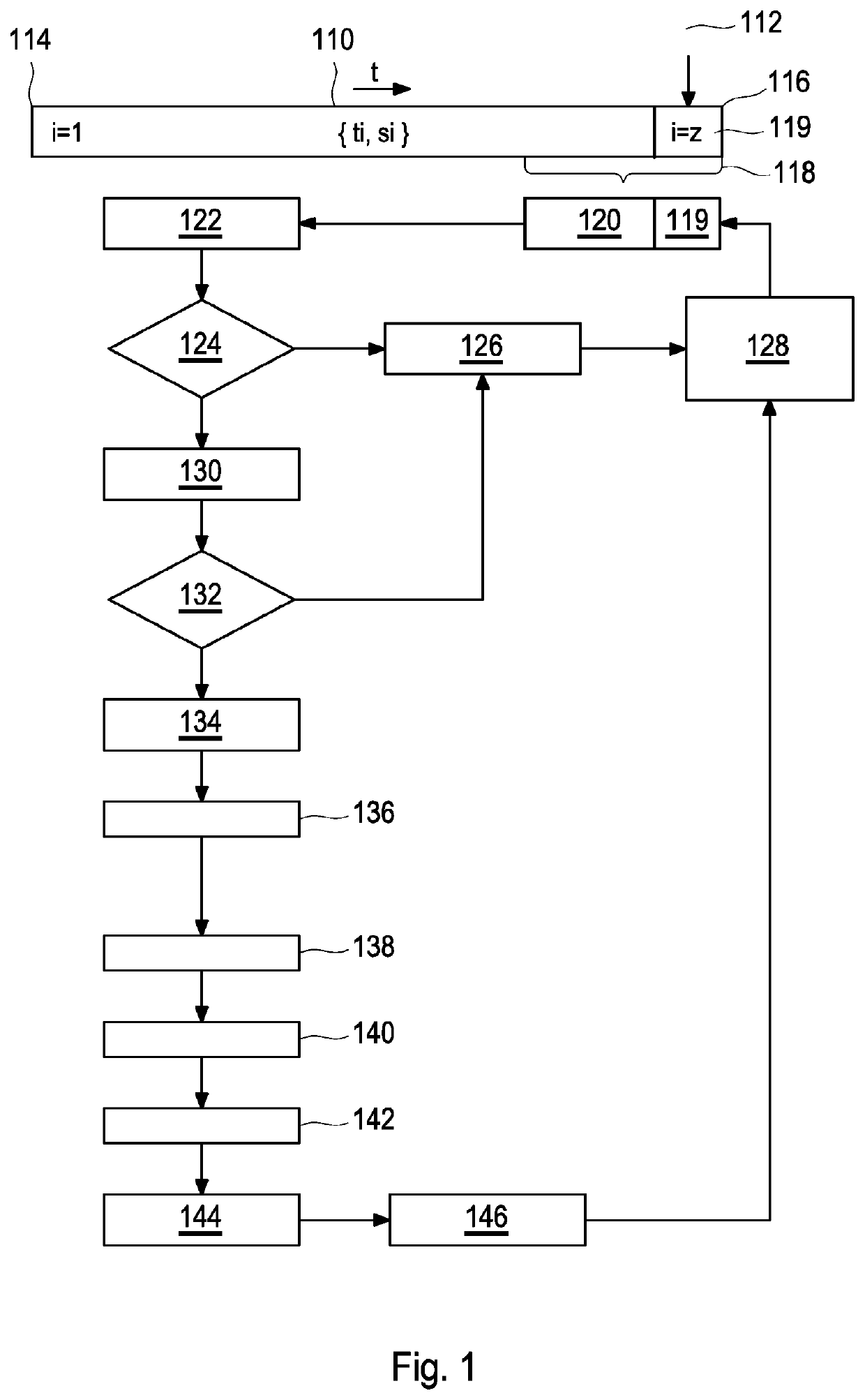
[0159]A first embodiment which could be designated as a “one-pass real-time smoothing”, therefore, employs the steps as presented in FIG. 1 and the respective description together with parameters which are selected from the range and / or values as given in Table 1.

second embodiment

[0160]A second embodiment, which could be designated as a “two-pass real-time smoothing with data reduction” may be selected in a case where a better smoothing is required while reporting in real-time or nearly real-time is still needed. In this case, the method as presented schematically in FIG. 1 may be applied twice in the following manner. First, the method as presented in FIG. 1 may be applied in a first pass to the original data set with parameters taken from Table 1. Thereafter, only every p-th data point in the data set resulting from the determining and returning step 146 may be retained while discarding the rest of the data points, wherein a typical value for p may be selected to be equal to 3. Thereby, a reduced data set may be obtained. Then, the method as depicted in FIG. 1 may be applied in a second pass to the reduced data set, particularly with the same parameters as used in the first pass. Alternatively, it may be possible to employ differing parameters, either sele...

third embodiment

[0162]In a third embodiment, which may be designated as a “real-time smoothing on a preprocessed reduced data set”, the method as shown in FIG. 1 may be applied to a reduced data set. The reduced data set may be prepared from the original data set by retaining only every p-th data point or by retaining items at such data points which are recorded at times t0, t0+r·Δt, t0+2r·Δt, . . . with 0<r, r being an integer. In case such a selected item turns out to be an invalid value or a missing value, an adjacent item, in particular wherein the adjacent item is at a distance of ±Δt or ±2·Δt from the respective data point, may be selected. Hereby, a number of attempts for searching a valid data point backward and / or forward may be chosen appropriately as long as any point may not be used twice. Thereafter, the method which is depicted in FIG. 1 may be applied to the reduced data set with parameters selected from Table 1.

[0163]A similar variation as applied to the second embodiment may mutati...

the structure of the environmentally friendly knitted fabric provided by the present invention; figure 2 Flow chart of the yarn wrapping machine for environmentally friendly knitted fabrics and storage devices; image 3 Is the parameter map of the yarn covering machine
Login to View More

PUM

No PUM Login to View More

Abstract

A method and an apparatus for determining at least one smoothed data point (tk, sk) within a stream of data points {ti, si} with 1≤i≤z, k<z is disclosed. Herein, the stream of data points {ti, si} is consecutively acquired in a manner that a data point (ti, si) is acquired after an acquisition of a preceding data point (ti-1, si−1), wherein each data point (ti, si) comprises a valid value or an invalid value or a missing value for the signal si at a time ti. Herein, the signal si at the time ti comprises physical, chemical, biological, environmental, and / or technical data acquired by means of a technical set-up. According to the method, a set of data points is provided, wherein for each smoothed data point (tk, sk) a smoothing set is created. For each smoothed data point (tk, sk), trailing data resulting from large gaps are removed until it is verified whether the smoothing set comprises a minimal number of data points. Thereafter, for each smoothed data point (tk, sk) an initial slope set is calculated, on which at least one exponential smoothing is applied, in which cause an at least once modified slope set is determined. By integrating the at least once modified slope set, a value for the smoothed data point (tk, sk) is determined and returned. The method provides a good degree of smoothing without introducing any lag time and with minimal distortions, and is capable of reporting derivatives for the set of smoothed data points at the same time. The method is particularly suited in real-time or nearly real-time measurements which may comprise large gaps within the stream of data points.

Description

FIELD OF THE INVENTION[0001]The present application relates to a method and to an apparatus for determining at least one smoothed data point within a stream of data points. In a further aspect of the invention, the application relates to a use of the apparatus. In a further aspect of the invention, the application refers to a computer program. In a further aspect of the invention, the application refers to a data carrier having a data structure stored thereon.RELATED ART[0002]An acquisition of a stream of data points {tim si}with 1≤i≤z, wherein z is an arbitrary number which refers to a number of the data points which are recorded within the stream of data points, wherein the stream of data points is consecutively acquired in a manner that a specific data point (ti, si) is acquired after a preceding data point (t,i−1, si−1), is a well-known problem which occurs in all areas of science and technology which are related to recording a scientific or technical effect which produces a sig...

Claims

the structure of the environmentally friendly knitted fabric provided by the present invention; figure 2 Flow chart of the yarn wrapping machine for environmentally friendly knitted fabrics and storage devices; image 3 Is the parameter map of the yarn covering machine
Login to View More

Application Information

Patent Timeline
no application Login to View More
Patent Type & Authority Applications(United States)
IPC IPC(8): G06F17/17A61B5/00A61B5/0476A61B5/0432A61B5/0205G16H50/50G06F17/18
CPCA61B5/7203A61B5/0002A61B5/021A61B5/7221A61B5/0022A61B5/024G06F17/18A61B5/0402A61B5/0432G06F17/17A61B5/14532A61B5/0476A61B5/72A61B5/0205G16H50/50A61B5/318A61B5/333A61B5/369
Inventor KÜSTER, FRANKKRIVÀNEK, ROLANDMÜLLER, ACHIM
Owner EYESENSE AG