Compositions and methods for improved detection of genomic editing events

Inactive Publication Date: 2020-12-31
INTEGRATED DNA TECHNOLOGIES
View PDF0 Cites 0 Cited by
  • Summary
  • Abstract
  • Description
  • Claims
  • Application Information

AI Technical Summary

Benefits of technology

This patent describes a way to detect single or multiple DNA mismatches using a mixture of mismatch endonucleases. This system can be used to detect DNA mismatches in both short and long DNA fragments. This method is particularly useful for detecting successful genome editing events by targeted genomic editing nucleases. It involves making a PCR amplicon from treated cells, which is then treated with a mismatch endonuclease to detect any DNA mismatches. The results can be visualized using methods like agarose gel electrophoresis or capillary electrophoresis.

Problems solved by technology

Some enzymes are very sensitive to buffer composition and contaminants present in reactions from PCR, so assays performed using these enzymes require purified nucleic acid samples, which increases cost, increases the time needed to perform the assay, and increases the yield needed for input PCR product, all undesired features.
Estimates of DNA editing may also be obtained using DNA sequencing methods, however these methods are costly and take days to weeks to perform.

Method used

the structure of the environmentally friendly knitted fabric provided by the present invention; figure 2 Flow chart of the yarn wrapping machine for environmentally friendly knitted fabrics and storage devices; image 3 Is the parameter map of the yarn covering machine
View more

Image

Smart Image Click on the blue labels to locate them in the text.
Viewing Examples
Smart Image
  • Compositions and methods for improved detection of genomic editing events
  • Compositions and methods for improved detection of genomic editing events
  • Compositions and methods for improved detection of genomic editing events

Examples

Experimental program
Comparison scheme
Effect test

example 1

[0026]Utilization of the T4 / T7 Nuclease Blend to Cleave Heteroduplexes Containing 1, 2, 3, and 12 Nucleotide Mismatches.

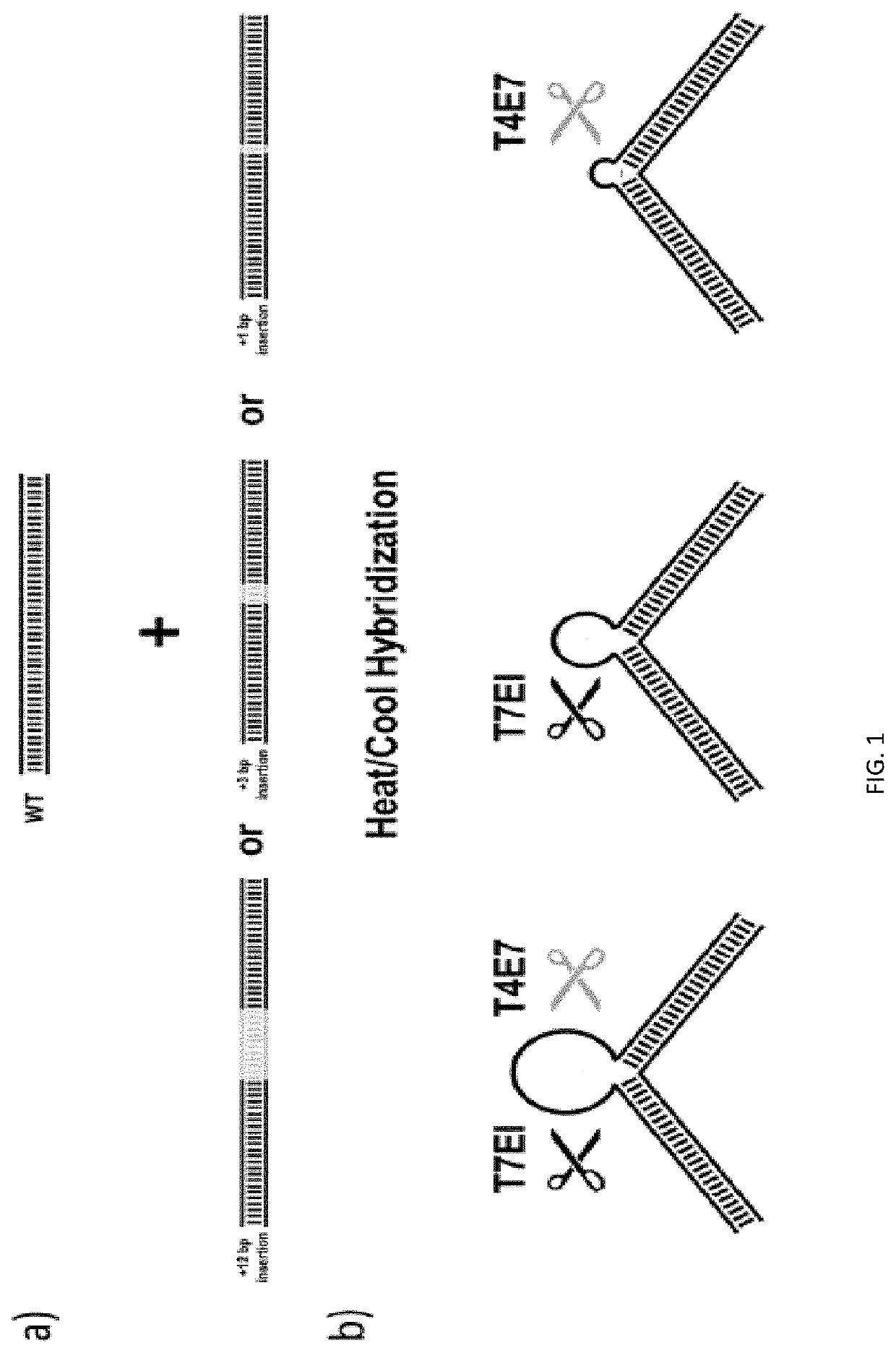
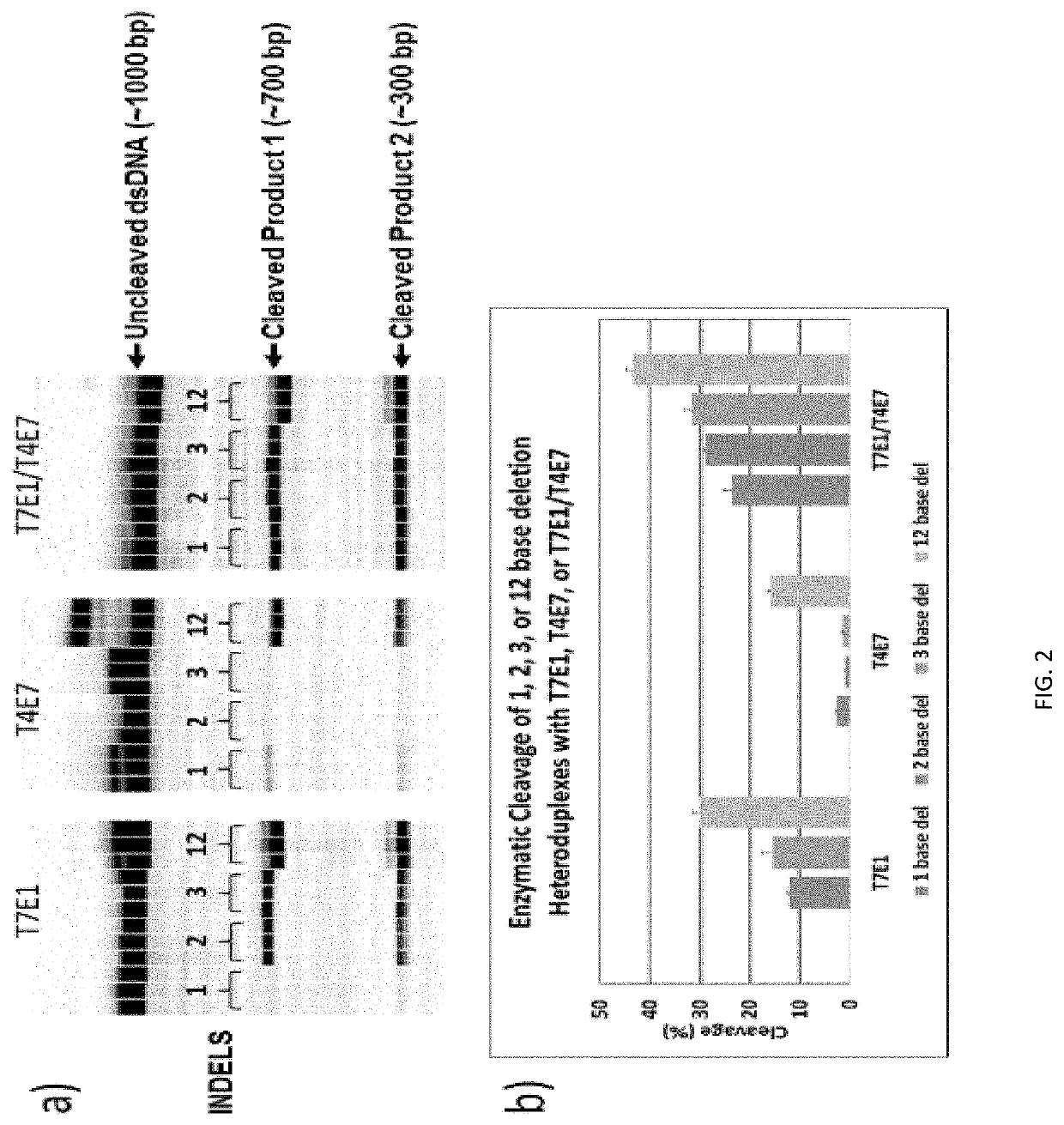
[0027]The following example demonstrates the ability of the method of the invention to efficiently cleave mismatched heteroduplexes PCR products more efficiently than traditional approaches using single enzyme protocols. PCR assays were designed to amplify a 1 kb fragment of the Human HPRT1 gene. HPRT gBlocks Gene Fragments were designed to contain 0(WT), 1, 2, 3, or 12 base deletions positioned at around base 300 of these amplicons, such that mismatch heteroduplex cleavage assays would yield fragments of ˜300 and ˜700 bp, sizes that are readily distinguished. The HPRT gBlocks gene fragments were amplified using the HPRT Forward primer and HPRT Rev Primer. Primers and DNA fragments are shown in Table 1 (SEQ IDs #1-7). These synthetic gBlocks gene fragments represent hypothetical repair fragments following genomic editing events using programmable nucleases.

TABLE 1 ...

example 2

[0031]The following example demonstrates the ability the combination of T7EI and T4E7 to more efficiently cleave mismatched heteroduplex PCR amplified genomic edited products as compared to T7EI alone.

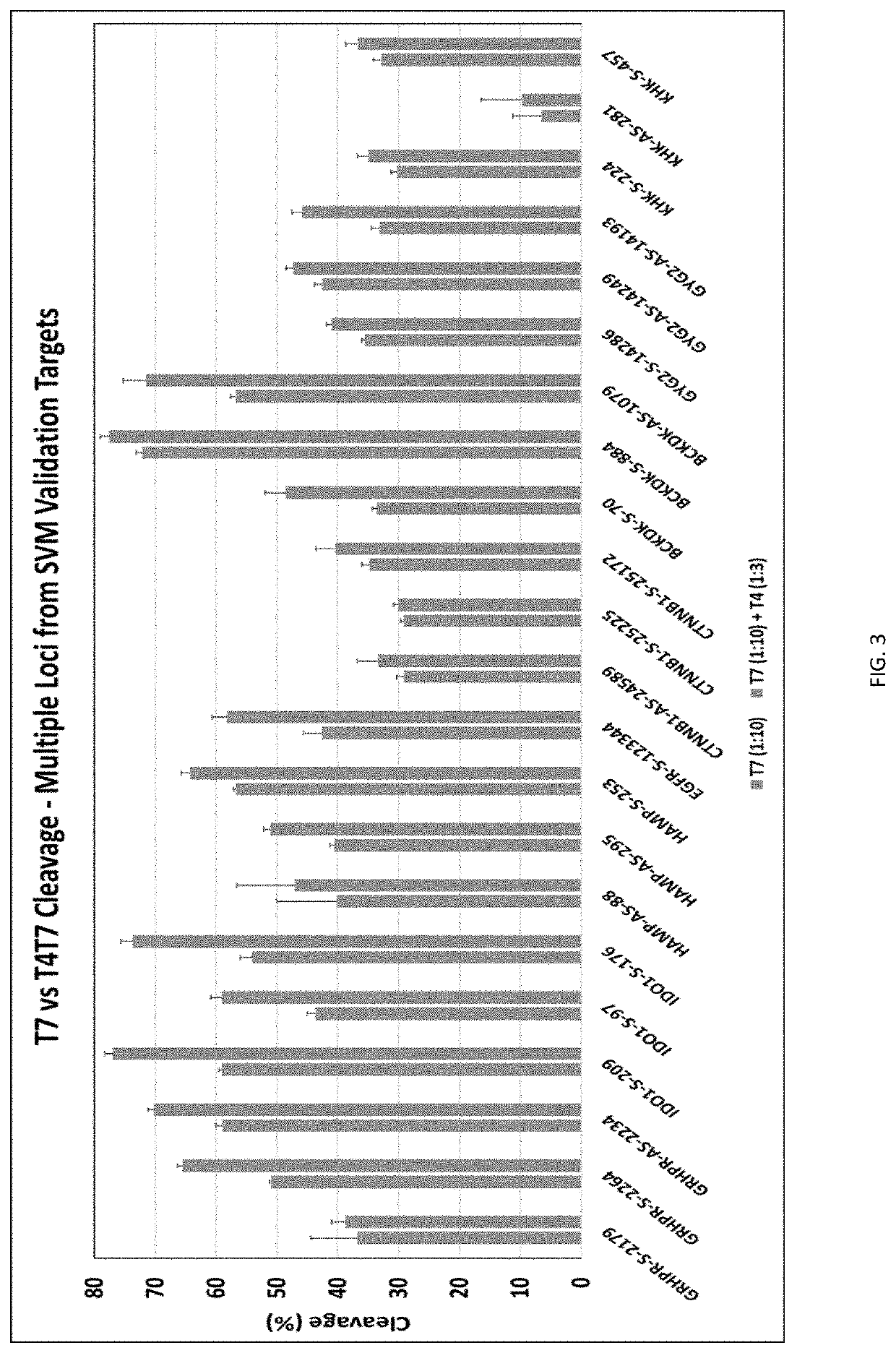
[0032]Following genomic editing with a CRISPR genomic editing system target sites were PCR amplified. Following PCR amplification, the target sites were enzymatically treated with either T7E1 enzyme alone or a mixture of T7E1 enzyme and T4E7 enzyme. Following enzymatic the target sample were run on a capillary electrophoresis and the cleavage percentage was determined.

[0033]FIG. 3 shows the cleavage percentage of multiple loci following enzymatic treatment with T7E1 alone or a mixture of T7E1 enzyme and T4E7 enzyme. As the figure shows the mixture of T7E1 and T4E7 is able to more accurately determine the true cleavage percentage.

[0034]All references, including publications, patent applications, and patents, cited herein are hereby incorporated by reference to the same extent as if each...

embodiments

[0037]A1. A method for detecting genomic editing events comprising:[0038]a) obtaining an edited genomic sequences;[0039]b) PCR amplifying the edited genomic sequences around the expected edited region to generate a plurality of PCR amplicons;[0040]c) reacting the plurality of PCR with a mixture of mismatch endonucleases to generate a plurality of cleaved fragments;[0041]d) detecting the cleaved fragments indicating a genomic editing event.

[0042]A2. The method of claim A1 wherein the edited genomic sequence edited with a programmable nuclease.

[0043]A3. The method of claim A2 wherein the programmable nuclease is a TALEN, a RGEN, or a ZFN.

[0044]A4. The method of claim A3 wherein the RGEN is a Cas9 enzyme or a Cpf1 enzyme.

[0045]A5. The method of claim A1 wherein the mixture of mismatch endonucleases comprises T7EI and T4E7.

[0046]A6. An enzyme composition for detecting edited genomic DNA comprising a mixture of mismatch endonucleases.

[0047]A7. The composition of claim A6 wherein the mixt...

the structure of the environmentally friendly knitted fabric provided by the present invention; figure 2 Flow chart of the yarn wrapping machine for environmentally friendly knitted fabrics and storage devices; image 3 Is the parameter map of the yarn covering machine
Login to View More

PUM

No PUM Login to View More

Abstract

This invention pertains to compositions and methods for detecting single and / or multiple nucleotide mismatches on DNA fragments in vitro by enzymatic cleavage using a mixture of mismatch endonucleases. Additionally, this invention pertains to the ability to detect successful genome editing events by programmable nucleases, e.g., TALENS, RGENs, or ZFNs.

Description

CROSS REFERENCE TO RELATED APPLICATIONS[0001]This application claims priority to U.S. Provisional Patent Application No. 62 / 866,806 filed on Jun. 26, 2019, the contents of which are incorporated by reference herein in their entirety.FIELD OF THE INVENTION[0002]This invention pertains to the ability to detect single and / or multiple nucleotide mismatches on DNA fragments in vitro by enzymatic cleavage using a mixture of mismatch endonucleases. Additionally, this invention pertains to the ability to detect successful genome editing events by programmable nucleases, e.g., TALENS, RGENs, or ZFNs.INCORPORATION BY REFERENCE OF MATERIAL SUBMITTED ELECTRONICALLY[0003]Incorporated by reference in its entirety herein is a computer-readable nucleotide / amino acid sequence listing submitted concurrently herewith and identified as follows: One 8,192 Byte ASCII (text) file named Seq_Listing.txt created on Jun. 25, 2020.BACKGROUND OF THE INVENTION[0004]Targeted genomic editing has become a powerful ...

Claims

the structure of the environmentally friendly knitted fabric provided by the present invention; figure 2 Flow chart of the yarn wrapping machine for environmentally friendly knitted fabrics and storage devices; image 3 Is the parameter map of the yarn covering machine
Login to View More

Application Information

Patent Timeline
no application Login to View More
IPC IPC(8): C12Q1/686C12Q1/34
CPCC12Q1/34G01N2333/922C12Q1/686C12Q2521/301C12Q1/6827C12Q2531/113C12Q2537/113
InventorVAKULSKAS, CHRISTOPHER ACOLLINGWOOD, MICHAEL ABEHLKE, MARK A
OwnerINTEGRATED DNA TECHNOLOGIES