Check patentability & draft patents in minutes with Patsnap Eureka AI!

Redox flow battery and method of operation

a technology flow outlet, which is applied in the field can solve the problems of large footprint of existing large volume of storage tank required to store electrolyte, etc., and achieve the effect of reducing the footprint reducing the lifetime of redox flow battery system, and simple effective management of fluid flow through the system

Inactive Publication Date: 2021-03-11
FUJIFILM MFG EURO
View PDF0 Cites 0 Cited by
  • Summary
  • Abstract
  • Description
  • Claims
  • Application Information

AI Technical Summary

Benefits of technology

The present invention is an improved redox flow battery system that reduces the size and complexity of the electrolyte storage tanks and the fluid flow through the system. By using a single tank for storing all electrolytes, the system has a smaller footprint and easier management of fluid flow. Additionally, the system allows for the use of a single electrolyte solution, which simplifies maintenance and safety procedures and ensures the lifetime of the system is not reduced by mixing different electrolyte solutions.

Problems solved by technology

One of the limitations of existing redox flow battery systems is the large volume of the storage tanks required to store the electrolyte.
Particularly in high energy applications (e.g. renewable energy storage), redox flow batteries comprising multiple large tanks will require a very large footprint.

Method used

the structure of the environmentally friendly knitted fabric provided by the present invention; figure 2 Flow chart of the yarn wrapping machine for environmentally friendly knitted fabrics and storage devices; image 3 Is the parameter map of the yarn covering machine
View more

Image

Smart Image Click on the blue labels to locate them in the text.
Viewing Examples
Smart Image
  • Redox flow battery and method of operation
  • Redox flow battery and method of operation
  • Redox flow battery and method of operation

Examples

Experimental program
Comparison scheme
Effect test

example 1

[0069]

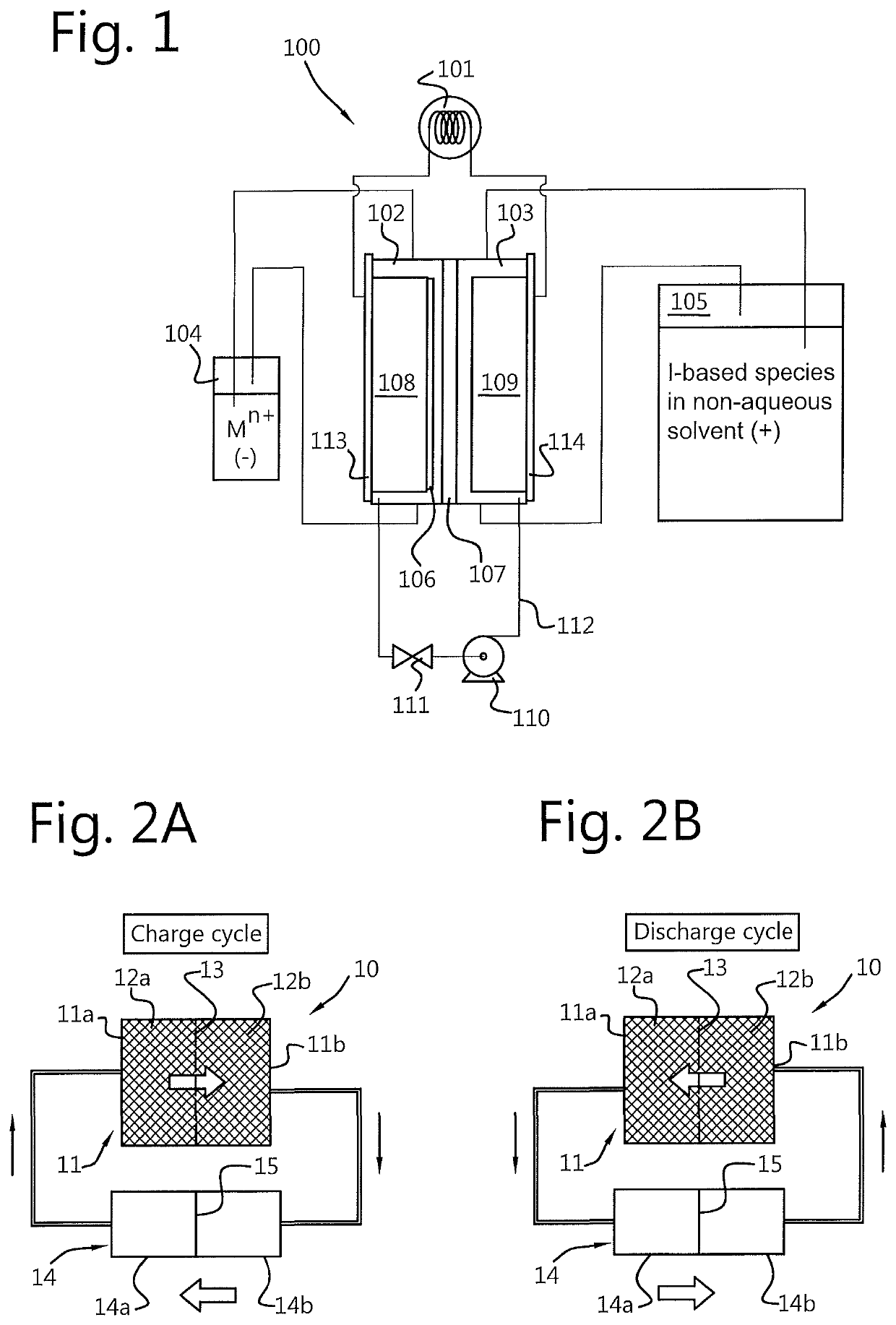
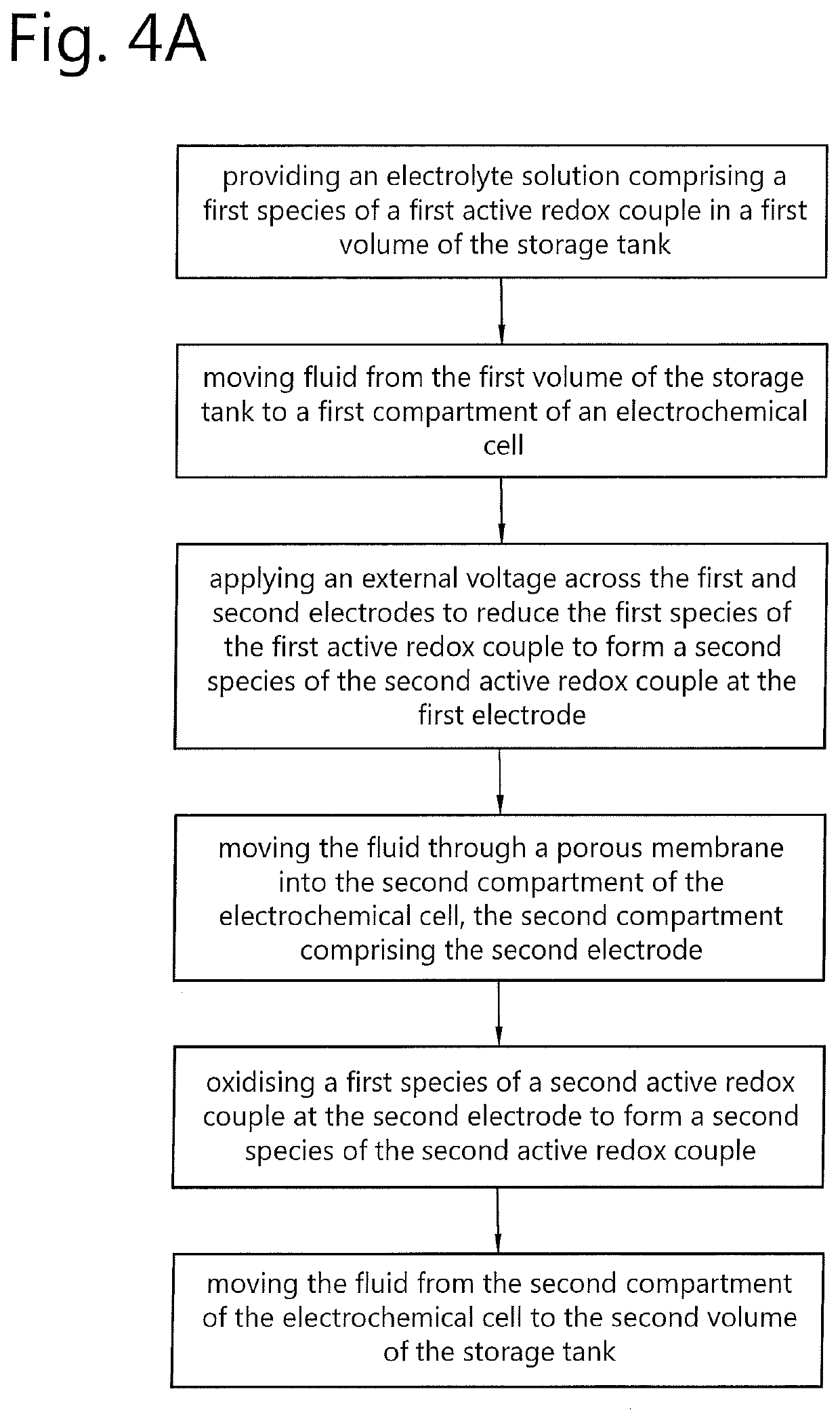
Charge cycleDischarge cycleFirst volume of3ZnI2Second volume ofZnI6storage tankstorage tankAt first electrode3Zn2+ + 4e−→ 2Zn0 + Zn2+At second2I2 + 2I− + 4e−→ 6I−electrodeMoves acrossZn2+ + 6I−Moves acrossZn2+ + 6I−membranemembraneAt second6I−− 4e−→ 2I2 + 2I−At first electrode2Zn0 + Zn2+− 4e−→ 3Zn2+electrodeSecond volume ofZnI6First volume of3ZnI2storage tankstorage tank[0070]Electrodes: Porous carbon electrodes e.g. carbon felts[0071]Voltage: Charging >1.3 V; discharge at 1.3 V[0072]Solvent: Water, e.g. containing additives for preventing dendrite formation of the Zn0 [0073]Membrane: Porous non-charged membrane (configured to allow passage of I− and Zn2+ through the membrane)

example 2

[0074]

Charge cycleDischarge cycleFirst volume ofZnI2Second volume ofH2Ostorage tankstorage tankAt first electrodeZn2+ + 2e−→At secondI2 + 2e−→ 2I−Zn0electrodeMoves across2I−Moves across2I−membranemembraneAt second2I−− 2e−→ I2At first electrodeZn0 − 2e−→ Zn2+electrodeSecond volume ofH2OFirst volume of2ZnI2storage tankstorage tank[0075]Electrodes: Porous carbon electrodes e.g. carbon felts[0076]Voltage: Charge >1.3 V; discharge at 1.3 V[0077]Solvent: Water, e.g. containing additives for preventing dendrite formation of the Zn0 [0078]Membrane: Porous membrane, preferably a positively charged porous membrane (configured to allow passage of I− but substantially prevent or limit passage of Zn2+ therethrough)

example 3

[0079]

Charge cycleDischarge cycleFirst volume ofZnCl2 + 2FeCl2Second volume of2FeCl3storage tankstorage tankAt first electrodeZn2+ + 2e−→At second2Fe3+ + 2e−→Zn0electrode2Fe2+Moves across6Cl− + 2Fe2+Moves across6Cl− + 2Fe2+membranemembraneAt second2Fe2+− 2e−→At first electrode Zn0 − 2e−→electrode2Fe3+Zn2+Second volume of2FeCl3First volume ofZnCl2 + 2FeCl2storage tankstorage tank[0080]Electrodes: Porous carbon electrodes e.g. carbon felts[0081]Voltage: Charge >1.53 V; discharge at 1.53 V[0082]Solvent: Water, e.g. slightly acidic (e.g. HCl) and preferably containing additives for preventing dendrite formation of the Zn0 [0083]Membrane: Porous non-charged membrane (configured to allow Fe2+ also Cl− to pass therethrough)

the structure of the environmentally friendly knitted fabric provided by the present invention; figure 2 Flow chart of the yarn wrapping machine for environmentally friendly knitted fabrics and storage devices; image 3 Is the parameter map of the yarn covering machine
Login to View More

PUM

PropertyMeasurementUnit
volumeaaaaaaaaaa
volumesaaaaaaaaaa
conductivityaaaaaaaaaa
Login to View More

Abstract

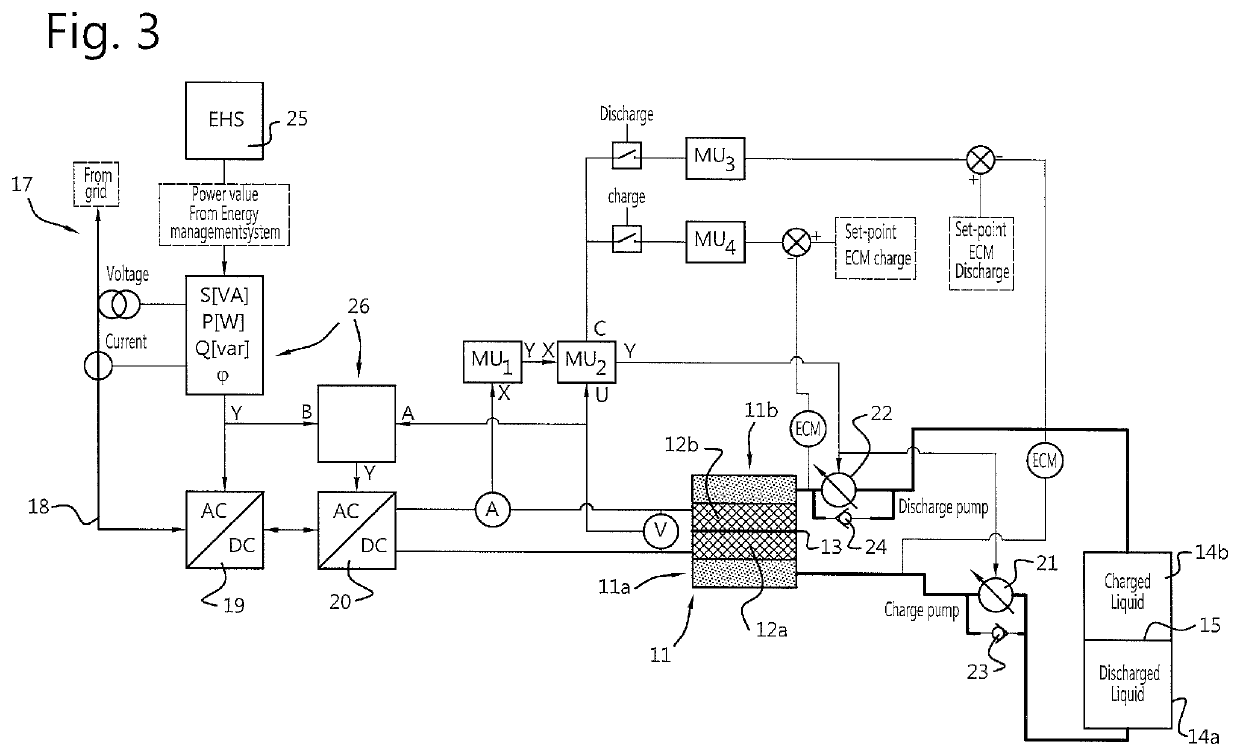
A redox flow battery system (10) comprises an electrochemical cell (11) divided into first and second compartments (11a, 11b) by a porous membrane (13). Each of the first and second compartment (11a, 11b) houses an electrode. An electrolyte storage tank (14) has a first volume (14a) and a second volume (14b) separated from the first volume by a movable separator (15). The first volume (14a) of the storage tank (14) is in fluid communication with the first compartment (11a) and the second volume (14b) of the storage tank (14) is in fluid communication with the second compartment (11b). The system (10) also includes a flow control system configured to move fluid between the first volume (14a) of the storage tank and the second volume (14b) of the storage tank through the first and second compartments (11a, 11b) of the electrochemical cell (11). An associated method is also described.

Description

FIELD OF THE INVENTION[0001]The present invention relates to a redox flow battery system comprising a movable separator between two electrolyte storage volumes. More particularly, the present invention relates to a system and method for moving a fluid comprising species of first and second active redox couples through an electrochemical cell, from one side of the movable separator to the other side of the movable separator.BACKGROUND OF THE INVENTION[0002]Redox flow battery systems can provide convenient storage of energy in chemical form due to their flexible construction (physical separation of energy and power components), long life cycle and quick response times. A wide range of chemistries have been employed in redox flow battery systems, leading to different storage tank arrangements.[0003]U.S. Pat. No. 4,786,567A describes an all-vanadium redox battery comprising an electrochemical cell having a first half cell and a second half cell. The system further comprises four electro...

Claims

the structure of the environmentally friendly knitted fabric provided by the present invention; figure 2 Flow chart of the yarn wrapping machine for environmentally friendly knitted fabrics and storage devices; image 3 Is the parameter map of the yarn covering machine
Login to View More

Application Information

Patent Timeline
no application Login to View More
Patent Type & Authority Applications(United States)
IPC IPC(8): H01M8/04746H01M8/04186H01M8/04082H01M8/18H01M8/04537H01M50/77
CPCH01M8/04753H01M8/04186H01M8/04634H01M8/188H01M8/04201Y02E60/50H01M8/04082
Inventor HESSING, JACKO
Owner FUJIFILM MFG EURO
Features
  • R&D
  • Intellectual Property
  • Life Sciences
  • Materials
  • Tech Scout
Why Patsnap Eureka
  • Unparalleled Data Quality
  • Higher Quality Content
  • 60% Fewer Hallucinations
Social media
Patsnap Eureka Blog
Learn More