Unlock instant, AI-driven research and patent intelligence for your innovation.

Systems and methods for detecting infectious pathogens

Active Publication Date: 2021-10-07
KALIGIA BIOSCIENCES LLC
View PDF0 Cites 2 Cited by
  • Summary
  • Abstract
  • Description
  • Claims
  • Application Information

AI Technical Summary

Benefits of technology

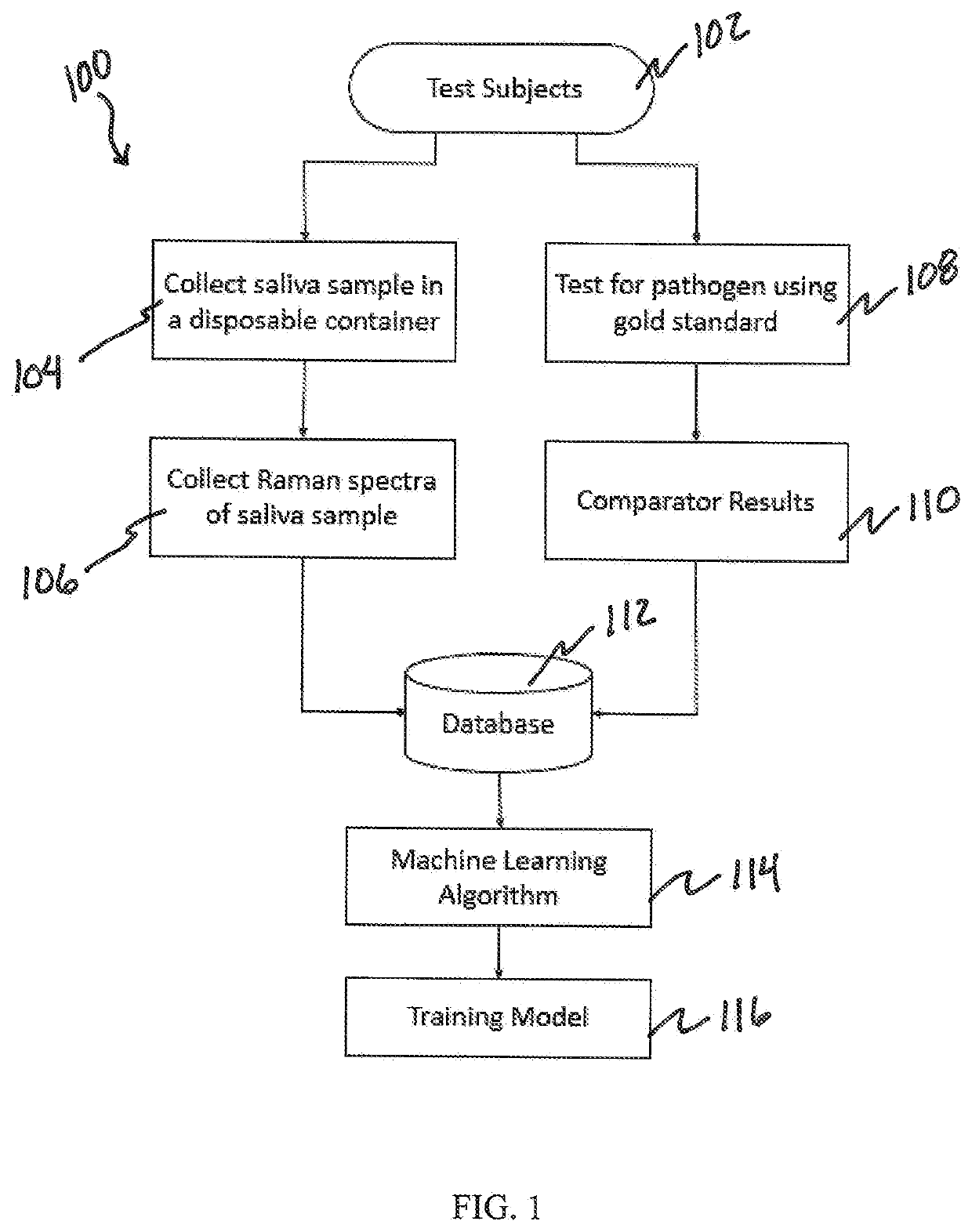
The present invention is about detecting infectious pathogens, like COVID-19, in human saliva using a method called Raman spectroscopy. The invention can detect the presence of COVID-19 by analyzing the molecular composition of saliva and comparing it to data from laboratory tests. This information can then be used to predict the presence of COVID-19 in saliva using machine learning algorithms. The invention has various advantages, such as being non-invasive and able to provide quick results, which can be useful in combating the spread of infections. The patent text outlines the main features and objectives of the invention, and allows for the design of various equivalent structures and methods.

Problems solved by technology

Infectious pathogens, whether bacterial, viral, or other origin, present acute and chronic challenges to human health.
Tuberculosis is caused by Mycobacterium tuberculosis, is typified by cough including spitting up blood, chest pain, chills, fever, night sweats, and other symptoms, and may be fatal.
However, present methods and systems for testing are often time-consuming, inconvenient for patients, may require sample collection methods or amounts that are painful or uncomfortable for patients, and may be expensive.
Methods that require large amounts of sample, or that require incubation of a sample for hours or days, are often ineffective at timely detection or identification of the cause of a respiratory disorder.
This leads to drastic reduction in test effectiveness and adversely affects the spread of virus among the population.

Method used

the structure of the environmentally friendly knitted fabric provided by the present invention; figure 2 Flow chart of the yarn wrapping machine for environmentally friendly knitted fabrics and storage devices; image 3 Is the parameter map of the yarn covering machine
View more

Image

Smart Image Click on the blue labels to locate them in the text.
Viewing Examples
Smart Image
  • Systems and methods for detecting infectious pathogens
  • Systems and methods for detecting infectious pathogens
  • Systems and methods for detecting infectious pathogens

Examples

Experimental program
Comparison scheme
Effect test

Embodiment Construction

[0029]Systems, methods, and devices for detecting the presence of one or more infectious agents in a single clinical sample, or in a plurality of aliquots of a single clinical sample, are provided.

[0030]In some embodiments, the invention is directed to systems, methods, and devices for testing for presence of one or more infectious pathogens in a single small-volume clinical sample, or aliquots thereof. In embodiments, the analysis of the small-volume clinical sample is completed in a short period of time. In embodiments, the infectious pathogens cause respiratory disease. In embodiments, the infectious pathogens cause a respiratory disease selected from an upper respiratory disease and a lower respiratory disease.

[0031]In some embodiments, the infectious disease is a bacterial disease, or a viral disease, or another type of disease, and analysis of the small-volume clinical sample determines whether the infectious pathogen is a bacterial disease, a viral disease, or another type of...

the structure of the environmentally friendly knitted fabric provided by the present invention; figure 2 Flow chart of the yarn wrapping machine for environmentally friendly knitted fabrics and storage devices; image 3 Is the parameter map of the yarn covering machine
Login to View More

PUM

No PUM Login to View More

Abstract

Methods and systems are provided for detecting infectious pathogens in a saliva sample by using a Raman spectrometer to obtain Raman spectrum data of the saliva sample. A score is determined based on the Raman spectrum data using a machine learning, the score indicates whether an infectious pathogen is present in the saliva sample. In certain aspects, the methods and systems operate to determine if an individual is infected with COVID-19 based on Raman spectrum data of a saliva sample of the individual.

Description

CROSS-REFERENCE TO RELATED APPLICATIONS[0001]This application claims the benefit of U.S. Provisional Patent Application Ser. No. 63 / 003,646, filed Apr. 1, 2020, the entirety of which is incorporated herein by reference.FIELD OF THE INVENTION[0002]The present disclosure relates to methods for detecting the presence of infectious pathogens in human saliva using Raman spectroscopy. In particular, this disclosure relates to detecting the presence of COVID-19 in human saliva using Raman spectroscopy.BACKGROUND OF THE INVENTION[0003]Infectious pathogens, whether bacterial, viral, or other origin, present acute and chronic challenges to human health. Many common infections affect the respiratory tract. Respiratory tract diseases, particularly infectious respiratory diseases of viral and bacterial origin, are prevalent in patients of all ages, although often are more serious in the very young and the very old. Viruses include DNA viruses and RNA viruses. Bacteria include Gram positive and G...

Claims

the structure of the environmentally friendly knitted fabric provided by the present invention; figure 2 Flow chart of the yarn wrapping machine for environmentally friendly knitted fabrics and storage devices; image 3 Is the parameter map of the yarn covering machine
Login to View More

Application Information

Patent Timeline
no application Login to View More
IPC IPC(8): A61B5/00G16H50/30G16H50/80
CPCA61B5/0075A61B5/7264A61B10/0051G16H50/80G16H50/30G16H50/20Y02A90/10
Inventor FAZLIN, FAZAL AZHDANOV, ARSENIIBUNCH, KEITH MICHAEL
Owner KALIGIA BIOSCIENCES LLC