Check patentability & draft patents in minutes with Patsnap Eureka AI!

Process for producing alloy nanoparticles

a nanoparticle and alloy technology, applied in the direction of electrode coating, cell components, physical/chemical process catalysts, etc., can solve the problems of low alloy production efficiency, low catalyst loading, and high cost of platinum (pt) in the fuel cell cathode,

Pending Publication Date: 2021-12-09
DANMARKS TEKNISKE UNIV
View PDF9 Cites 0 Cited by
  • Summary
  • Abstract
  • Description
  • Claims
  • Application Information

AI Technical Summary

Benefits of technology

This patent is about a new process for making alloy nanoparticles of platinum group metals or gold and other metals. This process is faster and easier than previous methods, as it doesn't require highly inert conditions and can be carried out in a small amount of oxygen and moisture. The process can also produce alloys of rare earth metals, which are difficult to make using other methods. The alloy nanoparticles produced using this process have better catalytic performance compared to other methods, and may have reduced sintering during annealing.

Problems solved by technology

Currently, a major challenge for the wide application of this technology lies in the high cost of platinum (Pt) and the high catalyst loading needed in the fuel cell cathode due to the sluggish oxygen reduction reaction (ORR).
Though with initial activity enhancement by alloying, these transition metals tend to leach out from the alloy structure during fuel cell operation, resulting in the decreased performance.
Nonetheless, these alloys have not yet been produced by a scalable method that allows for practical application, which is generally applicable to both rare earths and other metals for potential alloying with platinum group metals.
One major obstacle for the synthesis of e.g. Pt-rare earth metal (Pt-RE) alloy catalysts is the substantial difference between the standard reduction potential of Pt and that for rare earth metals, e.g. 1.188 V for Pt2+ and −2.279 V for Gd3+.
Therefore, the process does not disclose the annealing of a precursor mixture comprising a nitrogen rich compound.

Method used

the structure of the environmentally friendly knitted fabric provided by the present invention; figure 2 Flow chart of the yarn wrapping machine for environmentally friendly knitted fabrics and storage devices; image 3 Is the parameter map of the yarn covering machine
View more

Image

Smart Image Click on the blue labels to locate them in the text.
Viewing Examples
Smart Image
  • Process for producing alloy nanoparticles
  • Process for producing alloy nanoparticles
  • Process for producing alloy nanoparticles

Examples

Experimental program
Comparison scheme
Effect test

example 1

Preparation of PtxGd / C Nanoparticles

[0189]Preparation of the precursor was done by mixing 0.224 g of H2PtCl6.6H2O, 0.196 g of GdCl3, 1.806 g of CN2H2 and 0.336 g of graphitized mesoporous carbon black. The mixture was ground with a mortar and pestle to create a fine powder. The precursor was then transferred into a quartz boat which was placed in a quartz-tube furnace. The furnace was evacuated and purged with 5% H2 / Ar. The furnace was then heated from room temperature to 700° C. at the rate of 10° C. min−1 and stayed at 700° C. for 2 h, after which it was cooled down to room temperature at the rate of around 25° C. min−1. Cyanamide (CN2H2) can be replaced by melamine (C3H6N6) in the preparation, which yielded the same product of PtxGd nanoparticles with similar particle sizes.

example 2

Preparation of PtxGd / C Nanoparticles

[0190]Preparation of the precursor was done by mixing 0.224 g of H2PtCl6.6H2O, 0.196 g of GdCl3, 1.806 g of CN2H2 and 0.336 g of graphitized mesoporous carbon black. The mixture was ground with a mortar and pestle to create a fine powder. The precursor was then transferred into a quartz boat which was placed in a quartz-tube furnace. The furnace was evacuated and purged with 5% H2 / Ar. The furnace was then heated from room temperature to 700° C. at the rate of 10° C. min−1 and stayed at 700° C. for 2 h, after which it was cooled down to room temperature at the rate of around 25° C. min−1. The nanoparticles were then leached in 1.0 M H2SO4 with stirring at 80° C. for 2 h, thoroughly washed with hot Milli-Q water, and then vacuum-dried at 80° C. for 6 h.

example 3

Characterization of the PtxGd / C Nanoparticles

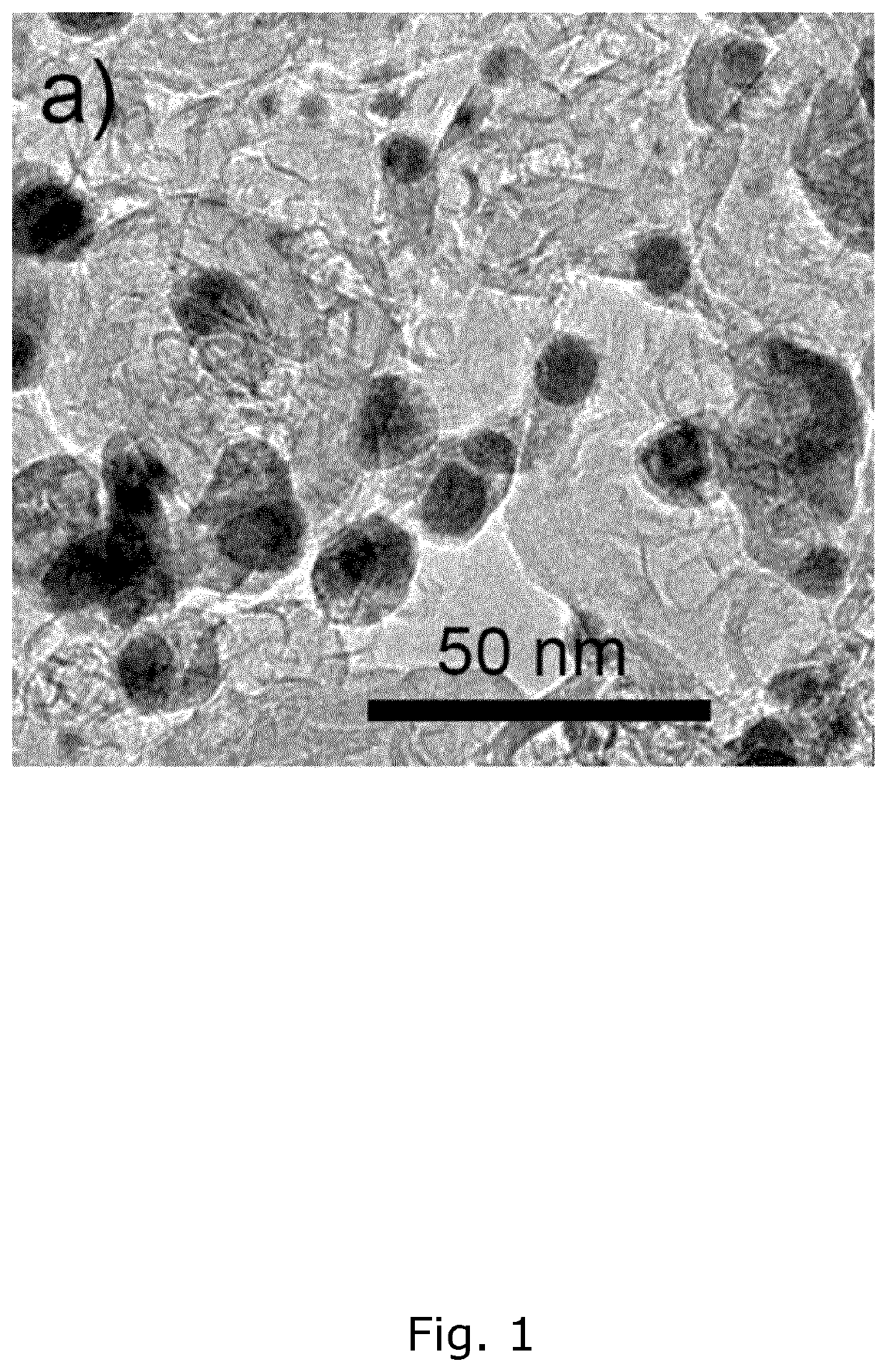
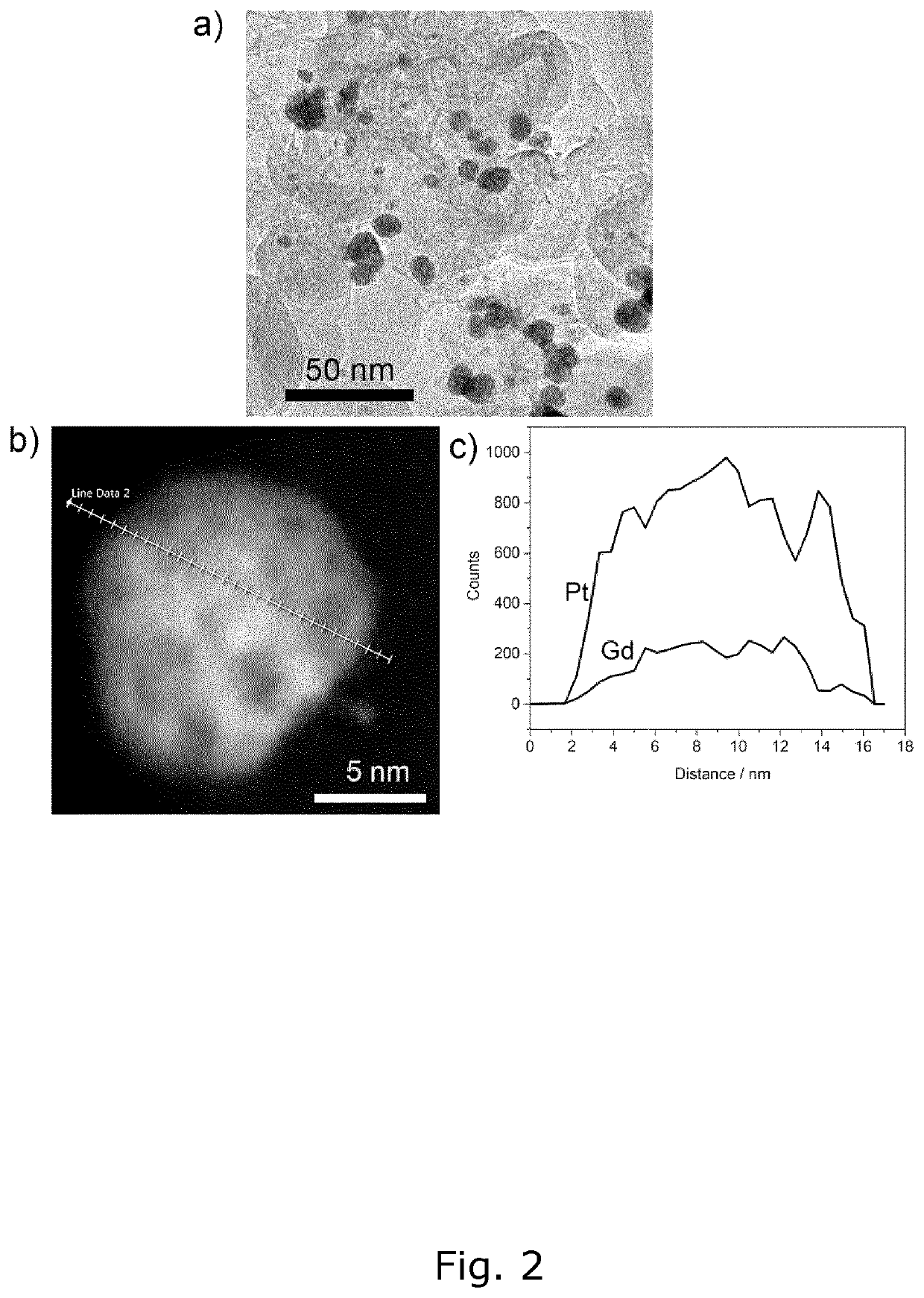
[0191]The size of the produced PtxGd / C nanoparticles is an important parameter when creating a catalyst as smaller particles have a higher surface-to-volume ratio and as the catalytic activity usually depends on the surface area. A transmission electron microscope (TEM) image of the PtxGd / C nanoparticles produced according to example 1, is depicted in FIG. 1. The image confirms that the size-range of the particles is within 3-15 nm. Another TEM image of PtxGd / C nanoparticles produced according to example 2, is depicted in FIG. 2a) and shows nanoparticles in the same size-range. A typical nanoparticle in FIG. 2a) was selected and a HAADF-STEM image taken, which is depicted in FIG. 2b). The content of platinum and gadolinium in the selected nanoparticle was measured along the line in FIG. 2b) using EDS. The resulting EDS line profile is illustrated in FIG. 2c) and shows the presence and distribution patterns of platinum and gadolinium atoms...

the structure of the environmentally friendly knitted fabric provided by the present invention; figure 2 Flow chart of the yarn wrapping machine for environmentally friendly knitted fabrics and storage devices; image 3 Is the parameter map of the yarn covering machine
Login to View More

PUM

PropertyMeasurementUnit
Temperatureaaaaaaaaaa
Login to View More

Abstract

The present invention relates to a process for the production of metal alloy nanoparticles which catalyse the oxygen reduction reaction (ORR) for use in proton exchange membrane fuel cells (PEMFC) or electrolyser cells. In particular, the present invention relates to a process for producing alloy nanoparticles from platinum group metals and other metals under reductive conditions. In particular the present invention relates to a process for producing alloy nanoparticles comprising the steps of mixing a salt of at least one metal, a material comprising a platinum group metal, a nitrogen-rich compound, and optionally a support material, to provide a precursor mixture, and heating said precursor mixture to a temperature of at least 400° C., in the presence of a gas comprising hydrogen (H2), to provide said alloy nanoparticles.

Description

TECHNICAL FIELD OF THE INVENTION[0001]The present invention relates to a process for the production of alloy nanoparticles which catalyse the oxygen reduction reaction (ORR) for use in e.g. proton exchange membrane fuel cells (PEMFC) or electrolyser cells. In particular, the present invention relates to a process for producing alloy nanoparticles from platinum group metals and other metals under reductive conditions. In particular the present invention relates to a process for producing alloy nanoparticles comprising the steps of mixing a salt of at least one metal, a material comprising a platinum group metal, a nitrogen-rich organic compound, and optionally a support material, to provide a precursor mixture, and heating said precursor mixture to a temperature of at least 400° C., in the presence of a gas comprising hydrogen (H2), to provide said alloy nanoparticles.BACKGROUND OF THE INVENTION[0002]Fuel cells are a highly efficient and environmentally benign technology to convert c...

Claims

the structure of the environmentally friendly knitted fabric provided by the present invention; figure 2 Flow chart of the yarn wrapping machine for environmentally friendly knitted fabrics and storage devices; image 3 Is the parameter map of the yarn covering machine
Login to View More

Application Information

Patent Timeline
no application Login to View More
IPC IPC(8): B22F9/24C22C1/04H01M4/92C25B11/089B22F1/054
CPCB22F9/24C22C1/0466H01M2008/1095C25B11/089B22F2301/25H01M4/921H01M4/926C22C5/04C25B11/04Y02E60/50B22F1/054B01J35/23C25B11/046
Inventor LI, QINGFENGBRANDES, BENEDIKT AXELJENSEN, JENS OLUFCLEEMAN, LARS NILAUSENHU, YANG
Owner DANMARKS TEKNISKE UNIV
Features
  • R&D
  • Intellectual Property
  • Life Sciences
  • Materials
  • Tech Scout
Why Patsnap Eureka
  • Unparalleled Data Quality
  • Higher Quality Content
  • 60% Fewer Hallucinations
Social media
Patsnap Eureka Blog
Learn More