Unlock instant, AI-driven research and patent intelligence for your innovation.

Method for fabrication of ridge waveguides

Pending Publication Date: 2022-09-22
UNIV OF SOUTHAMPTON
View PDF0 Cites 0 Cited by
  • Summary
  • Abstract
  • Description
  • Claims
  • Application Information

AI Technical Summary

Benefits of technology

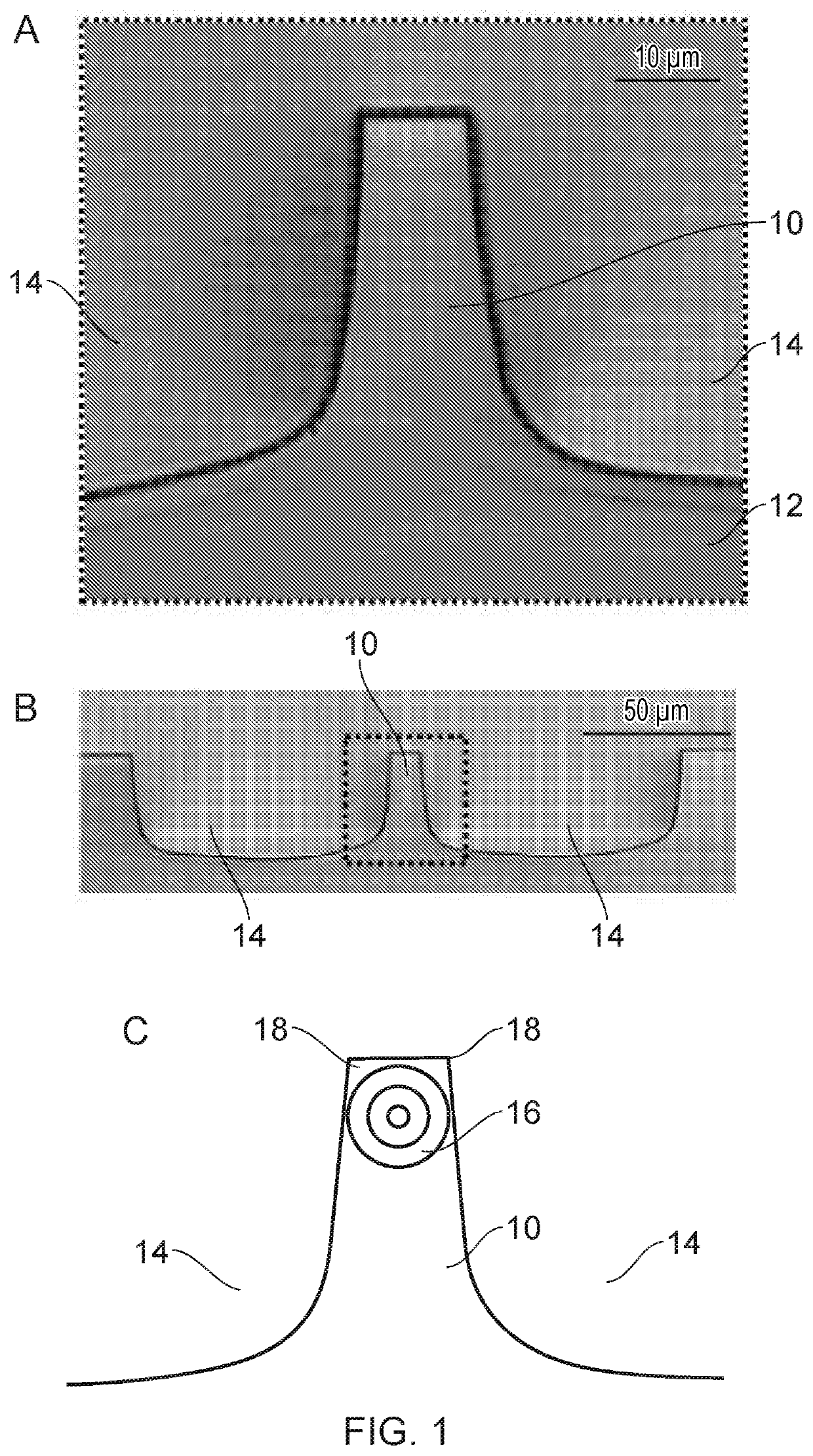
This patent describes a method for making an optical waveguide in lithium niobate by creating a grating of periodic domain inversion and then adding a layer of metallic zinc to the surface of the sample. The zinc diffuses into the lithium niobate to form a waveguiding layer of increased refractive index under the surface of the sample. A dicing blade is then used to cut two parallel channels along the length of the grating, creating a ridge waveguide. This method provides optical confinement in the ridge waveguide and can be used to create optical devices with improved performance. Various combinations of features from this patent can be used to create different optical devices.

Problems solved by technology

However, these methods have known issues when used with PPLN, including increased photorefractive damage in the case of titanium diffusion, and limited device lifetime / stability due to a low initial fabrication temperature in the case of proton exchange [4, 5].
These features make such waveguides unsuitable for use at relatively high, and desirable, optical power levels (up to watts or even tens of watts of input laser light).
This intrinsically creates a channel waveguide so there is no need for dicing, but issues with overlap between the modes of the fundamental wavelength and the nonlinearly generated wavelength(s) in the conversion interaction can limit efficiency.
Furthermore, for efficient operation it is beneficial to match the optical mode guided by the waveguide to that of an input mode, often from an optical fibre, and this can be difficult, not least in trying to match the symmetry of the guided modes to that of the fibre.
An option would be to use a direct semiconductor laser for each wavelength, but this has a number of associated challenges, such as development time and cost, achieving suitable power versus linewidth requirements, and achieving standardised performance across multiple devices.

Method used

the structure of the environmentally friendly knitted fabric provided by the present invention; figure 2 Flow chart of the yarn wrapping machine for environmentally friendly knitted fabrics and storage devices; image 3 Is the parameter map of the yarn covering machine
View more

Image

Smart Image Click on the blue labels to locate them in the text.
Viewing Examples
Smart Image
  • Method for fabrication of ridge waveguides
  • Method for fabrication of ridge waveguides
  • Method for fabrication of ridge waveguides

Examples

Experimental program
Comparison scheme
Effect test

Embodiment Construction

[0022]Aspects and features of certain examples and embodiments are discussed / described herein. Some aspects and features of certain examples and embodiments may be implemented conventionally and these are not discussed / described in detail in the interests of brevity. It will thus be appreciated that aspects and features of devices and methods discussed herein which are not described in detail may be implemented in accordance with any conventional techniques for implementing such aspects and features.

[0023]It is proposed herein to manufacture optical waveguides in periodically poled lithium niobate (PPLN) doped with magnesium oxide via a series of steps which enables the production of waveguides in which high nonlinear optical conversion efficiencies at the watt power level are achievable in combination with high launch efficiencies from optical fibres delivering input light for the waveguide. The fabrication technique is tolerant to variability in the process steps, and intrinsicall...

the structure of the environmentally friendly knitted fabric provided by the present invention; figure 2 Flow chart of the yarn wrapping machine for environmentally friendly knitted fabrics and storage devices; image 3 Is the parameter map of the yarn covering machine
Login to View More

PUM

PropertyMeasurementUnit
Temperatureaaaaaaaaaa
Login to View More

Abstract

A method for fabricating an optical waveguide comprises: providing a sample of lithium niobate doped with magnesium oxide and having at least one grating of periodic domain inversion defined therein; applying a layer of metallic zinc to a surface of the sample over the at least one grating using sputter deposition; heating the sample in an atmosphere of pure oxygen to cause the zinc to indiffuse into the lithium niobate to form a waveguiding layer of increased refractive index under the surface of the sample; and using a dicing blade to cut two substantially parallel channels along a length direction of the at least one grating, to define a ridge waveguide between the two channels.

Description

BACKGROUND OF THE INVENTION[0001]The present invention relates to a method for the fabrication of ridge waveguides, and ridge waveguides fabricated using the method.[0002]Quasi-phase matching (QPM) is a well-established technique for generating optical wavelengths using wavelength conversion provided by nonlinear optical interactions such as second harmonic generation and optical parametric generation. In contrast with conventional phase matching to support nonlinear processes, QPM utilises engineered nonlinear materials in which the phase matching capability is tailored for a desired interaction by manipulation of the material's crystal domain structure into a periodic arrangement known as periodic poling. QPM therefore has the potential to generate virtually any desired wavelength, and so is particularly useful for creating light at wavelengths where laser sources do not operate or are difficult to produce, or for unusual applications where the volume of lasers sold does not allow...

Claims

the structure of the environmentally friendly knitted fabric provided by the present invention; figure 2 Flow chart of the yarn wrapping machine for environmentally friendly knitted fabrics and storage devices; image 3 Is the parameter map of the yarn covering machine
Login to View More

Application Information

Patent Timeline
no application Login to View More
IPC IPC(8): G02F1/377G02F1/355G02F1/35B26D3/12C23C14/34C23C14/18C23C14/58C23C14/02
CPCG02F1/3775G02F1/3551G02F1/3558G02F1/3525B26D3/12C23C14/34C23C14/185C23C14/5806C23C14/021G02F2202/20G02F1/3548
Inventor CARPENTER, LEWIS GLYNNBERRY, SAM ADAMGAWITH, CORIN BARRY EDMUNDSMITH, PETER GEORGE ROBIN
Owner UNIV OF SOUTHAMPTON