Check patentability & draft patents in minutes with Patsnap Eureka AI!

Highly dispersed metal supported oxide as nh3-scr catalyst and synthesis processes

Pending Publication Date: 2022-09-29
TOYOTA MOTOR EUROPE +3
View PDF0 Cites 0 Cited by
  • Summary
  • Abstract
  • Description
  • Claims
  • Application Information

AI Technical Summary

Benefits of technology

The present invention aims to solve issues with existing products and processes in the field of ammonia selective catalytic reduction (NH3-SCR) catalysts for nitrogen oxides (NOx) reduction. The new processes and products have been developed to address these issues.

Problems solved by technology

The problem of such catalysts is the low performance, such as low NOx conversion and / or low N2 selectivity.

Method used

the structure of the environmentally friendly knitted fabric provided by the present invention; figure 2 Flow chart of the yarn wrapping machine for environmentally friendly knitted fabrics and storage devices; image 3 Is the parameter map of the yarn covering machine
View more

Image

Smart Image Click on the blue labels to locate them in the text.
Viewing Examples
Smart Image
  • Highly dispersed metal supported oxide as nh3-scr catalyst and synthesis processes
  • Highly dispersed metal supported oxide as nh3-scr catalyst and synthesis processes
  • Highly dispersed metal supported oxide as nh3-scr catalyst and synthesis processes

Examples

Experimental program
Comparison scheme
Effect test

example 1a

[0093]Preparation of of NbOx / CeO2 Using [Nb(OEt)5]2 as Precursor

[0094]Step 1: Pre-Treatment of Support Material, Ceria (CeO2)

[0095]Ceria Actalys HAS-5 Actalys 922 from Solvay (Rare Earth La Rochelle), CeO2-(200) (ceria with specific surface area of 210±11 m2 g−1), was calcined for 16 h at 500° C. under a flow of dry air, and evacuated under vacuum at high temperature. After moisture, re-hydratation under inert atmosphere the ceria was partially dehydroxylated at 200° C. under high vacuum (10−5 Torr) for 15 h to give a yellow solid having a specific surface area of 200±9 m2.g−1.

[0096]The support ceria was characterized by DRIFT, BET, NMR and XRD.

[0097]Characterization of Ceria by DRIFT

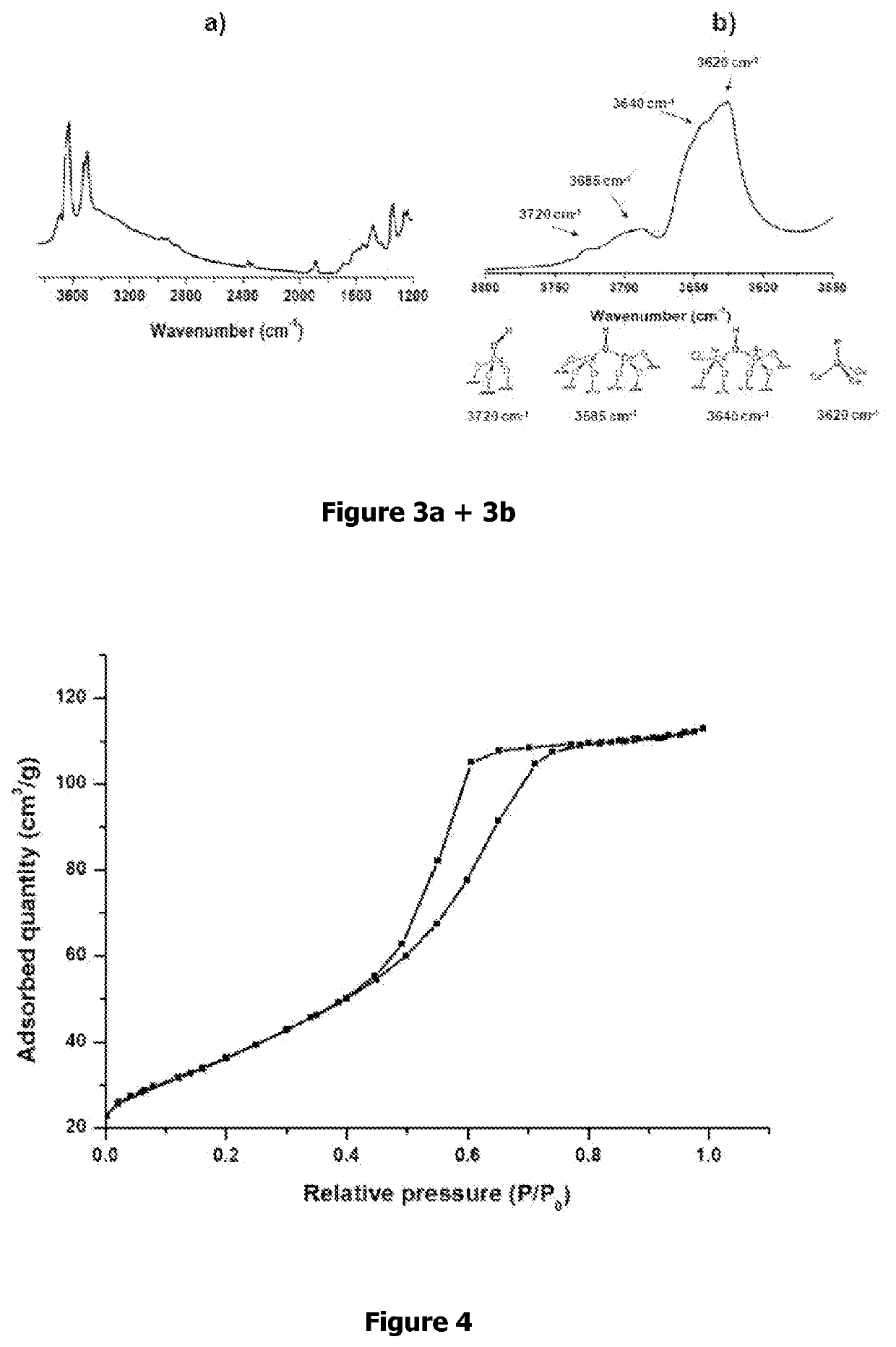
[0098]The DRIFT study depicted in FIG. 3 showed that the thermal treatment under vacuum (10−5 mbar) at 200° C., after calcination and hydration, resulted in the removal of physisorbed water and mainly showed bridged OH group. The spectrum of ceria dehydroxylated at 200° C. pictured in FIG. 3a) showed fo...

example 1b

Preparation of [NbOx] / CeO2-200 by Using [Nb(OAr)5] as Precursor Where Ar is 2,6-diisopropyl-phenyl

[0138]Step 1: Pretreatment of Support Material, CeO2

[0139]The pretreatment of the support material was performed in the same way as for the pretreatment of the support in step 1 of Example 1a above.

[0140]Step 2: Grafting [Nb(Oar)5] Precursor on CeO2-(200)

[0141]A mixture of [Nb(Oar)5] (1.225 mg, 1.75 mmol) and CeO2-(200) (2.5 g) in toluene (20 mL) was stirred at 25° C. for 12 h. After filtration, the solid [Nb(Oar)5] / CeO2-200 was washed three times with toluene. The resulting yellow powder was dried under vacuum (10−5 Torr). 1H MAS NMR (ppm, 500 MHz): δ 6.4 (Oar aromatic proton), 1.8 (ArMe proton of methyl) 13C CP MAS NMR (ppm, 200 MHz): δ 158.7 (ipso Oar C-ipso of aryl), 118.5-126.8 (Oar aromatic carbon), 16.7 (ArCH3 methyl). Elemental analysis % Nb=0.99% wt % C=5.19% wt C / Nb=40.6 (th 32).

[0142]Step 3: Calcination

[0143]The material [Nb(Oar)5] / CeO2-200 was calcined using a glass reacto...

example 2a

Preparation of Wox / CeO2 by Using [W═O(Oet)4]2 as Precursor

[0144]A mixture of [W═O(Oet)4]2 (0.625 g, 1 mmol) and 6 g CeO2-(200) in toluene (30 mL) was stirred at 25° C. for 12 h. After filtration, the obtained solid [W═O(Oet)4]2 / CeO2 was washed three times with toluene in order to extract the unreacted complex and then with pentane to remove toluene. The resulting yellow powder was dried under vacuum (10−5 Torr).

[0145]1H MAS NMR (ppm, 500 MHz): δ 4.8 (OCH2CH3), 1.3 (OCH2CH3) 13C CP MAS NMR (ppm, 200 MHz): δ 68.5 (terminal OCH2CH3), 64.6 (bridging OCH2CH3), 18.3 (terminal OCH2CH3), 16.5 (bridging OCH2CH3). Elemental analysis % W=4.1 Wt % % C=1.2% wt C / W=4.5 (th 6). The DRIFT analyses showed that the bands at higher wavenumbers (v(OH)=3400-3700 cm−1) corresponding to Ce—OH reacted selectively with tungsten complex. In addition, bands characteristic of v(C—H) and δ(C—H) in the 2850-3050 and 1110-1470 cm−1 region respectively are found.

[0146]The material [W═O(OEt)4]2 / CeO2 was calcined us...

the structure of the environmentally friendly knitted fabric provided by the present invention; figure 2 Flow chart of the yarn wrapping machine for environmentally friendly knitted fabrics and storage devices; image 3 Is the parameter map of the yarn covering machine
Login to View More

PUM

PropertyMeasurementUnit
Temperatureaaaaaaaaaa
Timeaaaaaaaaaa
Login to View More

Abstract

A process for preparing a catalyst material, includes: (a) providing a support material having surface hydroxyl (OH) groups, the support material is ceria (CeO2), zirconia (ZrO2) or a combination, and the support material contains between 0.3 and 2.0 mmol OH groups / g of the support material; (b) reacting the support material with at least one of: (b1) a compound containing at least one alkoxy or phenoxy group bound though its oxygen atom to a metal element from Group 5 (V, Nb, Ta) or Group 6 (Cr, Mo, W); (b2) a compound containing at least one hydrocarbon group bound though a carbon atom to a metal element from Group 5 or 6; (b3) a compound containing at least one hydrocarbon group bound though a carbon atom to a metal element which is copper (Cu); and (c) calcining the product obtained in step (b).

Description

FIELD OF THE INVENTION[0001]The present invention relates to the synthesis of ammonia selective catalytic reduction (NH3-SCR) catalysts for nitrogen oxides (NOx) reduction.BACKGROUND ART[0002]Toxic NOx gases (NO, NO2, N2O) included in exhaust gases from fossil-fuel-powered vehicles or stationary sources such as power plants are required to be converted to N2 before being released to the environment. This is normally done by using different types of NOx reduction catalysts such as three-way catalysts (TWC), NOx storage reduction (NSR), or selective catalytic reduction (SCR) using ammonia as external reducing agent (NH3-SCR).[0003]Metal oxides such as V2O5 are known to be good NH3-SCR catalysts. It has been suggested that the catalytic activity is achieved by the complementary features of acidity and reducibility of the surface species. Briefly, NH3 is adsorbed on a Brønsted acid site (V5+—OH) followed by N—H activation through the adjacent V═O surface groups through a redox cycle (V5...

Claims

the structure of the environmentally friendly knitted fabric provided by the present invention; figure 2 Flow chart of the yarn wrapping machine for environmentally friendly knitted fabrics and storage devices; image 3 Is the parameter map of the yarn covering machine
Login to View More

Application Information

Patent Timeline
no application Login to View More
IPC IPC(8): B01J37/02B01J23/10B01J21/06B01J23/30B01J23/28B01J23/72B01J23/20B01J37/08B01J31/16B01J23/22B01J31/22B01J31/02B01D53/94
CPCB01J37/0207B01J23/10B01J21/066B01J23/30B01J23/28B01J23/72B01J23/20B01J37/086B01J31/1625B01J23/22B01J37/0209B01J37/0203B01J31/2295B01J31/2265B01J31/0212B01D53/9418B01J2531/58B01J2531/66B01J2531/64B01J2531/57B01J2531/16B01D2255/20776B01D2255/20723B01D2255/20761B01D2255/20769B01J2531/56B01J2231/62B01J31/2226B01J31/0214B01D2255/2065B01D2255/207B01D2255/407B01D2251/2062B01D2255/20715B01J35/397
Inventor NGUYEN, PHUC HAIMERLE, NICOLASCHARLIN, MARC-OLIVIERSZETO, KAI CHUNGTAOUFIK, MOSTAFA
Owner TOYOTA MOTOR EUROPE
Features
  • R&D
  • Intellectual Property
  • Life Sciences
  • Materials
  • Tech Scout
Why Patsnap Eureka
  • Unparalleled Data Quality
  • Higher Quality Content
  • 60% Fewer Hallucinations
Social media
Patsnap Eureka Blog
Learn More