The process has the
advantage that the level of caprolactam
oligomer in the polyamide chips is reduced in a simple manner to obtain an extract which requires distinctly less workup before being feedable into the
polymerization reactor. In addition, the required low residual extractables content of <0.5%, especially <0.1% of
dimer, is achieved in an economical and simple manner in a single extraction apparatus. The extraction, moreover, provides the desired low level of
oligomer appreciably faster than is the case in existing processes.
The extractant absorbs caprolactam
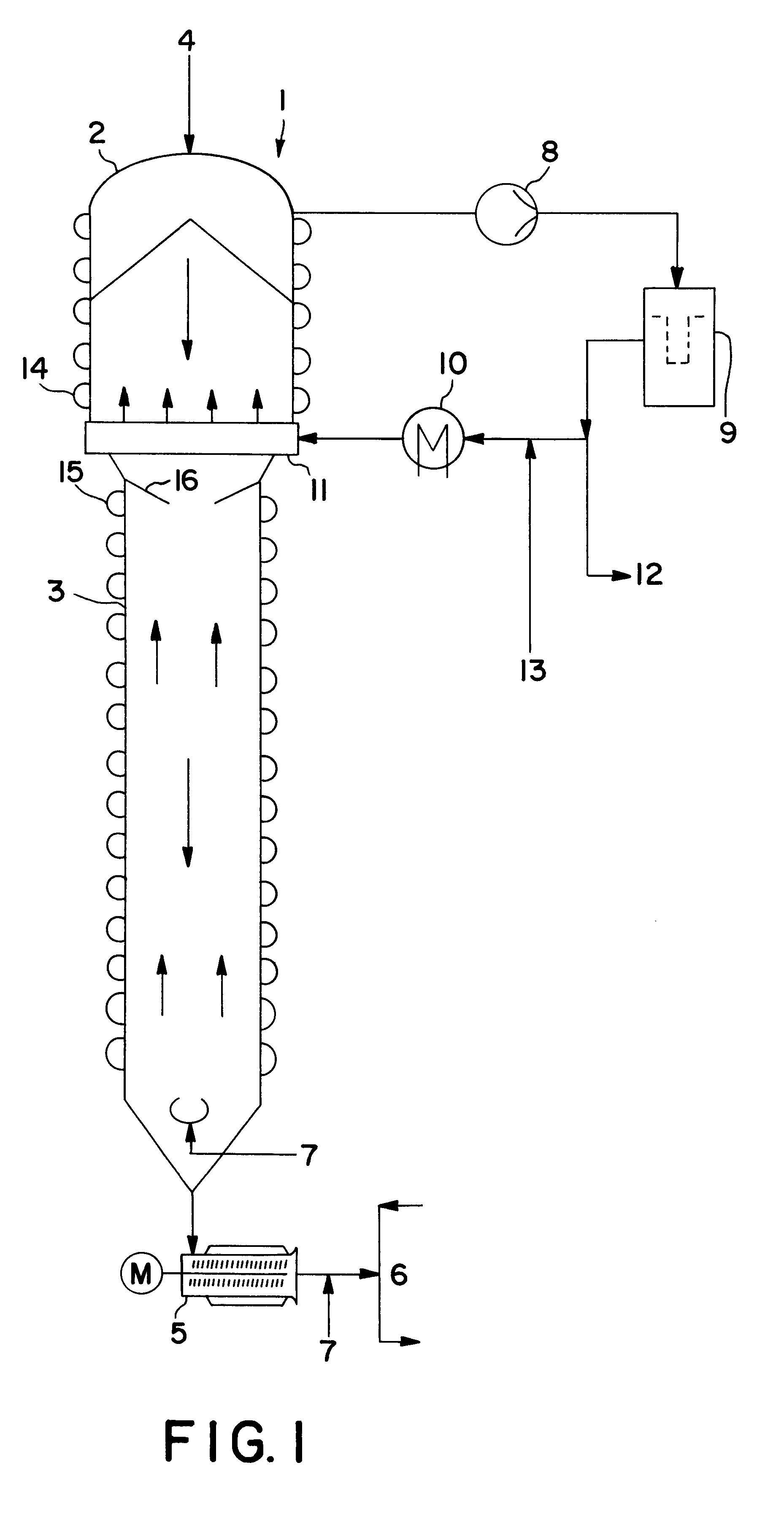
monomer and oligomer in the bottom region of the extraction column, the second zone. The extractant is recirculated in the top part of the extraction column (extractor head). This extractor head, the first zone, accounts for 5 to 50%, preferably 15 to 30%, of the total volume of the extractor. The extractant is preferably withdrawn at the top of the first zone and reintroduced into the extraction column in the bottom region of the first zone by a distributing means at a uniform rate. However, it is also possible to proceed conversely, i.e., the extractant is withdrawn in the bottom region and reintroduced in the top region. The amount of extractant recirculating within the head is chosen so that, on the one hand, a temperature and concentration equilibration is ensured within this zone and an intensive
mass transfer takes place at the phase interface of the polyamide particles. On the other hand, the flow rate of the
aqueous solution should not exceed the swirling point of the particles. Accordingly, the velocity is generally set within the range from about 2 to 20 m / h, preferably within the range from 3 to 15 m / h. In addition, the extractor head has a larger
diameter than the second zone to additionally counteract any swirling up of the particles. The ratio of the cross-sectional area in the first zone to that in the second zone is within the range from about 1:1 to 3:1, especially within the range from 1:1 to 2:1. The ratio of the length of the first zone to that of the second zone is generally within the range from 0.05:1 to 1:1, preferably within the range from 0.1:1 to 0.3:1. The temperature in the extractor head is within the range from 100 to 140.degree. C., preferably within the range from 115 to 130.degree. C., and is set by a
heat exchanger disposed within the head circuit of the extractant, outside the extraction column. Liquid caprolactam at from 80 to 100.degree. C. is added to the head circuit to set a caprolactam concentration of from 15 to 40%, preferably of from 20 to 40%, especially of from 20 to 30%, within the extractor head. This provides for faster and, owing to the better equilibrium position, more thorough removal of caprolactam oligomer, especially caprolactam
dimer, from the polyamide. The extractant is continuously removed from the head circuit at the rate of the water feed at the base of the extractor and the caprolactam feed into the first zone.
The transition from the first zone to the second zone of the extraction column is preferably equipped with a flow barrier which, for example, by narrowing the flow cross-section, prevents any sinking of the
aqueous solution, which has a higher
specific gravity, from the extractor head into the second zone underneath. For example, a
honeycomb-shaped
constriction can be used to raise the superficial velocity of the ascending
liquid phase. The narrowing of the flow cross-section underneath the extractor head additionally provides a very effective means for separating the region of the first zone which is characterized by pronounced backmixing from the second zone, in which a countercurrent concentration profile with little if any backmixing is desired. Sinking of the heavier extractant from the extractor head is further prevented by reducing the temperature in the second zone by from 5 to 40.degree. C., preferably by from 10 to 20.degree. C., as compared to the temperature in the first zone. In addition, the extractant flow velocity in the second zone is made relatively high by constructing this second, for example tubular, zone with a very small
diameter. The superficial flow velocity is customarily within the range from 0.2 to 6.0 m / h, preferably within the range from 1 to 3 m / h. The tube cross-section can be comparatively small owing to the comparatively short total
residence time of from 5 to 20 hours, especially of from 8 to 15 hours, required for adequate extraction. Furthermore, the resulting smaller extractor volume results in a relatively low, economical equipment height.
The addition of caprolactam during the extraction serves to stabilize the
wash water obtained, so that oligomer concentrations of up to 6% are possible in the removed extractant without troublesome precipitations occurring in the subsequent process. The ratio of extractant to polyamide is within the range from 0.5:1 to 2:1 in the process of the invention. Compared with the prior extraction art without addition of caprolactam, accordingly, the process of the present invention requires a smaller water polyamide ratio owing to the better equilibrium position and the faster extraction. This reduces the amount of water to be evaporated when recovering the
wash water, which improves the economics of the overall process.
The polyamide is preferably discharged from the reactor and continuously metered into a transportation water circuit by a screw, especially a deep-drawn single screw. The discharged amount of polyamide and hence the polyamide level in the extraction column can be controlled via the speed of the screw. The
discharge screw provides for a very uniform and attritionless
discharge of the polyamide and prevents bridging of particles. Since, moreover, this form of
discharge is leakage-free, the countercurrent concentration profile in the extractor is not disturbed. The addition of small quantities of water in the transportation water circuit, which enter the extractor through the screw, serves to create, in the screw, a flow of liquid which is countercurrent to the exiting polyamide and at the same time ensures an upward flow of
liquid phase in the base region of the extractor, preventing any backmixing.



 Login to View More