The present invention has been made having regard to the state of the art noted above, and its object is to provide a propelling transmission control apparatus having a relatively inexpensive construction free from any complicated electric systems with sensors for automatically responding to variations in engine load.
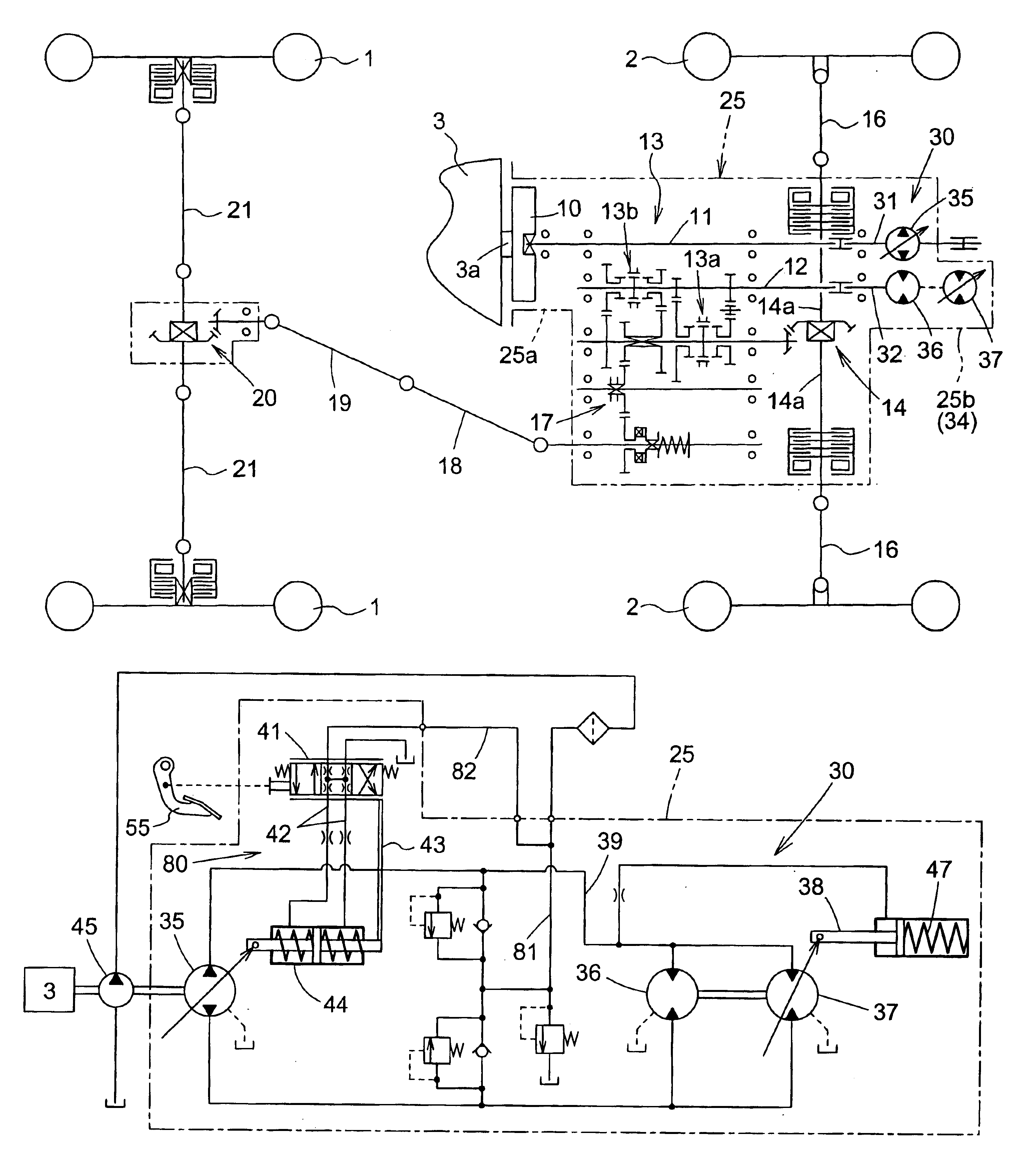
With this construction, the heavier the propelling load becomes, the higher
hydraulic pressure in the pressure
oil supply line is applied to the main and auxiliary hydraulic motors. Therefore, the swash plate angle of the auxiliary hydraulic motor becomes large by action of the control piston operated by the
hydraulic pressure, thereby increasing the volume of the auxiliary hydraulic motor. Thus, the total volume of the main and auxiliary motors is increased while the rotating speed of the common output shaft is reduced. That is, speed is automatically reduced with an increase in the propelling load to increase output torque.
Conversely, the lighter the propelling load becomes, the lower hydraulic pressure in the pressure
oil supply line is applied to both the hydraulic motors. Thus, the total volume of the main and auxiliary motors is reduced while the rotating speed of the common output shaft is increased. That is, speed is automatically increased with a decrease in the propelling load.
Hence, it is possible to automatically effect transmission control in response to variations in the load with the relatively inexpensive construction employing only the hydraulic
system and not any electric
system, which enables the operator to effect a light and smooth driving control.
According to another preferred embodiment of the invention, the hydraulic
servomechanism has, applied thereto as a
system pressure therefor, a charge pressure for a change speed
hydraulic circuit having the main hydraulic pump and the main and auxiliary hydraulic motors. With this construction, a charge oil line for receiving pressure oil from a
charge pump is connected to an oil line of the hydraulic
servomechanism, thereby to realize a simple
servomechanism operable under low pressure.
According to a further preferred embodiment of the present invention, the control device is operatively connected to a speed adjusting device for an engine, the speed adjusting device being operable to a high speed rotation in response to a shifting operation of the control device to high speed drive, and to a
low speed rotation in response to a shifting operation of the control device to
low speed drive. With this construction, the rotating speed of the engine is reduced in response to the speed
change control device operated to
low speed drive while being automatically increased in response to the control device operated to high speed drive. Thus, the speed
change control device is operated to high speed drive when a load is applied thereby to increase the rotating speed of the hydraulic pump to raise pressure in the
hydraulic circuit. As a result, an automatic
speed reduction is effected utilizing the auxiliary hydraulic motor to increase output torque. Thus, a change speed operation may be carried out with an excellent accelerating efficiency sensitively responding to the operation of the change speed control device and to quickly increase output torque when a
heavy load is applied thereby to enhance driving efficiency.


 Login to View More
  Login to View More