Method and system for reducing false detections of access signals

US6901116B1Inactive Publication Date: 2005-05-31CISCO TECH INC
11 Cites 20 Cited by

Patent Information

Authority / Receiving Office
US · United States
Current Assignee / Owner
Publication Date
2005-05-31
Estimated Expiration
Not applicable · inactive patent

Smart Images

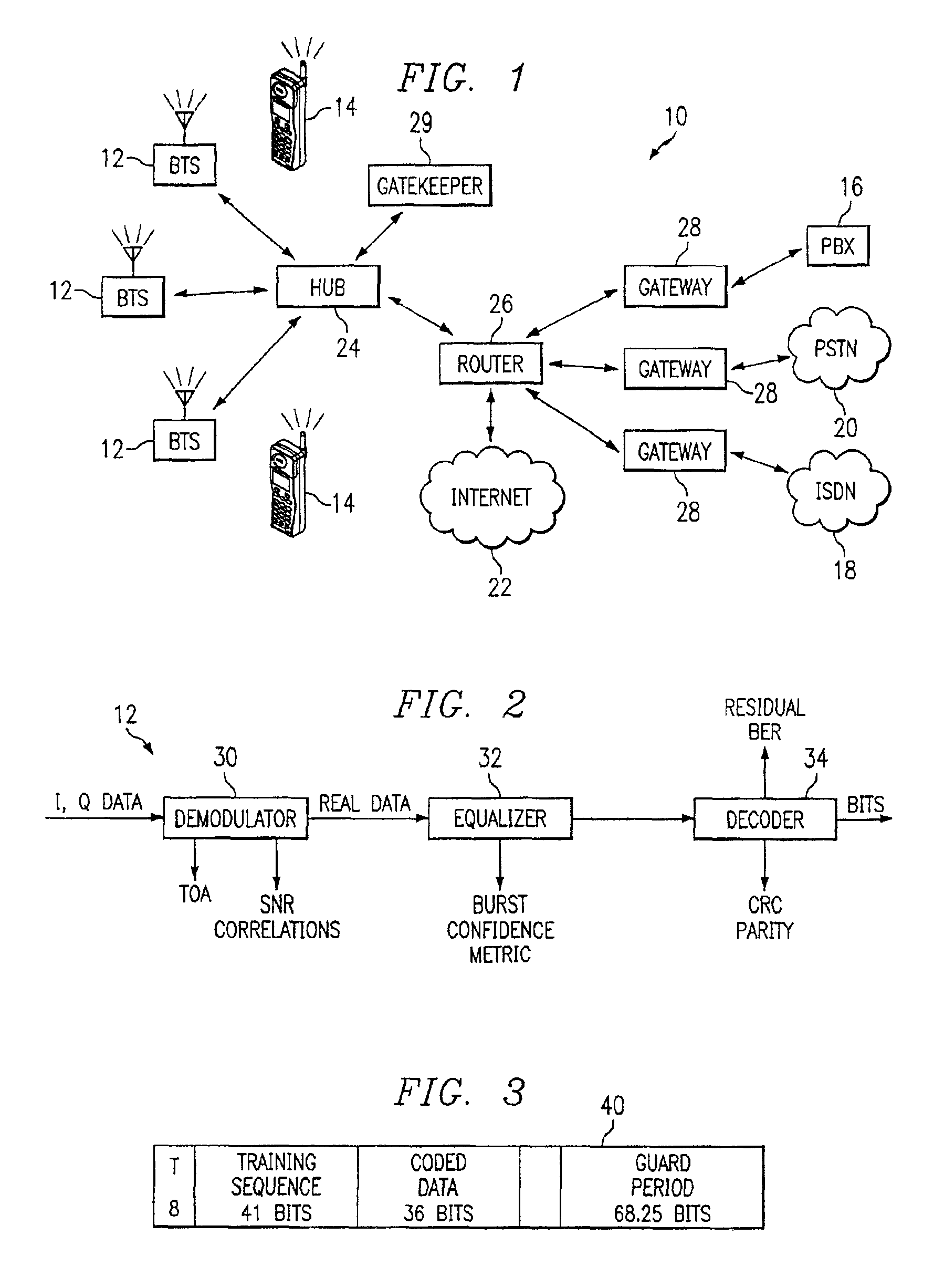
  • Figure 1
    Figure 1
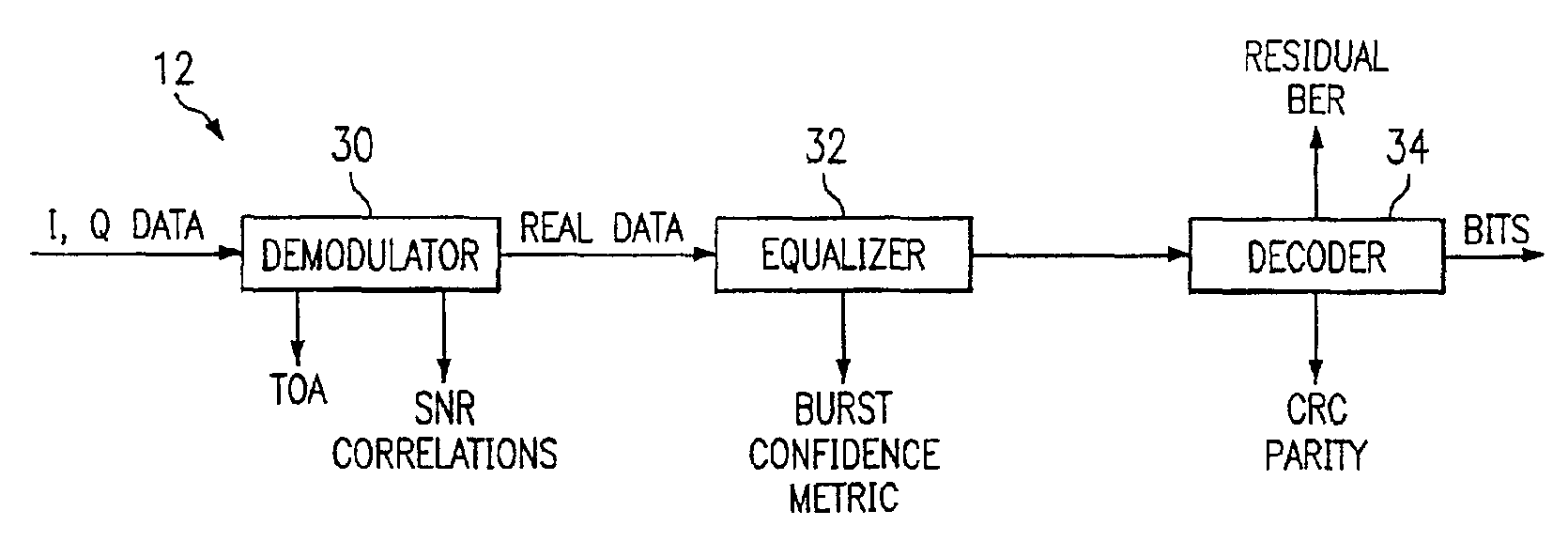
  • Figure 2
    Figure 2
  • Figure 3
    Figure 3
Patent Text Reader

Abstract

A demodulator determines a time of arrival of an access signal. Access signals that do not result in a time of arrival are discarded. Upon obtaining a time of arrival, the access signal is equalized and a training sequence of bits in the equalized access signal is compared to a reference sequence of bits. A burst confidence metric is obtained in the comparison by summing the number of matching bits. The access signal is discarded if the burst confidence metric is less than a threshold number. A decoder performs a parity check on access signals that have a burst confidence metric exceeding the threshold number. The access signal is discarded if the parity check fails. Upon passing the parity check, the access signal is re-encoded and compared to its received version. If a number of errors from the comparison exceeds a bit error threshold, the access signal is discarded.
Need to check novelty before this filing date? Find Prior Art

Description

BACKGROUND OF THE INVENTION

[0001] In a synchronized wireless communications system, a common method for a remote mobile unit to request access to the system is to send an uplink access message to a fixed base station. An example of this uplink access message is a random access channel (RACH) message found in a time division multiple access (TDMA) type Global System for Mobile Communications (GSM) system. Each time a base station detects a RACH message, physical and logical resources are allocated for the remote mobile unit to communicate. The physical and logical resources in a typical system are limited, resulting in degradation of system performance and preventing other potential mobile units from accessing the system whenever a RACH message is falsely detected. The development of reliable procedures to minimize false RACH message has a very high priority in the system. These procedures should be designed to have a negligible adverse impact on the detection sensitivity of actual RA...

Examples

Embodiment Construction

[0011]FIG. 1 is a block diagram of a wireless telecommunications network 10. Network 10 includes a plurality of base transceiver stations 12 that send and receive wireless communications to a plurality of mobile units 14. Network 10 provides a capability to establish a communication link between mobile units 14 or between a mobile unit 14 and any of a plurality of network facilities, including a private branch exchange 16, an integrated services data network 18, a public switched telephone network 20 and Internet 22. Communication links may also be established between mobile unit 14 and a local or wide area network as desired. A hub 24 interconnects mobile units 14 with the network facilities. A router 26 directs calls among the various network facilities. Gateways 28 provide interconnection interfaces and protocol conversion capability between router 26 and the network facilities. A gatekeeper 29 provides the functions to register mobile units 14, permit access through network 10, ...