

Light-emitting diode (LED) with amorphous fluoropolymer encapsulant and lens
a technology of light-emitting diodes and encapsulants, applied in the field of ultraviolet, can solve the problems of inability to meet the requirements of intermediate-wavelength uv packaging technologies for leds, more uv absorption, and inevitable catastrophic failur
- Summary
- Abstract
- Description
- Claims
- Application Information
AI Technical Summary
Benefits of technology
Problems solved by technology
Method used
Image

Examples
Embodiment Construction
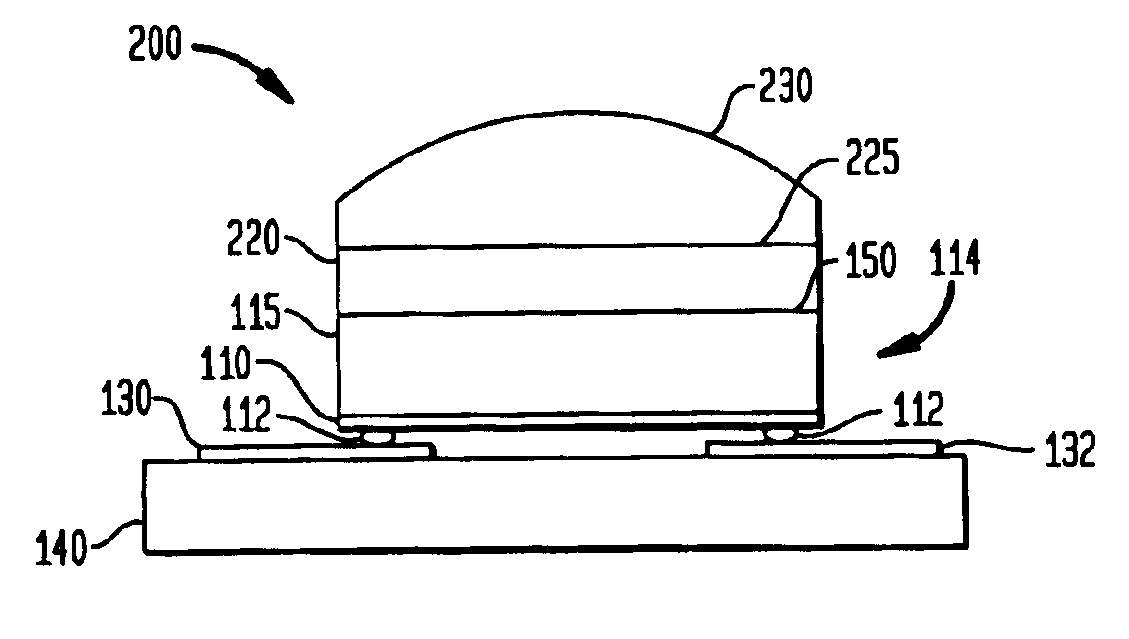
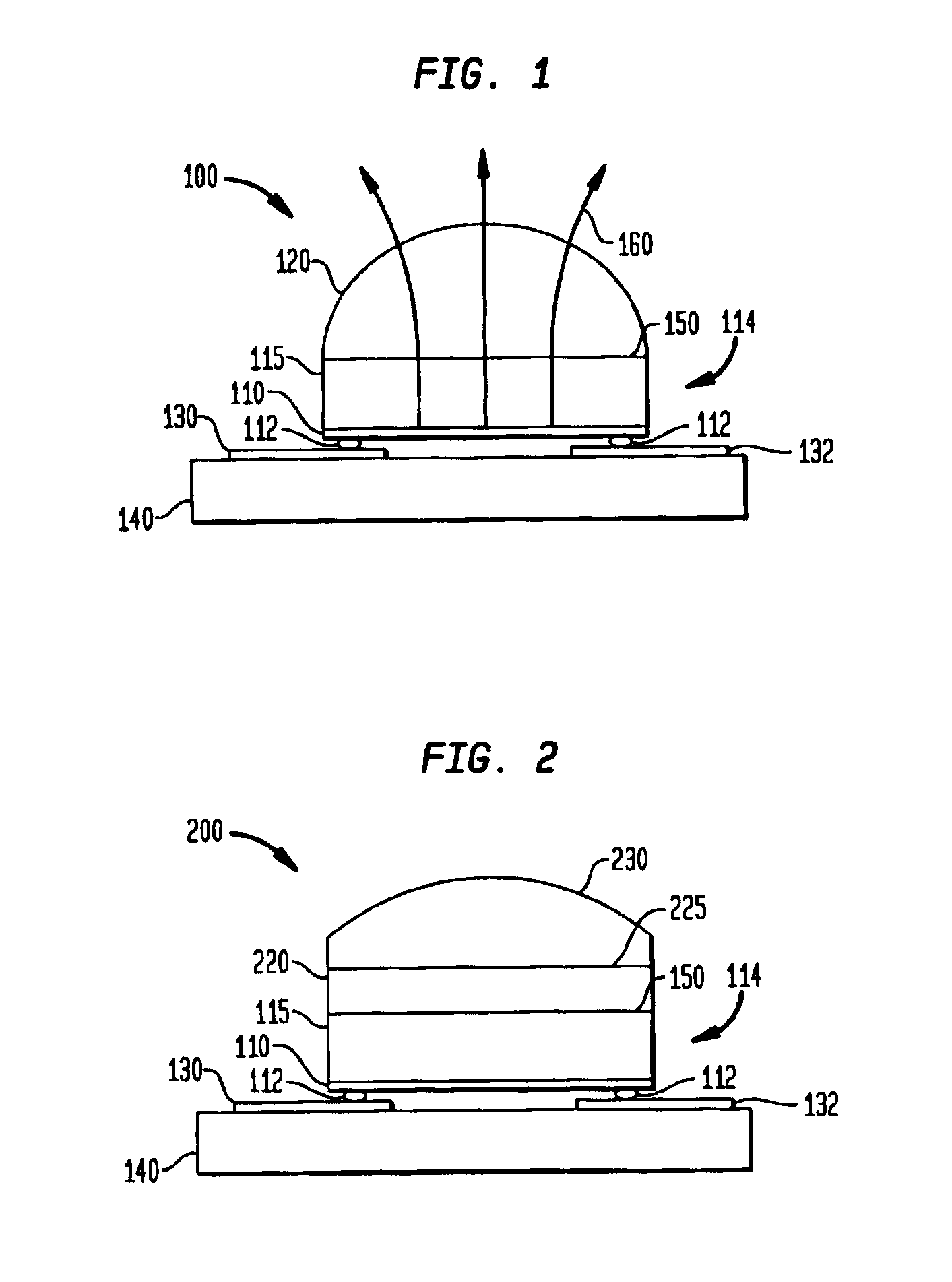
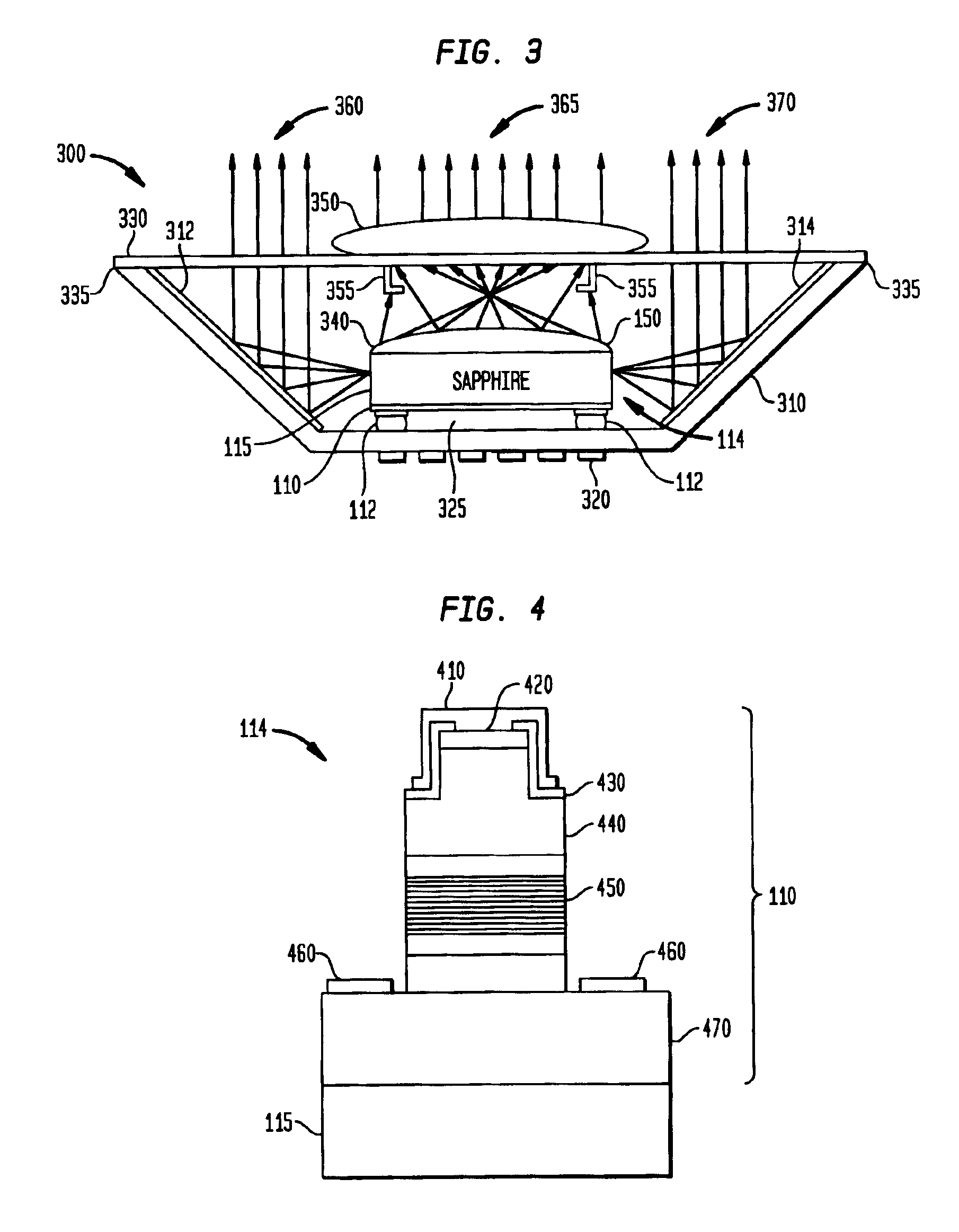
[0017]FIG. 1 illustrates a schematic view of an encapsulated LED with an integral encapsulant / lens mounted to a circuit board according to the invention. The encapsulated LED 100 includes a semiconductor diode die 114, which may be a UVLED die, and a shaped integral lens / encapsulant 120. The die 114 may include a diode 110 that is grown on a substrate layer 115 as a flip chip, discussed further below. To improve UV light extraction from the die 114, a form of amorphous polytetrafluoroethylene (PTFE) fluoropolymer is advantageously used as an encapsulant and / or lens. Examples of amorphous fluoropolymers that are commercially available include Teflon® AF from Dupont® and Cytop(tm) from Asahi Glass Co., Ltd., Tokyo, Japan. Such materials are able to transmit UV light, while also passing infrared (IR) light, and are compatible with current LED encapsulation / lens packaging techniques. For example, these materials can be readily injection molded to any desired shape, such as into an encap...
PUM
 Login to View More
 Abstract
Description
Claims
Application Information
 Login to View More