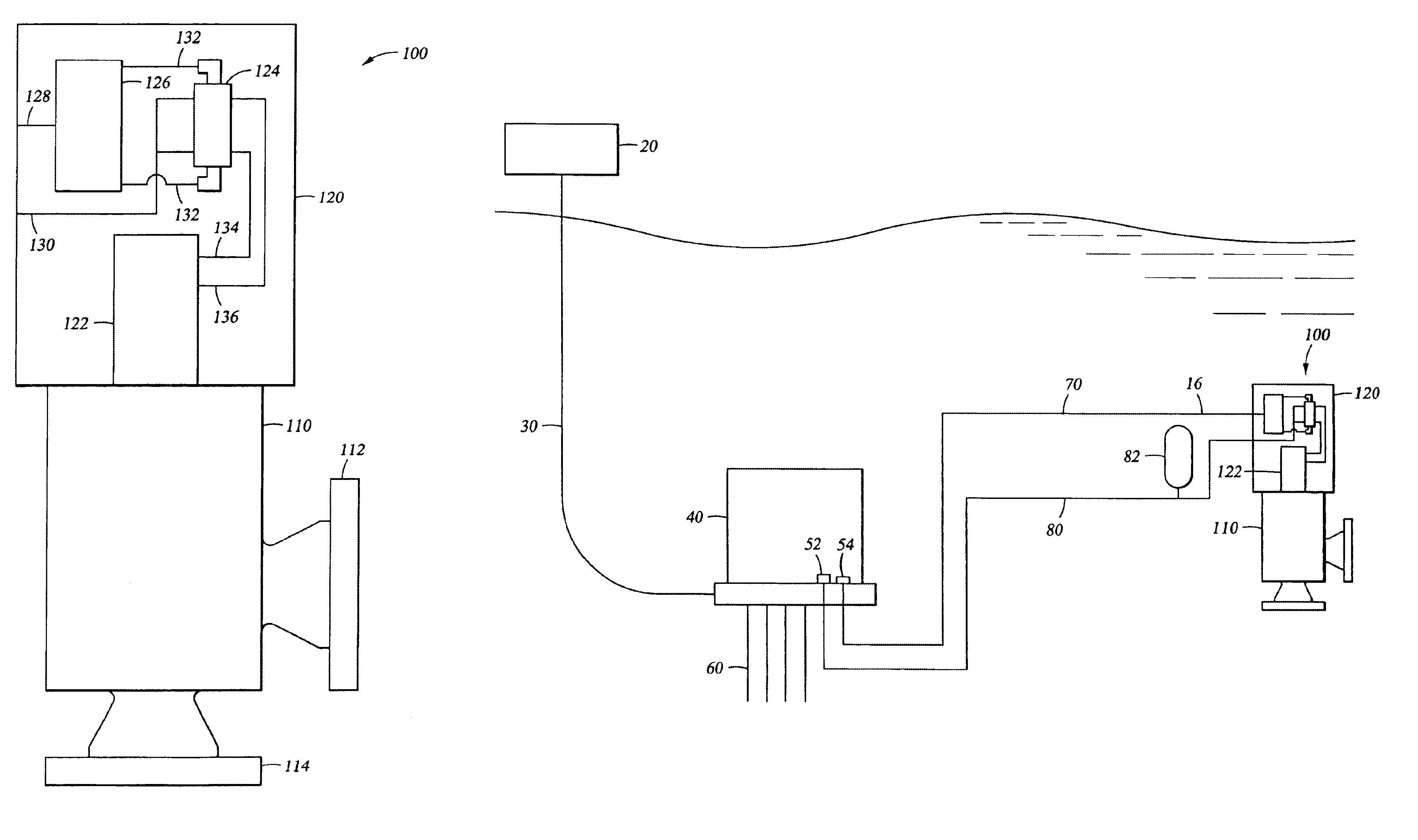
[0010]The preferred embodiments provide a choke or choke actuator having an integrated control
system enabling fast closure and opening of the choke. The control
system includes integral
electronics, such as a valve electronic module, controlling directional
control valves and / or solenoid valves, which regulate the flow of
hydraulic fluid from a local hydraulic supply to the choke actuator. By locating the control system, directional control valves, and hydraulic supply
proximate to the choke actuator, response times for choke actuation are greatly reduced. Additional embodiments may also include other electronic sensing and
instrumentation enabling the choke control system to monitor and adjust the choke to maintain selected flow characteristics or in accordance with a predetermined production scheme. Any or all of the components of the choke, the choke control system, or the choke actuator may also be retrievable separately from the other components so as to allow maintenance and replacement.
[0011]In certain embodiments, the choke control system includes one or more valve
electronic modules that receive electric signals from the surface along a single, or dual redundant,
control line(s). The valve electronic module processes these signals and transmits electrical signals to a directional control valve. The directional control valve includes solenoid valves that, upon receiving a
signal from the valve electronic module, actuate to allow
hydraulic fluid to flow between a supply and the choke actuator. In the preferred embodiments, the hydraulic supply is located
proximate to the choke, such as in an accumulator, so as to minimize the reaction time of the hydraulic
signal between the supply and the choke actuator. The choke control system and actuator are preferably integrated into a single
package that can be retrieved to the surface for maintenance independent of the choke. Alternatively, the choke control system and actuator can be packaged for separate and / or singular retrieval.
[0012]Incorporating a valve electronic module into the choke control system allows for gains in efficiency in actuating the choke directly from a control system located at the surface, or in actuating the choke from a subsea control module receiving commands from a control system located at the surface. Communication to the choke control system could be provided by hydraulic and electric umbilicals run between the surface control system, or the subsea control module, and the choke control system. The hydraulic and electric signals would merely be commanded by the surface control system or passed along by the subsea control module to the choke control system. Once the
electric signal is received by the choke control system, the valve electronic module processes the
signal and actuates the directional control valve to open or close the choke as commanded.
[0014]In certain embodiments, the valve electronic module could also provide the choke and choke control system with additional functionality. For example, the valve electronic module may be equipped to monitor pressure transmitters attached to the directional control valve to monitor the application of
hydraulic pressure to the actuator. The electronic module may also operate in conjunction with a position measurement sensor to determine the actual position of the choke at any time. The electronic module could also be used to gather data from these and other sensors, such as pressure and / or temperature sensors on the choke inlet and outlet, and transmit this data back to the surface to give the operators an indication of flow conditions at the choke. For example, the use of a venturi, or other geometry change, in conjunction with additional pressure and
temperature measurement transmitted to the subsea control module and / or to the surface could enable analytical measurement and determination of flow rates and flow constituency make-up parameters.
[0015]In the preferred embodiments, the improved choke control system allows for significantly increased stepping rates leading to decreased reaction time for choke actuation. Certain embodiments may also provide for increased
data acquisition and analysis of flow condition at or near the choke, which could lead to indications of flow characterization and detection of the formation of hydrates.


 Login to View More
  Login to View More