Reconfigurable digital processing system for space

US6996443B2Inactive Publication Date: 2006-02-07GULA CONSULTING LLC
4 Cites 49 Cited by

Patent Information

Authority / Receiving Office
US · United States
Current Assignee / Owner
Publication Date
2006-02-07
Estimated Expiration
Not applicable · inactive patent

Smart Images

  • Figure 1
    Figure 1
  • Figure 2
    Figure 2
  • Figure 3
    Figure 3
Patent Text Reader

Abstract

A reconfigurable digital processing system for space includes the utilization of field programmable gate arrays utilizing a hardware centric approach to reconfigure software processors in a space vehicle through the reprogramming of multiple FPGAs such that one obtains a power / performance characteristic for signal processing tasks that cannot be achieved simply through the use of off-the-shelf processors. In one embodiment, for damaged or otherwise inoperable signal processors located on a spacecraft, the remaining processors which are undamaged can be reconfigured through changing the machine language and binary to the field programmable gate arrays to change the core processor while at the same time maintaining undamaged components so that the signal processing functions can be restored utilizing a RAM-based FPGA as a signal processor. In one embodiment, multiple FPGAs are connected together by a data bus and are also provided with data pipes which interconnect selected FPGAs together to provide the necessary processing function. Flexibility in reconfiguration includes the utilizing of a timing and synchronization block as well as a common configuration block which when coupled to an interconnect block permits reconfiguration of a customizable application core, depending on the particular signal processing function desired. The result is that damaged or inoperable signal processing components can be repaired in space without having to physically attend to the hardware by transmitting to the spacecraft commands which reconfigure the particular FPGAs thus to alter their signal processing function. Also mission changes can be accomplished by reprogramming the FPGAs.
Need to check novelty before this filing date? Find Prior Art

Description

[0001] This application claims benefit of provisional application 60 / 347,670, filed Jan. 11, 2002.STATEMENT OF GOVERNMENT INTEREST

[0002] The invention described herein was made under Contract No. 572100 with the Government of the United States of America and may be manufactured and used by and for the Government of the United States of America for Governmental purposes without the payment of any royalties thereon or therefor.FIELD OF INVENTION

[0003] This invention relates to the repair or mission redirection of space vehicle electronics and more in particularly to the utilization of field programmable gate arrays to provide a hardware centric approach to the repair or mission redirection.BACKGROUND OF THE INVENTION

[0004] In the past decade, signal and data processing aboard spacecrafts have advanced rapidly from KIPS or kilo instructions per second to MIPS or millions of instructions per second. The result is the utilization of increasingly powerful commercial technology which has to be...

Examples

Embodiment Construction

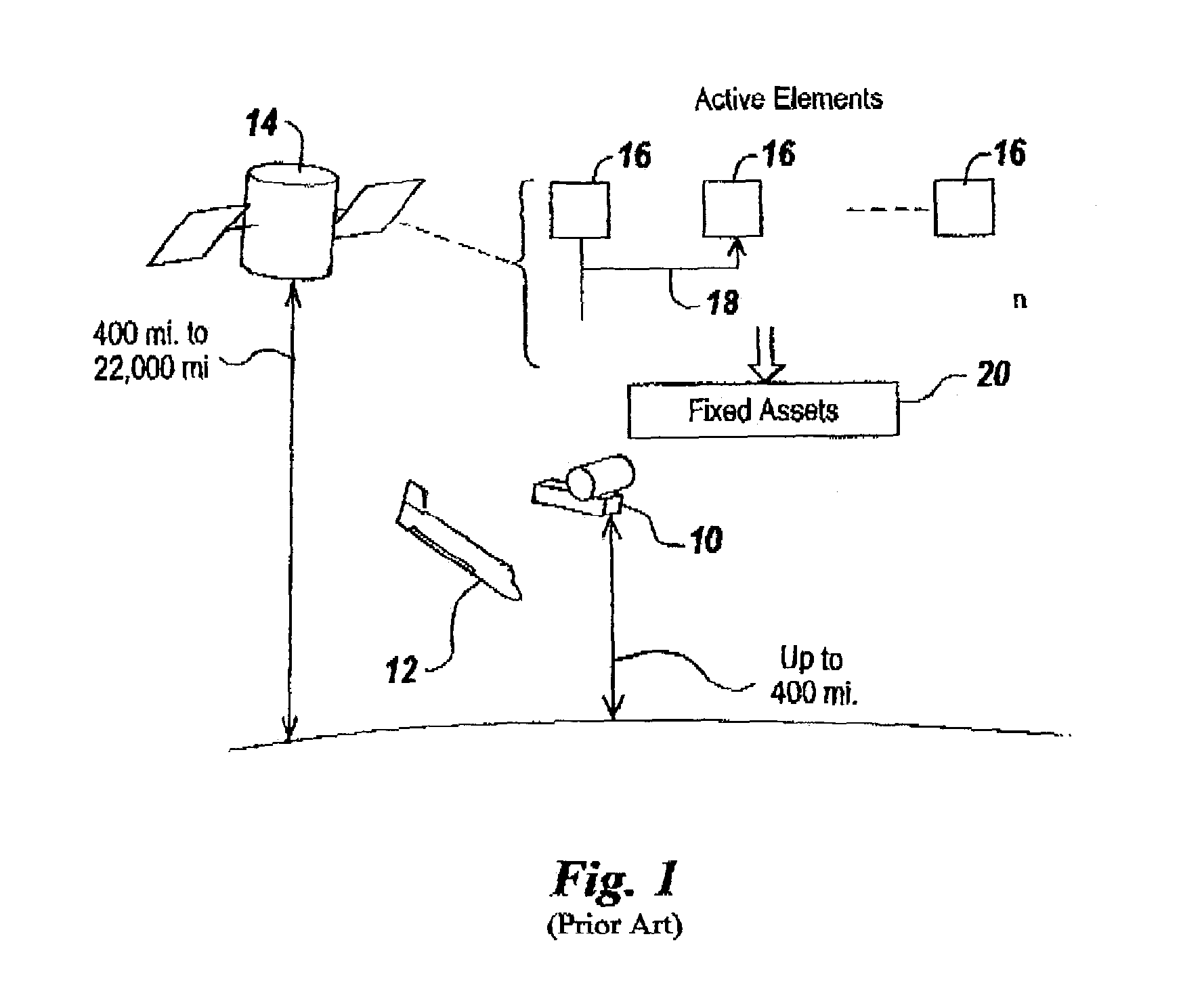
[0027]Referring now to FIG. 1, in the prior art, a low earth orbit spacecraft such as illustrated at 10 could be serviced by a space shuttle 12 such that for any malfunctioning equipment or any change in mission task equipment could be removed, repaired and re-installed. Such was the case with the Hubbel space telescope. However, for those spacecraft above the shuttle's reach such as geosyncronous satellites 14 it is impossible to do a manned repair for any equipment that may be malfunctioning.

[0028]It will be appreciated that such satellites may be on station multiple years to decades and that the electronic circuits within the satellite may simply deteriorate with age or may be damaged by a burst or the build-up of radiation. In order to assure that such failures could be remedied, the number of active unique elements in the spacecraft electronics were duplicated for redundancy purposes such as illustrated at 16, such that whatever functions the active elements were to perform, if...