This helps you quickly interpret patents by identifying the three key elements:
Problems solved by technology
Method used
Benefits of technology
Benefits of technology
[0019]Therefore, with the foregoing in mind, it is a first object of the present invention to provide a novel oxide that can be a phosphor host of a highly efficient phosphor or a highly efficient phosphor itself, and a novel phosphor including the oxide as the phosphor host or made of the oxide. It is a second object of the present invention to provide a novel phosphor that is excited with blue light and emits light including a yellowish component, which is suitable especially as a light-emitting device to which a blue LED is applied. Furthermore, it is a
Problems solved by technology
On the other hand, almost no development of the phosphors different from the YAG:Ce host phosphor has been performed, partly because it requires significant effort.
On the other hand, a blue exciting yellow phosphor other than the YAG:Ce host phosphor for a light-emitting device (e.g., white LED) in which the blue LED and a blue exciting yellow phosphor other than the YAG:Ce host phosphor are combined has a fatal problem in that the luminescent efficiency under the excitation of blue light is at least 10% lower than that of the YAG:Ce host phosphor, and has a secondary problem in that there is only a little of a red light-emitting component, which is required especially when it is used for illumination.
At the same time, a light-emitting device in which the blue LED and a blue exciting yellow phosphor other than the YAG:Ce host phosphor are combined has a problem in that the light-emitting intensity is low, the intensity of a red light-emitting component is low, and this light-emitting is inferior to a device in which the YAG:Ce host phosphor is used.
Method used
the structure of the environmentally friendly knitted fabric provided by the present invention; figure 2 Flow chart of the yarn wrapping machine for environmentally friendly knitted fabrics and storage devices; image 3 Is the parameter map of the yarn covering machine
View more
Image
Smart Image Click on the blue labels to locate them in the text.
Viewing Examples
Smart Image
Click on the blue label to locate the original text in one second.
Reading with bidirectional positioning of images and text.
Smart Image
Examples
Experimental program
Comparison scheme
Effect test
embodiment 1
[0108]Hereinafter, the inorganic oxides and the phosphors of the present invention will be described as Embodiment 1 of the present invention.
[0109]One embodiment of the inorganic oxides that can be a phosphor or a phosphor host of the present invention is expressed by a chemical formula I below and preferably has the crystal structure of garnet.
MLn2QR4O12 (I)
[0110]where in the chemical formula I, M is at least one element selected from the group consisting of Mg, Ca, Sr, and Ba; Ln is at least one rare earth element selected from the group consisting of Sc, Y, La, Ce, Pr, Nd, Sm, Eu, Gd, Tb, Dy, Ho, Er, Tm, Yb, and Lu, and preferably Sc, Y, La, and Gd; Q is at least one element selected from the group consisting of Si, Ge, Sn, and Pb, and preferably Si and Ge; and R is at least one element selected from the group consisting of B, Al, Ga, In, and Tl, preferably Al and Ga.
[0111]In the crystal structure, a part of M can be substituted with at least one element (e.g., Zn) selected fro...
embodiment 2
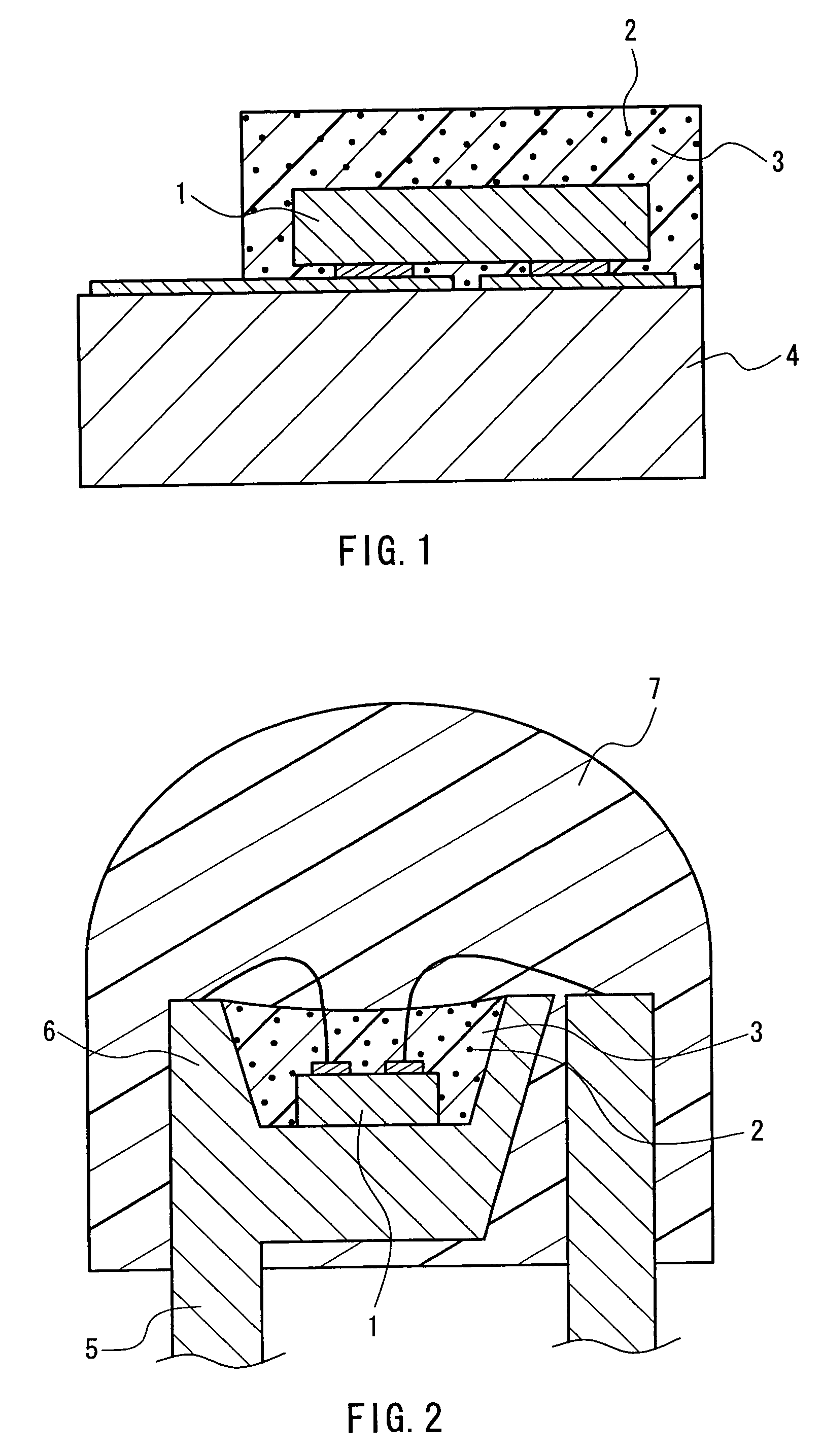
[0161]FIGS. 1 to 3 are longitudinal sectional views of semiconductor light-emitting elements as examples of the light-emitting element of the present invention. FIG. 1 shows a typical example of a semiconductor light-emitting element having a structure in which a light-emitting element 1 is conductively mounted on a sub-mount element 4, and the light-emitting element 1 is sealed with a resin package that contains at least the phosphor 2 of the present invention as described above (hereinafter, referred to as the phosphor 2 of the present invention) and also serves as a phosphor layer 3.
[0162]FIG. 2 shows a semiconductor light-emitting element having a structure in which a light-emitting element 1 is conductively mounted on a cup 6 provided in a mount lead of a lead frame 5, a phosphor layer 3 formed of a resin containing at least the phosphor 2 of the present invention is provided in the cup 6, and the whole is sealed with a sealing resin 7.
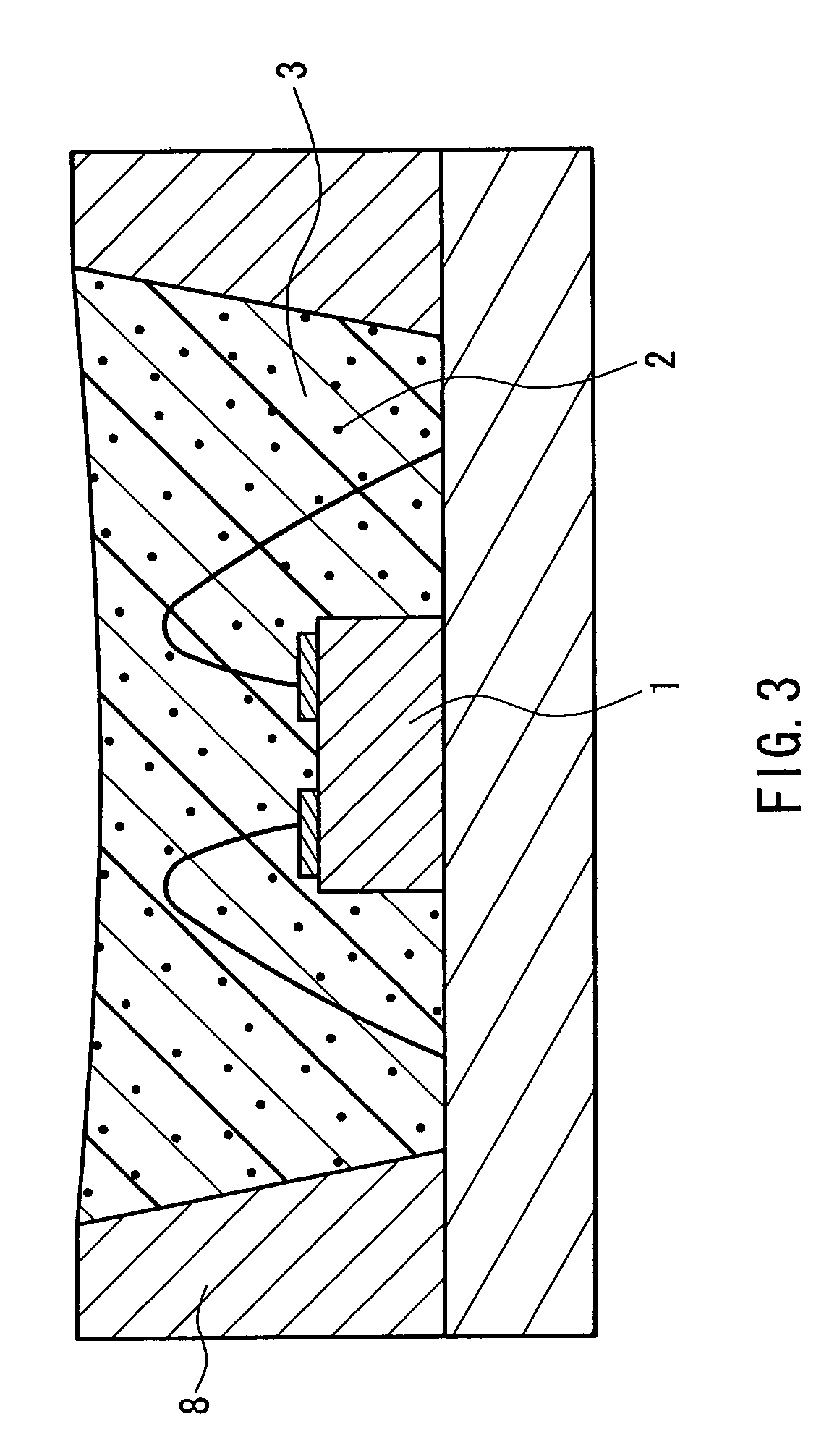
[0163]FIG. 3 shows a semiconductor light-e...
example 1
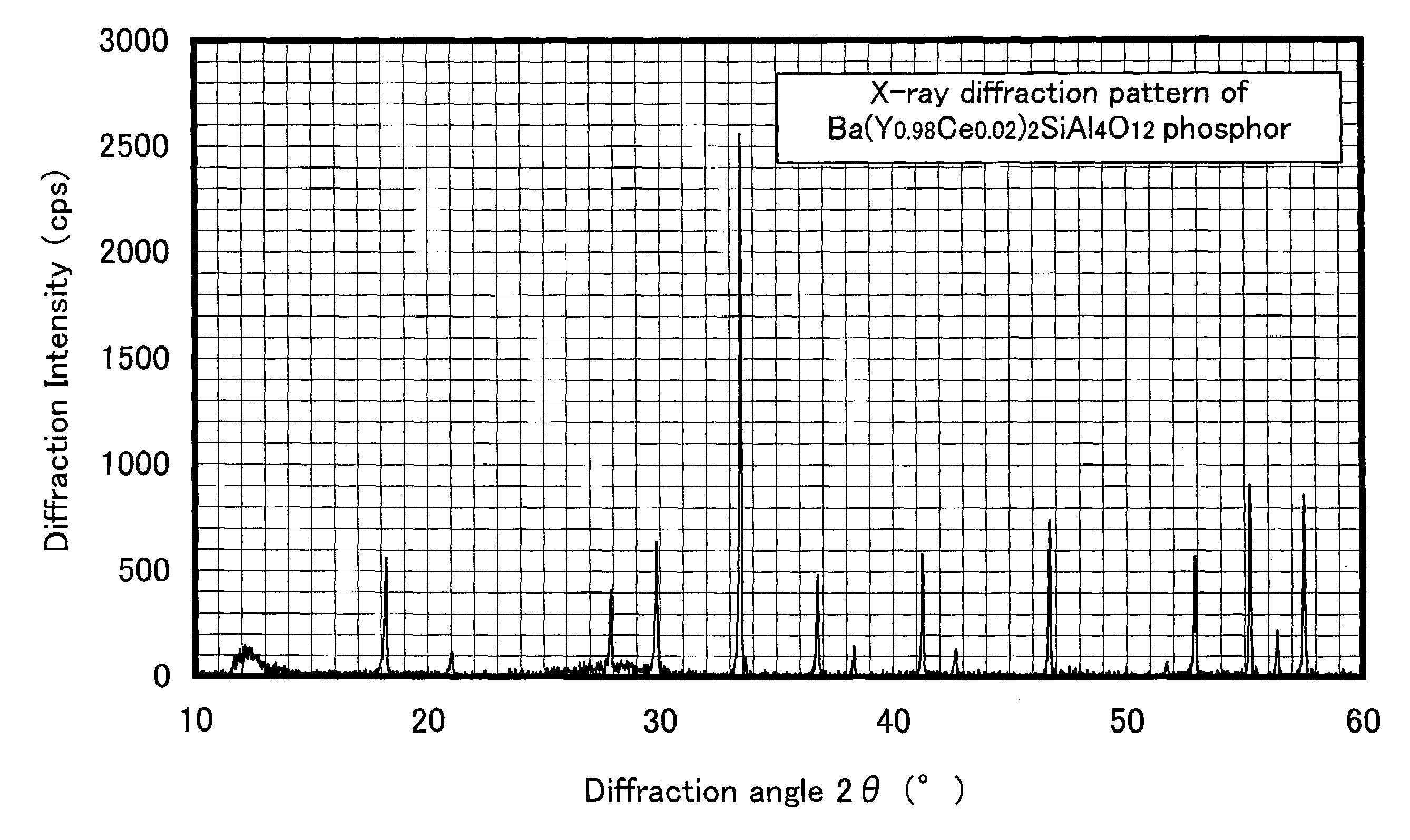
[0173]Hereinafter, a method of producing a Ba(Y0.98Ce0.02)2SiAl4O12 inorganic oxide, that is, a BaY2SiAl4O12:Ce3+ phosphor, and the characteristics thereof will be described in Example 1 of the present invention.
[0174]The following inorganic compound powders were used as the phosphor raw materials (inorganic oxide raw materials).[0175](1) bariumcarbonate (BaCO3): 9.87 g, the purity 99.95%[0176](2) yttriumoxide (Y2O3): 11.07 g, the purity 99.99%[0177](3) aluminum oxide (Al2O3): 10.20 g, the purity 99.99%[0178](4) silicon dioxide (SiO2): 3.07 g, the purity 99.9%[0179](5) cerium oxide (CeO2): 0.34 g, the purity 99.99%
[0180]In Example 1, no flux was used for simplicity.
[0181]The phosphor raw materials were mixed sufficiently with an automatic mill, and then the mixed raw materials were fed into a firing container and were fired under the following firing conditions.
the structure of the environmentally friendly knitted fabric provided by the present invention; figure 2 Flow chart of the yarn wrapping machine for environmentally friendly knitted fabrics and storage devices; image 3 Is the parameter map of the yarn covering machine
Login to View More
PUM
Property
Measurement
Unit
Percent by atom
aaaaa
aaaaa
Temperature
aaaaa
aaaaa
Temperature
aaaaa
aaaaa
Login to View More
Abstract
The present invention provides an inorganic oxide made of MLn2QR4O12, where M is at least one element selected from the group consisting of Mg, Ca, Sr, and Ba; Ln is at least one rare earth element selected from the group consisting of Sc, Y, La, Ce, Pr, Nd, Sm, Eu, Gd, Tb, Dy, Ho, Er, Tm, Yb, and Lu; Q is at least one element selected from the group consisting of Si, Ge, Sn, and Pb,; and R is at least one element selected from the group consisting of B, Al, Ga, In, and Tl. This inorganic oxide serves as a phosphor or a phosphor host and if it contains ions capable of being the luminescent center, it becomes a phosphor emitting fluorescent light. Thus, a novel oxide that can be a phosphor host of a high efficiency phosphor or the phosphor itself and a novel phosphor are provided.
Description
FIELD OF THE INVENTION[0001]The present invention relates to novel inorganic oxides and phosphors.BACKGROUND OF THE INVENTION[0002]Conventionally, a large number of phosphor materials in which ions capable of emitting fluorescent light are doped into inorganic compound materials (hereinafter, referred simply as “phosphors”) have been known. Phosphors have the properties of emitting ultraviolet, visible and infrared light by action of external exciting means such as irradiation of electromagnetic waves (e.g., electron beams, X-rays, ultraviolet rays, visible light, etc.) or application of an electric field, and therefore are used in a large number of photoelectric transducers or photoelectric conversion devices. Examples thereof are light-emitting devices such as white light-emitting diodes (hereinafter, referred to as “white LED”), fluorescent lamps, electron beam tubes, plasma display panels, inorganic electroluminescent displays, and scintillators.[0003]The phosphors will be descr...
Claims
the structure of the environmentally friendly knitted fabric provided by the present invention; figure 2 Flow chart of the yarn wrapping machine for environmentally friendly knitted fabrics and storage devices; image 3 Is the parameter map of the yarn covering machine
Login to View More
Application Information
Patent Timeline
Application Date:The date an application was filed.
Publication Date:The date a patent or application was officially published.
First Publication Date:The earliest publication date of a patent with the same application number.
Issue Date:Publication date of the patent grant document.
PCT Entry Date:The Entry date of PCT National Phase.
Estimated Expiry Date:The statutory expiry date of a patent right according to the Patent Law, and it is the longest term of protection that the patent right can achieve without the termination of the patent right due to other reasons(Term extension factor has been taken into account ).
Invalid Date:Actual expiry date is based on effective date or publication date of legal transaction data of invalid patent.


 Login to View More