This height—as per straight arm actuator and suspension system—being a microscopic distance; a range of 0.000004 to 0.00002 inch of fly height, has the potential danger of head crashes and loss of data when for example an unexpected
impact-shock occurs to the desktop or to the notebook as the system is running—and this causes the head to ding as it is called in the field, to the hard disk surface, or sudden power failures result in head
crash, or damage to heads or to surface.
Another problem with prior art hard disk drives is that at
specific time intervals during normal operation of hard disk drive, a sequence called
Servo Bank Write (SBW) is performed.
In prior art hard disk drive systems, the sensitive read heads are subject to
voltage variation in the SBW mode, where bias current can drop from I.sub.biastotal in the read mode to I.sub.biastotal / N in the SBW mode, that could result in read head damage.
This CSS motion is a major cause that lowers reliability as the drive gets older and therefore reduces reliability in the long run.
Friction is related to two important problems: 1)
Power consumption, 2) Head vibration.
Among various causes, the main cause of
data loss is hard drive failures.
For small and mid size companies, those that can not or have not made an investment in additional back up systems,
data loss due to hard drive failures can mean great economic losses and may even result in business failures.
The
recovery services provided by
data recovery companies for hard disk failures and to recover valuable data are very costly.
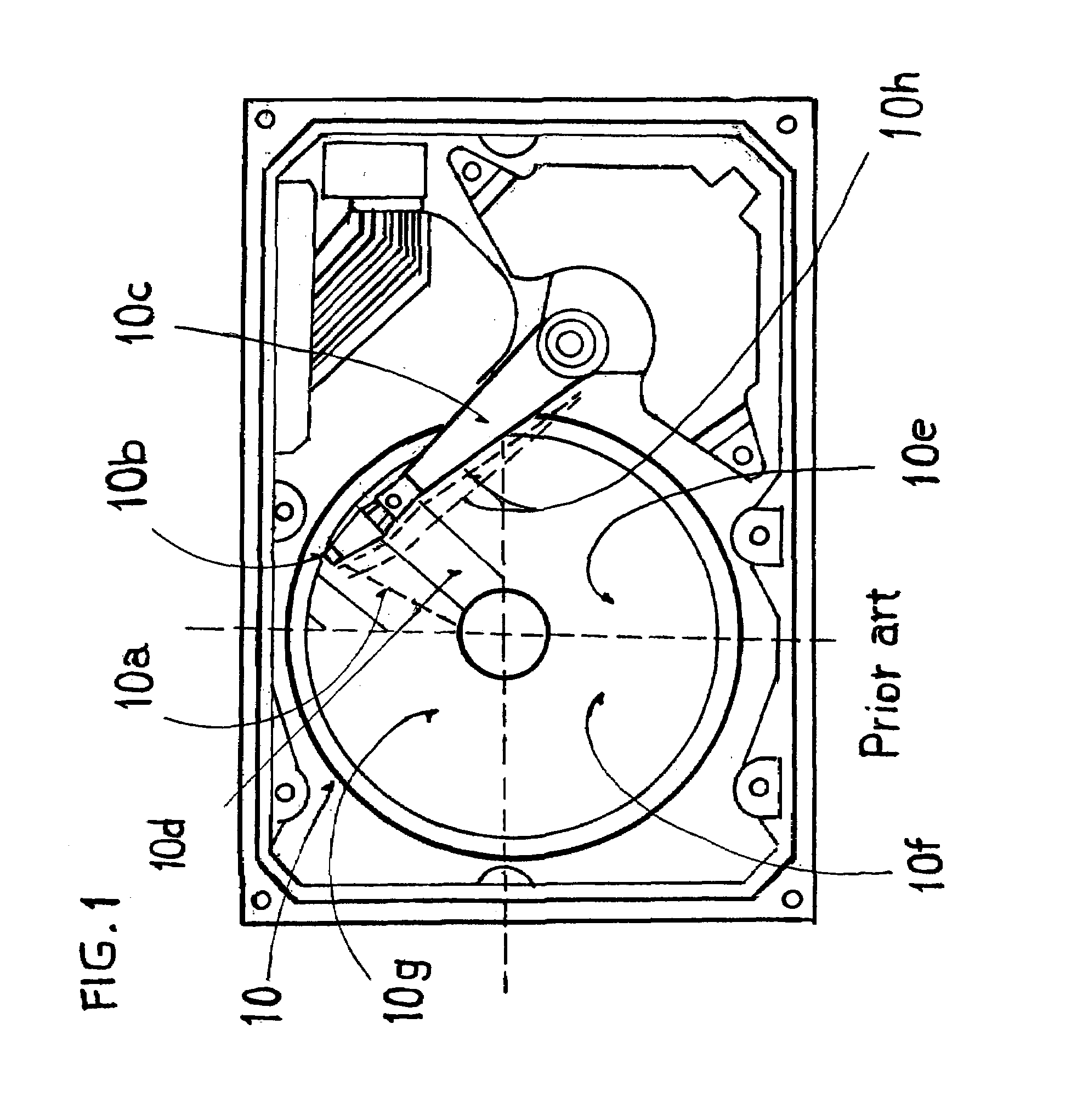
The straight-arm actuator system—which is a standard on most disk drives—is actually a system with inherently problematic structural and functional aspects.
First major problem is the limitation of the straight-arm actuator with respect to the disk area that it can cover simultaneously at any given instant in time.
Despite the swift motions of the straight arm actuator, reaching the different tracks on the many different concentric areas of the disk is not instantaneous and requires many motions that involve sudden direction reversals of the straight-arm actuator that also have to be precise.
However, second, these motions of the straight-arm actuator and the associated read / write head
assembly are subject to vibrations.
Vibration has
adverse effect on these small and sensitive components, including head vibration.
However, this creates a third problem, high rpm has the problem of creating
excess heat and is more demanding on the spindle motor.
Such a temperature is not tolerable in a cramped case without extra cooling.
Additional cooling has both space and cost constraints.
Furthermore, high rpm has more
wear and tear-
instability potential, especially in systems that are frequently turned on and off.
Fourth problem with any type of straight arm actuator system involves the constraint of having to park the R / W heads away from data tracks to a zone near the spindle, before the platter stops turning, because it depends on a microscopic distance of
air cushion, that in turn depends on the turning of the disk that must not have any variation in the rpm during operation.
When system is turned off or due to unexpected power failures for instance the constraint of having to park the heads come up.
Therefore, fifth, additionally because of microscopic fly height of the R / W heads, there is always the potential for damage to both R / W heads and damage to the substrate on the disk as the system is running—for example when the system is subject to external inadvertent shocks-bumps.
Sixth, these frequent motions also involve interruptions of reading or writing data streams.
These back and forth swings over a relatively long distance are erratic.
This is especially true during the parking and boot up sequences, that are often repeated and hence in the long term, these sudden swings each time the system is started and turned off cause
wear and tear.
As a result, the system has lower reliability and lower product
life expectancy.


 Login to View More